Deciduous vs coniferous tree blocks for landscaping
When to choose deciduous versus coniferous tree DWG blocks for a seasonal landscape plan, with canopy shape and sizing guidance.
Sumana KumarUpdated 8 May 20266 min read
A drafting decision that's really a design decision
Whether a landscape plan needs deciduous tree blocks, coniferous tree blocks, or a mix of both isn't really a CAD question at all, it's a planting design question that shows up in your CAD file, but I bring it up because I've watched drafters default to whatever tree block happens to be first in the folder rather than thinking about what the species mix is actually meant to communicate, and on a seasonal landscape drawing that choice matters a lot more than it does on a generic site plan. A deciduous tree, something like a maple or an oak, reads completely differently across a year, full canopy in summer, bare structural branching in winter, while a coniferous tree, a pine or a spruce, holds roughly the same silhouette year round, and if your drawing set is meant to communicate seasonal character at all, using the wrong block type for the wrong season undersells the design.
Canopy shape is the visual tell
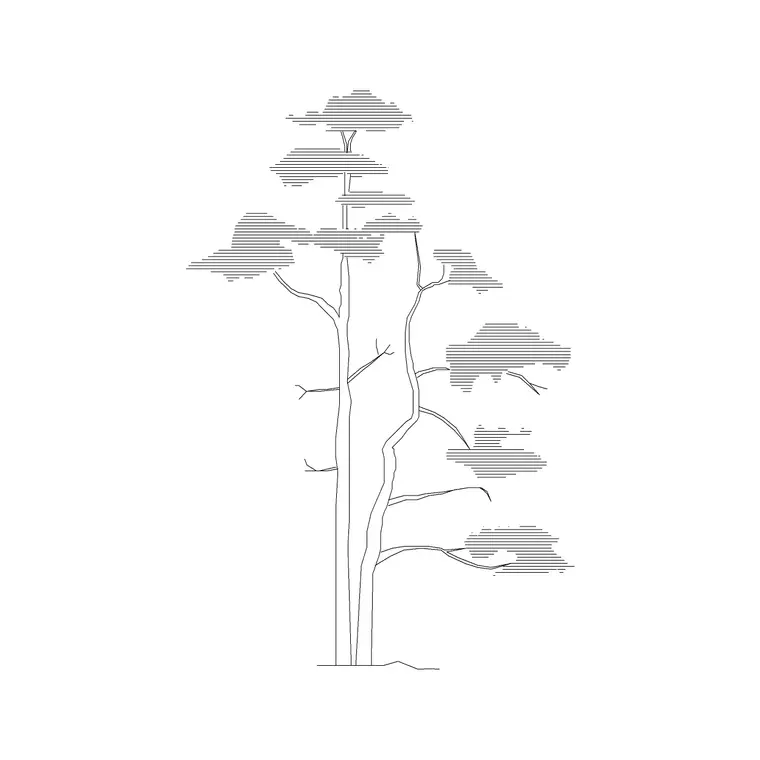
In elevation, deciduous tree blocks are usually drawn as a rounded, irregular canopy mass sitting on a visible trunk and branch structure, sometimes with the branch structure fully exposed for a winter condition drawing and sometimes shown with full leaf coverage for a summer condition, while coniferous blocks are typically a conical or pyramidal silhouette with dense, consistent texture from top to bottom and very little visible trunk once you get above the base. A block like Pine Elevation 1 on cadblockdwg.com is a clean example of that conical conifer profile, useful anywhere you want a year round evergreen presence on a streetscape or a screening line, as opposed to a deciduous block which you'd reach for when the design wants seasonal change, shade in summer and sun penetration in winter, which is a genuinely common landscape architecture strategy for south facing facades.
Root structure and planting proximity are worth a quick mention alongside canopy shape too, since the two groups don't always behave the same way close to foundations or paving, and while this is more of a planting design concern than a strictly drafting one, it's the kind of context that helps you understand why a landscape architect specified one type over the other in a location where either could technically work visually, which in turn helps you draft the block placement with the reasoning behind it in mind rather than treating tree selection as a purely cosmetic choice on the plan.
Practical species mixing on a planting plan
Most real landscape plans mix both types deliberately rather than choosing one exclusively, conifers often go along property boundaries or windward sides for year round screening and windbreak, since a deciduous hedge loses its screening value completely in winter just when a windbreak might be needed most, while deciduous trees go closer to buildings and outdoor living spaces specifically for that seasonal shade and sun tradeoff. If you're drafting a plan that shows this kind of intentional mix, it helps to keep deciduous and coniferous tree blocks on separate layers, something like L-PLANT-DECID and L-PLANT-CONIFER, so a reviewer or contractor can isolate one planting strategy from the other and so you can toggle a winter condition view by turning off deciduous foliage layers if your blocks are drawn with a foliage overlay.
Sizing differences worth knowing
Coniferous species as a group tend to hold a narrower canopy relative to height than deciduous shade trees, commonly a 3 to 6 meter spread even at a substantial mature height of 10 to 20 meters, whereas a mature deciduous shade tree can spread quite wide relative to its height, often reaching a canopy diameter close to or even exceeding its own height, somewhere in the 6 to 12 meter range for a common street tree species. That difference in proportion is worth reflecting in your block scaling, a conifer block scaled with a deciduous tree's wide, rounded proportions is going to look wrong even before anyone checks the actual dimensions against a schedule, so match the block's inherent silhouette shape to the species you're actually calling out rather than just resizing whatever block is handy.
It's worth double checking these proportions against the specific cultivar named in the planting schedule rather than a generic species assumption, since a columnar deciduous cultivar bred specifically for a narrow footprint along a tight urban street will have a much narrower canopy than a typical open grown specimen of the same species, and using a standard wide canopy deciduous block for a columnar cultivar will misrepresent the design just as much as using the wrong species type entirely, so it's worth reading the schedule closely rather than assuming every maple or oak reads the same on a plan.
Working from an existing tree survey
On a lot of projects you're not choosing species freely, you're drafting around an existing tree survey that's already documented which trees on or near the site are deciduous and which are coniferous, along with their condition and retention category, and matching your new planting's character to what's already there is often part of the brief even when nobody states it explicitly. If a site already has a strong coniferous character along one boundary, a windbreak of mature pines for instance, new planting nearby often continues that species character rather than introducing an unrelated deciduous species that would visually compete with the existing screen once both are mature, and reflecting that continuity in your block selection is a subtle but real way a landscape plan demonstrates it was actually designed with the existing site conditions in mind rather than dropped onto the survey without reference to it.
When you're working from a tree survey drawing supplied by an arborist, it's worth checking whether their symbols distinguish deciduous from coniferous at all, since a lot of arboricultural surveys use a single generic tree symbol regardless of species type, and if that's the case your landscape drawing is often the first place in the documentation set where that seasonal distinction actually gets drawn correctly.
Bringing seasonal intent into the drawing set
If the project genuinely needs to communicate a seasonal story, a common approach is producing two versions of the same elevation or streetscape, one showing summer condition with full deciduous canopy and one showing winter condition with bare branching and only the coniferous blocks holding their form, and having both deciduous and coniferous tree blocks cleanly separated on layers from the start makes that a fast toggle rather than a rebuild. Even on a single static drawing, a short planting schedule note distinguishing which species are evergreen and which are deciduous helps a client or reviewer read the intent correctly, since a plan view canopy circle alone doesn't tell anyone which trees will still be providing screening in January and which won't.
For a project team working across summer and winter versions of the same view, it's worth keeping the underlying tree positions identical between the two drawings and only toggling foliage, so the two versions genuinely read as the same landscape at different times of year rather than looking like two subtly different layouts that happen to share a title block.
Further reading
Questions
Frequently asked
When should a landscape plan lean on coniferous trees over deciduous ones?+
Mainly for year round screening, windbreaks, or boundary definition where losing foliage in winter would defeat the purpose, since conifers hold roughly the same silhouette across all seasons.
Do deciduous tree canopies spread wider than coniferous ones at maturity?+
Generally yes, a mature deciduous shade tree often spreads 6 to 12 meters or more, sometimes close to its own height, while conifers tend to stay narrower relative to height, commonly 3 to 6 meters.
Can I show both a summer and winter version of the same landscape elevation?+
Yes, and it's common practice on projects where seasonal character matters, done by keeping deciduous and coniferous tree blocks on separate layers so you can toggle full canopy versus bare branch conditions without rebuilding the drawing.
Free downloads from this article
Free CAD block library
Download the blocks from this article — free, no signup