Top landscape CAD blocks every landscape architect needs
The planting, tree and groundcover blocks a landscape architect uses on every site plan — download them free, scale canopies honestly, keep planting layered.
Sumana KumarUpdated 10 February 20265 min read
Planting is the package, not the garnish
For a landscape architect, planting blocks are not decoration sprinkled on at the end — they are the deliverable. Canopy spread, species mix and planting density carry real design intent about shade, screening and how the scheme matures over time. A planting plan assembled from honest, correctly scaled blocks reads as the work of someone who understood the site; one stamped from a single clip-art tree reads as filler and undermines everything around it.
This post is the standing kit a landscape architect should have downloaded before the next site plan lands: trees in plan and elevation, palms and conifers, shrubs and groundcover. Everything is in the Trees & Plants category on cadblockdwg.com, free in DWG with no signup and free for commercial use, so you can pull the whole set once and stop interrupting design work to go hunting for a conifer.
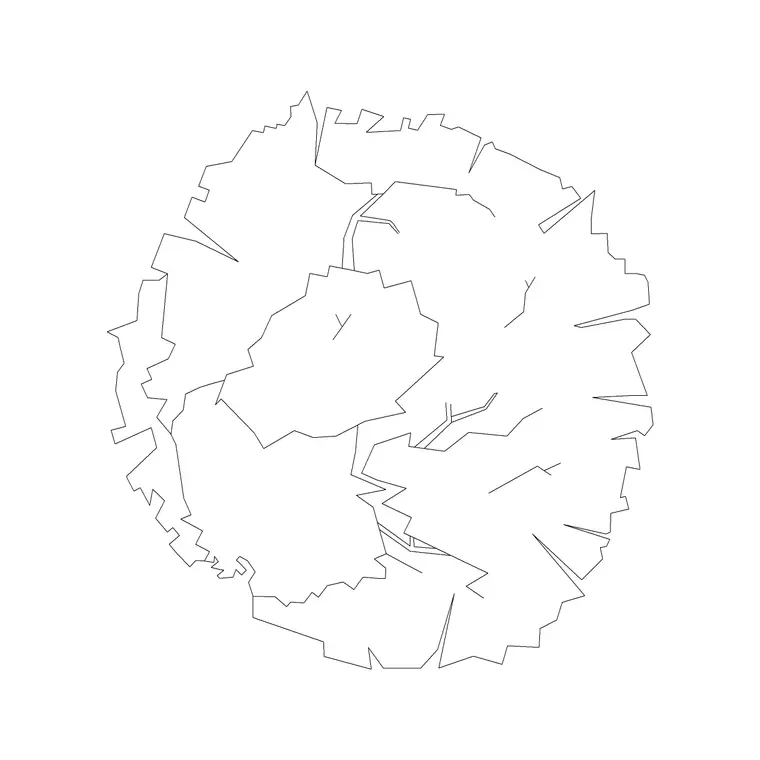
The Pine Plan 1 block is a good anchor for a coniferous top-down canopy, and a useful reminder of why a kit beats one-off downloads: the moment you have a handful of trusted plan and elevation blocks on hand, laying out planting becomes a design decision about composition rather than a scavenger hunt for the right species. You spend your time on where the planting goes, not on whether the block is any good.
Match the view before you place a single tree
Trees come in two views and choosing the wrong one is the fastest way to make a drawing look amateur. Plan-view trees are the top-down canopy — a circle with radial texture inside — used on site plans, landscape layouts and masterplans. Elevation trees are the side silhouette, showing trunk and canopy in profile, used on street elevations and sections to convey height and form.
An elevation tree lying flat on a plan, or a plan circle floating in an elevation, looks wrong to anyone trained and cheapens the whole sheet. The Trees & Plants category labels each block by view, so you can grab the right one for the drawing you are in rather than guessing. This labelling is worth leaning on, because under deadline pressure the view is exactly the detail that gets overlooked.
Build a small plan kit and a small elevation kit separately, keep them on different Tool Palettes, and you will never drop the wrong view into the wrong sheet. The discipline costs nothing once it is set up, and it removes one of the most common — and most visible — mistakes in landscape drawing before it can happen.
Scale canopies to reality, not to taste
Scale matters more for trees than for any other block family, because a canopy's size is a factual claim about shade and spacing, not a styling choice. Draw each tree at its real mature — or design-year — spread: roughly three to four metres for a small ornamental, six to eight metres for a medium street tree, and ten to fifteen metres or more for a large mature specimen. A row of street trees crammed at three-metre centres when each spreads eight metres is a drawing that will mislead everyone on site about how the planting will actually perform.
Correctly scaled canopies let you and the client reason truthfully about overshadowing, screening and which gaps will close as planting matures. They also protect you: a planning officer who measures your canopies and finds them honest trusts the rest of the drawing, while one who catches a tree drawn at half its real spread starts doubting everything.
When you insert a downloaded tree, measure it against these figures before you rely on it. If a block labelled as a large oak measures four metres across, it is mis-scaled; correct it with SCALE so the plan tells the truth. Honest canopies are what make a planting plan a design document rather than a pretty picture, and they are the single most important thing to get right in landscape work.
Vary, rotate, and mass-plant for realism
The copy-paste grid — one identical block stamped at regular intervals — is the single biggest tell of inexperienced planting work, because nature is never regular and trained eyes read regularity as fake instantly. The fix is cheap: use two or three different tree blocks within a planting area, rotate and mirror individual instances so no two are identical, and vary sizes within a sensible range for the species.
For mass planting — hedges, shrub beds, groundcover — a dense cluster of small shrub blocks or a hatch communicates intent far better than scattered individual trees would. Pull a few shrub and groundcover blocks from the Trees & Plants category specifically for this, and keep them distinct from your specimen trees on the palette so you never confuse a feature tree with bedding.
Even a small amount of deliberate randomness reads as a designed environment rather than a polygon someone filled with a single stamp. The aim throughout is planting that looks composed by a person who understood the site — varied, scaled and considered — not assembled by dragging one block across an area. A scale figure such as the Human Figure Plan 1 block dropped on a path nearby reinforces the sense of a real, inhabited place and helps anyone reading the drawing judge the size of the planting at a glance.
Keep planting on its own layer
Put every planting block on a dedicated layer — or a small set, such as trees, shrubs and groundcover — so you can dim, freeze or recolour planting independently of the architecture and engineering. This is what lets you issue a clean planting-only drawing for the landscape package and stops busy canopy geometry from cluttering a structural or services sheet that does not need it.
Blocks built on layer 0 inherit whichever planting layer you insert them onto, so set that layer current before you place and the control is free. Bring blocks in with the INSERT command, snap them to your site grid or to setting-out lines, and keep scale at 1 since they are drawn at real size. Where planting meets paving, a paver such as the Paving Block 1 unit on its own hardscape layer keeps the two systems readable side by side.
Combine correct views, honest canopy spreads, natural variation and disciplined layering, and your site plans will read as professional and genuinely useful to everyone who builds from them — planning officers, contractors and clients alike. None of these moves is difficult on its own; they simply require knowing to make them, and once they are habit your landscape drawings improve dramatically for almost no extra effort.
Questions
Frequently asked
Where do landscape architects get free tree CAD blocks?+
The Trees & Plants category on cadblockdwg.com has plan and elevation trees, palms, conifers, shrubs and groundcover as free DWG downloads, no signup, free for commercial use.
How big should a tree canopy be drawn on a site plan?+
At its real mature or design-year spread — about 3–4m for small ornamentals, 6–8m for medium street trees, and 10–15m+ for large trees — so the plan honestly shows shade and spacing.
How do I make CAD planting look natural?+
Use two or three different tree blocks, rotate and mirror instances, vary sizes within a species range, and use clustered shrub blocks or a hatch for mass planting instead of a regular grid.
Free downloads from this article

Free CAD block library
Download the blocks from this article — free, no signup