How to scale a downloaded tree block correctly in AutoCAD
A tree block is only useful if its canopy reads at the real spread. Here is how to scale a free DWG tree to true canopy size in AutoCAD, plan or elevation.
Saumyajit MaityUpdated 28 February 20264 min read
Scale a tree to its canopy, not a label
Trees are the one block family where scale carries real meaning. The diameter of the canopy tells everyone on the project how much shade the tree casts, how far apart to plant, and how the gaps will close as the planting matures. Get it wrong and the drawing actively misleads. So before scaling, decide the canopy spread you are representing: a small ornamental tree is roughly 3 to 4 metres across, a medium street tree 6 to 8 metres, and a large mature tree 10 to 15 metres or more.
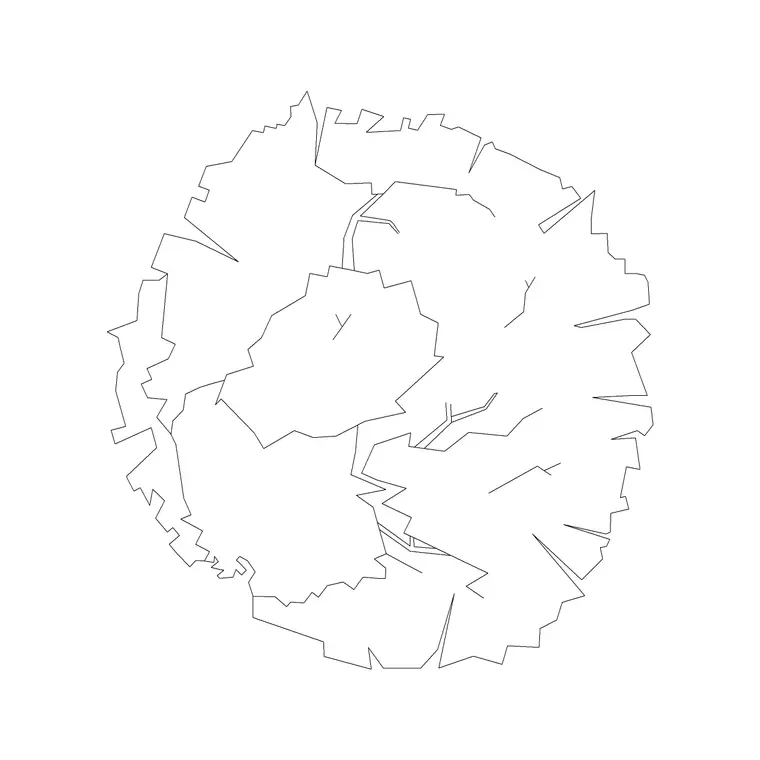
The free Pine Plan 1 block in the Trees & Plants category is a plan-view block — the top-down canopy you use on site plans and landscape layouts. Download it as DWG (no account, free for commercial use). Plan trees are scaled by the canopy diameter; elevation trees, by contrast, are scaled by overall height. Knowing which view you have decides which dimension you calibrate against, so glance at the block's view label before you do anything else.
Measure the canopy you actually downloaded
Insert the tree with the INSERT command (type I, Enter, browse to the file, place it), then measure across the widest part of the canopy with DIST. Read the number. If a tree you expect to be about 6 metres across reports 6000, it is in millimetres; if it reports 6, it is in metres. As with every block, a value that is off by a factor of 1000 — a canopy reporting 6000 in a metre drawing — is the classic units mismatch that makes the tree swallow the whole site or shrink to a speck.
Measuring first means you are calibrating against the real geometry rather than trusting a unit label that planting blocks often omit. It takes five seconds and turns scaling from a guess into a calculation. It also catches the subtler problem of a tree that was simply drawn at an unrealistic spread by whoever made it — a canopy that measures a tidy 6000 but represents a species that only ever reaches 4 metres, which no units setting would have flagged for you.
Set the exact spread with SCALE Reference
Because the target is a specific canopy diameter, the Reference method is ideal. Select the tree, type SCALE, pick the centre of the trunk as the base point, type R for Reference, then click two points across the current canopy to tell AutoCAD its present width. Finally type the spread you want — for example 8000 in a millimetre drawing for an 8-metre street tree — and the canopy resizes to exactly that.
If you would rather use a plain factor: millimetre block into a metre drawing is 0.001, metre block into a millimetre drawing is 1000. But Reference is usually faster for planting because you think in canopy metres, not in unit conversions, and it lets you draw the same block at several different sizes to represent different species or maturities in one planting area. Anchoring at the centre of the trunk keeps the tree sitting on the same point as it grows or shrinks, so its position on the plan does not drift when you adjust the spread.
Vary the size so the planting looks real
Once you can scale a tree to any spread on demand, use that power to avoid the dead giveaway of fake planting: identical blocks stamped at a regular spacing. Insert the same Pine block a few times and scale each instance to a slightly different diameter within a sensible range for the species, rotate or mirror some of them, and the row immediately reads as natural rather than as clip art. For a mass like a hedge or shrub bed, a tight cluster of small-scaled blocks or a hatch communicates the intent better than a few oversized trees.
Correct scale plus gentle variation is what separates a planting plan that a landscape architect trusts from one that looks generated. The drawing should let a client reason honestly about overshadowing and screening, and that only works if every canopy is at its true spread. A useful trick is to keep two or three tree blocks of different character on hand and mix them, scaling each to the right size, so the planting reads as a considered selection of species rather than one block copied across the whole site.
Keep planting controllable on its own layer
Put trees on a dedicated planting layer — or a small set such as trees, shrubs and groundcover — so you can dim, freeze or recolour all the planting without disturbing the architecture or engineering. That is what lets you issue a clean planting-only sheet, and it keeps busy canopy geometry from cluttering a structural plan that does not need it. Blocks built to inherit their host layer will pick up the planting layer's colour and lineweight the moment you insert them.
Put the pieces together — confirm the view, measure the canopy, scale to the real spread, vary the instances, and layer the planting cleanly — and your site and landscape drawings will read as designed by someone who understood the site rather than assembled from a single stamped block. If you also drop in a scale figure or a car nearby, both at true size, the planting gains an instant sense of proportion that makes the whole site plan more legible to a client or a planning authority reviewing it.
Questions
Frequently asked
How wide should a tree canopy be in CAD?+
Draw it at the real mature or design-year spread: about 3–4m for small ornamentals, 6–8m for medium street trees, and 10–15m+ for large trees, so the plan honestly shows shade and spacing.
Do I scale a tree block by height or width?+
A plan-view tree is scaled by canopy diameter (its width seen from above). An elevation tree is scaled by overall height. Check which view the block is before you calibrate.
What is the easiest way to set a tree to an exact canopy size?+
Use SCALE with the Reference option: pick two points across the current canopy, then type the diameter you want and AutoCAD resizes it exactly, no factor arithmetic needed.
Free downloads from this article
Free CAD block library
Download the blocks from this article — free, no signup