Round vs Rectangular vs Curved Conference Tables Compared
Comparing round, rectangular and curved conference table CAD blocks by sightlines, video call framing and cable management, not size.
Sumana KumarUpdated 1 June 202610 min read
A hybrid call that exposed the wrong table shape
A team I was helping with a boardroom layout had already settled on a 10-seater-rec-table well before the room's actual use came up in conversation, and it wasn't until someone mentioned that most of their meetings now involve at least two or three people joining by video that the choice started to look questionable. On a rectangular table, the camera at one end of the room only ever frames the people closest to it clearly, while whoever's sitting at the far end becomes a small, poorly lit figure at the back of the shot, which is exactly the kind of thing that doesn't show up until the room is actually used for a real hybrid meeting rather than judged on a floor plan.
That's the part that a lot of table shape decisions skip entirely, treating round, rectangular and curved as basically interchangeable as long as the seat count matches, when the shape itself changes how a meeting behaves, who gets seen clearly on a call, and where the cables and power actually need to run.
What table shape actually changes in a meeting
The three shapes we're comparing here, rectangular, round and curved, aren't just aesthetic choices, they each set up a different social geometry in the room. A rectangular table has a defined head, or two, which naturally puts whoever sits there in a position of visual authority whether that's intended or not. A round table removes that hierarchy entirely, since every seat has an equal relationship to the center, which is why round tables get used deliberately in settings meant to read as collaborative rather than top down. A curved table sits in between, keeping most of the equal sightline benefit of a round table while still giving the room a directional focus toward whatever the curve opens up toward, usually a screen wall.
None of this is abstract, it shows up directly in how a meeting feels to sit in, and it's worth choosing deliberately rather than defaulting to whichever shape happens to be the first block that matches the seat count you need.
It also shows up in something as simple as where people naturally sit when they walk in without being told. On a rectangular table, people tend to cluster toward the middle of the long sides and leave the head seats empty unless someone senior is expected, which is its own quiet signal about hierarchy even in a meeting that's supposed to be informal. On a round or curved table, seating tends to distribute itself more evenly around the shape, since there's no seat that visually announces itself as the important one, and that difference in how a room fills up on its own is a genuine, observable effect of the shape choice, not just a theoretical one.
Rectangular tables: hierarchy, presentation, and the head of table problem
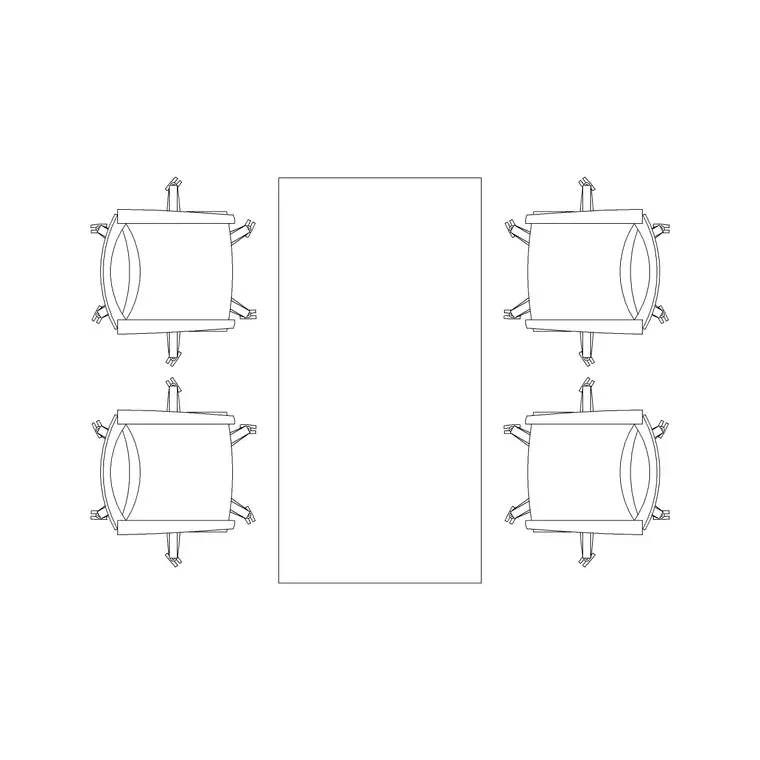
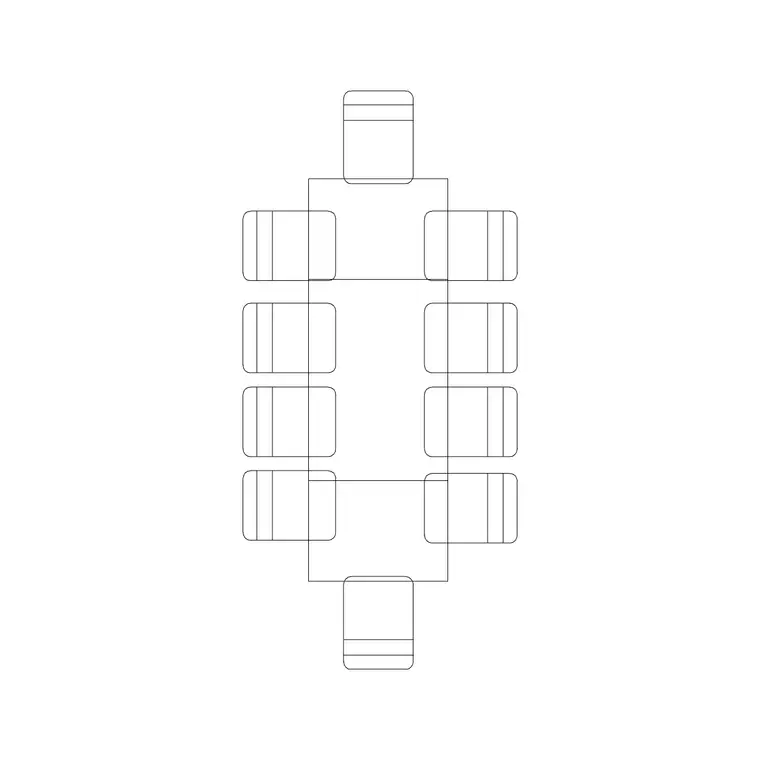
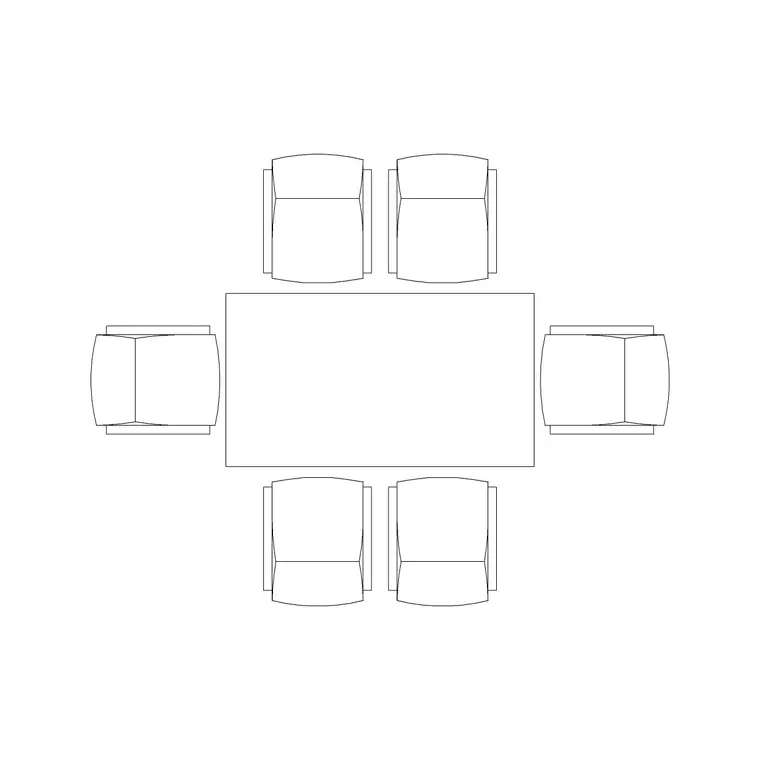
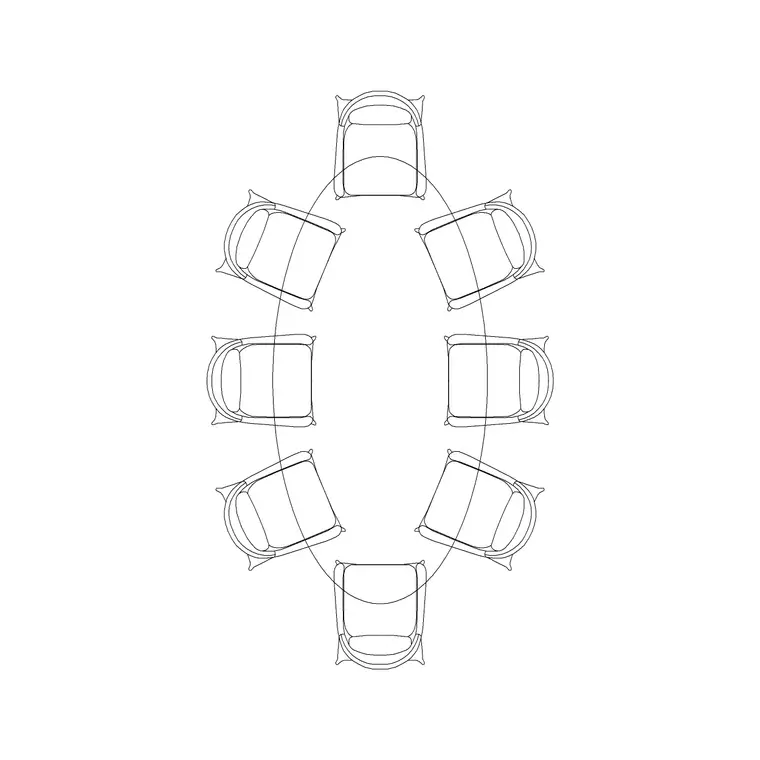
Rectangular blocks like the 6-seater-rec-table and 10-seater-rec-table are the right call when a meeting genuinely has a presenter and an audience, a board update, a client pitch, anything where one person or a small group at one end is meant to be the visual and functional focus of the room. The long straight sides also make cable management simpler than either round or curved shapes, since power and data drops along a straight run are easier to plan and route consistently than around a curve.
The tradeoff is exactly the hierarchy that makes rectangular tables good for presentations, since that same defined head of table position works against a room that's meant to feel collaborative rather than directional. If the actual use of the room is closer to a working session between equals than a presentation to an audience, a rectangular table like the 10-seater-rec-table quietly reinforces a hierarchy the meeting doesn't actually need.
There's a middle sized version of this worth calling out too, since a 6-seater-rec-table in a smaller room often gets chosen purely because it's the compact option, without anyone actually asking whether that room hosts presentations or working sessions more often. A smaller rectangular table still carries the same head of table effect at a reduced scale, it's just less obvious with fewer seats involved, so the same question about the room's actual primary use applies just as much at six seats as it does at ten or twelve.
Round tables: flattening hierarchy, and the camera problem
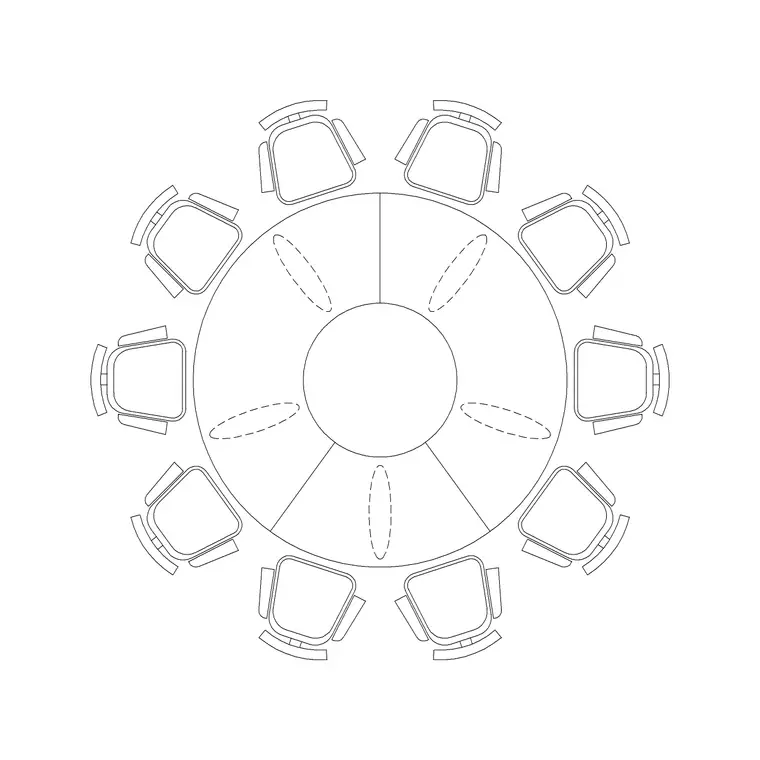
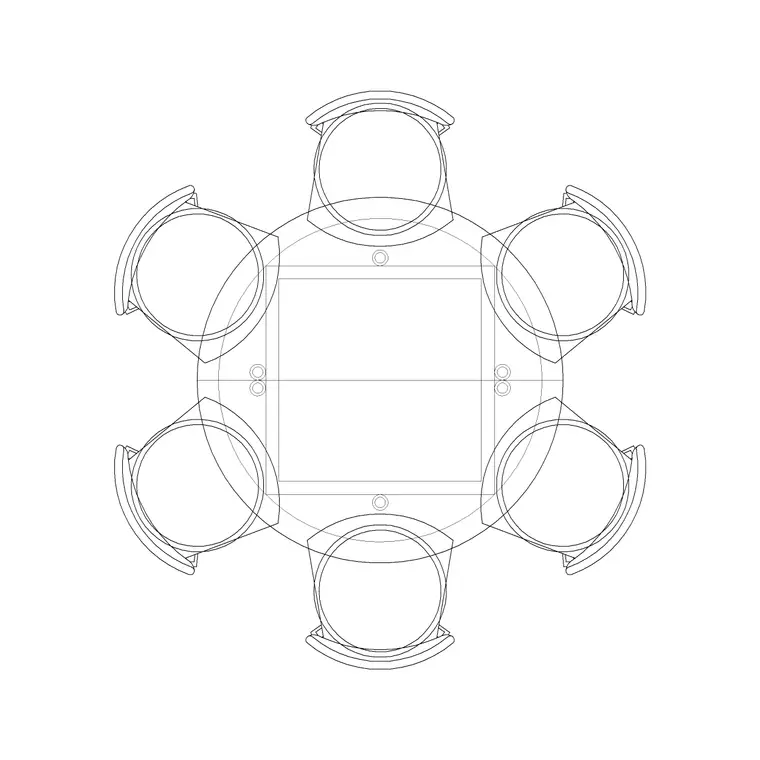
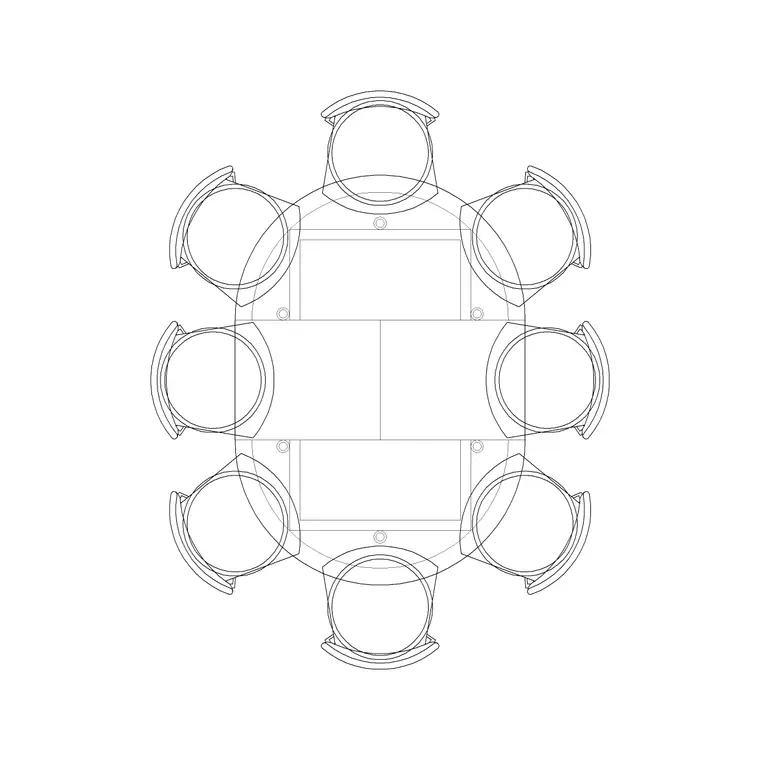
Round tables, the 6-seater-round-table, 8-seater-round-table and 10-seater-round-table across our range, solve the hierarchy problem cleanly, since there's no head of table position for anyone to occupy and every seat has roughly the same relationship to the center of the discussion. This makes them the natural choice for genuinely collaborative sessions, workshops, brainstorms, anything where the point is that everyone's input carries equal weight in the room.
The problem, which is exactly what came up in the opening example, is video conferencing. A single camera at one point around a round table can only frame a portion of the circle clearly, and as the table gets bigger, going from 6-seater-round-table up toward 10-seater-round-table or beyond, more of the seated group ends up outside a comfortable single camera frame. Round tables work best for video heavy rooms either at smaller sizes, or paired with more than one camera angle, which is a real cost to weigh against the hierarchy benefit.
Curved tables: the middle path, and where they genuinely win
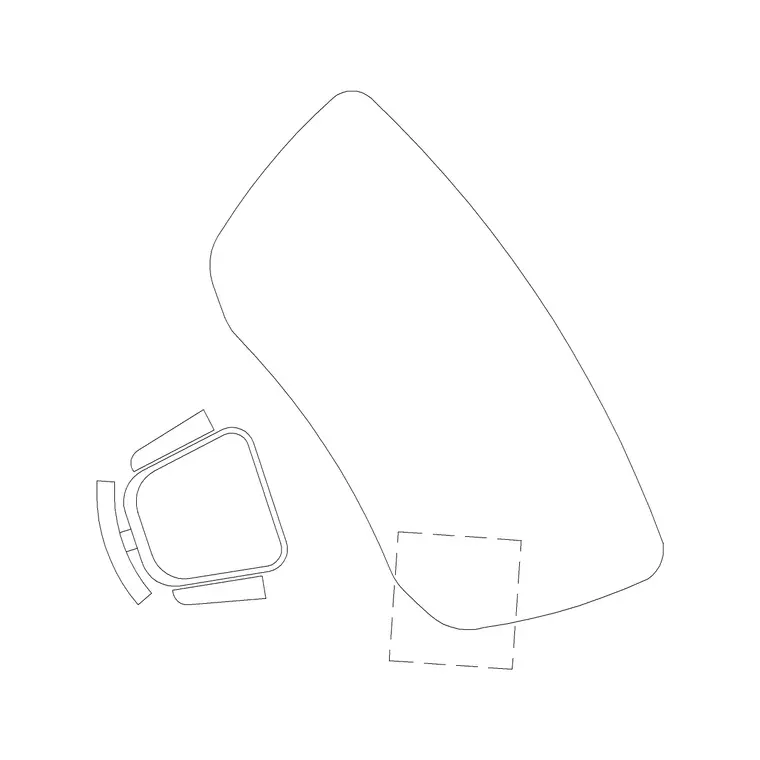
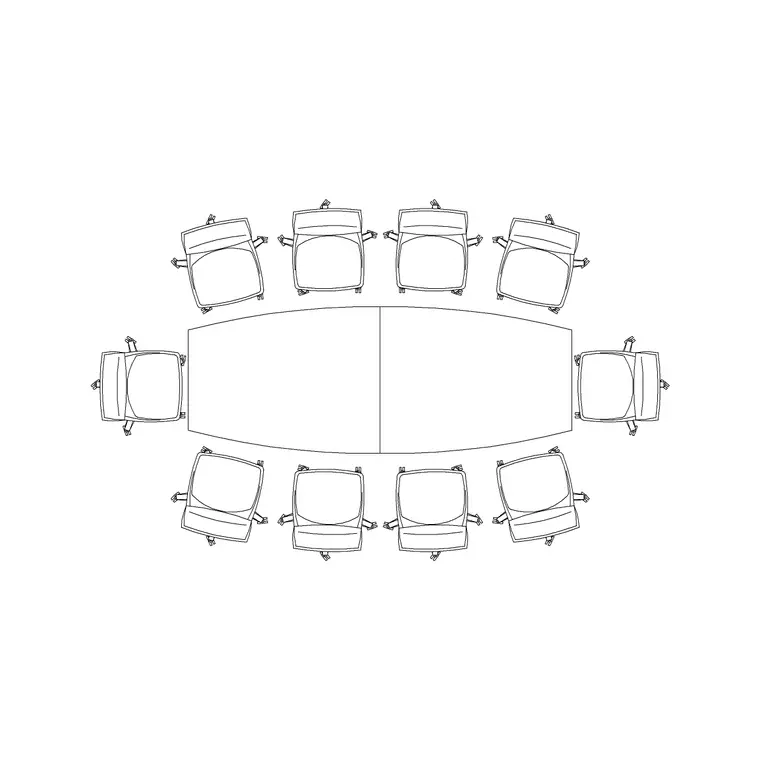
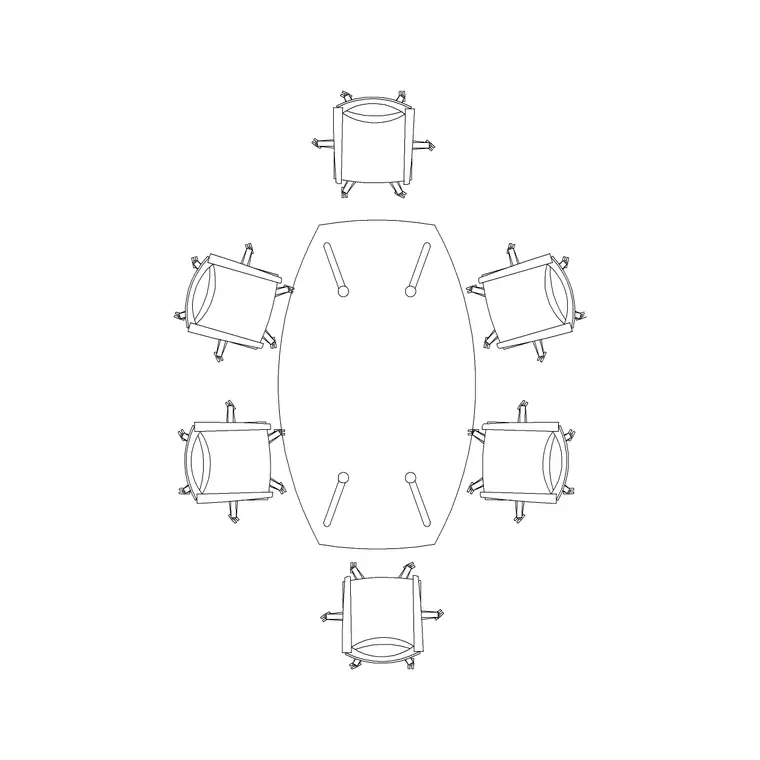
Curved tables like the 6-seater-curve-table, 8-seater-curve-table and 10-seater-curve-table exist for a specific reason, giving a room most of the sightline and equality benefits of a round table while still keeping a directional focus toward one wall, almost always a screen or a window run. The curve lets seating bow away from that focal wall so nobody's chair is jammed against glazing or fighting glare, while still keeping the group facing roughly the same direction, which happens to be exactly what a video call setup wants, since a single camera mounted on the focal wall can frame a curved table's seating far more evenly than it can a full circle.
This is where curved tables genuinely earn their spot over both alternatives, in rooms that are primarily used for video conferencing with a screen wall, where you want the collaborative feel of a round table without giving up the single camera coverage that a rectangular or curved layout naturally provides.
Cable and power management differences by shape
This is a practical detail that rarely gets factored into shape decisions early enough, and it's worth being specific about, since retrofitting power into the wrong shape after installation is a genuinely annoying problem. Rectangular tables are the simplest to wire, since power and data modules can be placed at regular intervals along a straight run and every seat's cable path is predictable and roughly the same length. Round tables complicate this, since a center mounted power module works for a small round table like a 6-seater-round-table, but as the diameter grows toward an 8-seater-round-table or 10-seater-round-table, cables from the center to the outer seats get progressively longer and messier unless the table has a built in cable channel.
Curved tables split the difference, generally allowing power modules along the outer curve at intervals similar to a rectangular table, since the curve is gentle enough that cable runs stay roughly predictable, which is one more practical point in favor of a curved table like the 10-seater-curve-table in any room where power and AV cabling actually matters day to day.
This is also worth thinking about at the drawing stage rather than after installation, since power and data drops are usually specified against the floor plan before the table itself physically arrives. If the cabling plan gets drawn against a rectangular table's straight edges and the room later ends up with a round table instead, the floor boxes and power whips end up in the wrong position relative to where seats actually land around a circle, which is a genuinely expensive mistake to fix once the floor is finished, so it's worth locking the table shape before finalizing where power gets routed, not after.
Matching shape to how the room is actually used
Pulling this together, the honest way to choose between round, rectangular and curved isn't about which looks more modern or which fits the seat count, it's about answering what the room is actually for most of the time. A room used mainly for presentations and client facing meetings, where a defined front of room matters, points toward a rectangular block, whether that's a 6-seater-rec-table for a smaller space or a 10-seater-rec-table for a larger one. A room used mainly for internal collaborative sessions with little to no video conferencing points toward a round table, scaled from a 6-seater-round-table up to a 10-seater-round-table depending on the group size. And a room that's primarily a video conferencing space, especially one with a fixed camera and screen wall, points toward a curved table, the 6-seater-curve-table, 8-seater-curve-table or 10-seater-curve-table depending on headcount.
Larger boardrooms complicate this slightly, since something like the 12-seater-round-sides brings round table equality to a bigger group, but at that scale it's worth genuinely testing the video conferencing framing before committing, since the camera coverage problem only gets more pronounced as the table grows.
Swapping shape in a room that already exists
A situation that comes up almost as often as designing a room from scratch is a room whose actual use has changed since it was originally furnished, a space that used to host client presentations and now spends most of its time on internal video calls, or the reverse, a room built for collaborative workshops that's increasingly used to pitch to clients. In both cases the question isn't whether to redesign the whole room, it's whether the existing footprint can take a different table shape without moving walls, and that comes back to the same clearance principles that decide table sizing in the first place.
A rectangular table swapped for a round or curved one of similar seat count usually needs slightly more depth on the shorter axis, since a circle or curve pushes seating outward on all sides rather than concentrating it along two long edges, so a room that was tightly sized around a 6-seater-rec-table might not comfortably fit a 6-seater-round-table without feeling cramped, even though the seat count hasn't changed. Going the other direction, from round to rectangular, is usually the easier swap, since a rectangular table tends to fit inside whatever footprint a round table of the same capacity already occupied.
The practical takeaway is that it's worth checking a prospective shape swap against the room's actual clearance the same way you would when sizing a brand new table, rather than assuming that because the seat count is staying the same, the shape change is automatically a drop in replacement.
There isn't a single winner, and that's the actual point
None of the three shapes is objectively better than the others, and treating this as a search for the single best conference table shape misses what the comparison actually shows, which is that each shape is a genuine tradeoff between hierarchy, sightlines and practical cabling, and the right answer depends entirely on how a specific room gets used most often. A rectangular table that's wrong for a collaborative workshop room is exactly right for a client presentation room down the hall, and a curved table that's the obvious choice for a video heavy meeting room might be unnecessary in a room that never hosts a remote call at all.
So the useful exercise isn't picking a favorite shape and applying it everywhere, it's walking through how each specific room actually gets used, matching that against the tradeoffs above, and letting different rooms in the same building end up with genuinely different table shapes because their actual use is genuinely different.
The hybrid meeting from the opening of this piece is a fair illustration of where that thinking actually lands in practice. Once the team looked honestly at how the room got used, mostly video calls with a handful of remote attendees rather than in person presentations, the 10-seater-rec-table came off the plan and a 10-seater-curve-table went in its place, oriented so the curve bowed toward the screen wall where the camera sat. Nobody at the far end of the room disappeared out of frame anymore, and the room still worked fine for the occasional fully in person meeting, which is exactly the outcome this kind of shape comparison is meant to produce, a table chosen for how the room is actually used most of the time, not for how it looks on a floor plan.
Further reading
Questions
Frequently asked
Is a round or rectangular conference table better for video conferencing?+
Neither is automatically better. Rectangular tables give a single camera predictable framing along a straight run, which suits video calls, but reinforce a defined head of table hierarchy. Round tables remove that hierarchy but get harder for a single camera to frame evenly as the table grows past a 6-seater-round-table. Curved tables like the 10-seater-curve-table are often the better middle ground for video heavy rooms.
Why would I choose a curved conference table over a round one?+
A curved table like the 8-seater-curve-table keeps most of the equal sightline benefit of a round table while still giving the room a directional focus, usually toward a screen wall, which makes single camera video conferencing coverage more even than it typically is around a full circle.
Which conference table shape is easiest to wire for power and data?+
Rectangular tables are the simplest, since power and data modules sit at regular intervals along a straight run with predictable cable lengths to every seat. Curved tables are close behind, since the curve is gentle enough for similarly regular spacing. Round tables get progressively harder to wire cleanly as the diameter increases from something like a 6-seater-round-table toward a 10-seater-round-table.
Do larger conference tables need a different shape decision than smaller ones?+
The same tradeoffs apply, but they become more pronounced at scale. A large round table like the 12-seater-round-sides gives every seat equal standing, but camera coverage for video calls gets harder to manage as the group grows, so it's worth testing the video framing specifically before committing to a round shape at that size.
Free downloads from this article
Free CAD block library
Download the blocks from this article — free, no signup