Reading a block's bounding box to judge real-world size
A block's bounding box gives you an instant sanity check on real-world size before you insert. Here's how to read it and what ranges to expect by block type.
Saumyajit MaityUpdated 4 July 20266 min read
The single fastest sanity check there is
If I only had one tool to judge a block's real-world size before inserting it, it'd be the bounding box, because it collapses a potentially complicated piece of geometry down to a single set of overall width, depth, and height numbers, which is exactly the information you need for a first-pass sanity check. It won't tell you if the internal proportions are right, we covered that in the true-to-scale piece, but it will tell you in about two seconds whether the block is even in the right ballpark for what it's supposed to be.
How to actually pull the bounding box
Select the block, whether it's inserted or you're looking at loose geometry in the source file, and open the Properties palette. Under the Geometry section you'll see overall width, depth, and height reported directly, which is effectively the bounding box without you needing to draw a rectangle around anything yourself. Alternatively, run MEASUREGEOM and choose the area or the bounding box sub-option for a more explicit readout. Either way, you get three numbers back in a few seconds that tell you the maximum extent of the block in each direction.
One thing worth being aware of is that a 2D plan-view block only reports meaningful width and depth, since height is effectively zero or irrelevant for flat geometry, while an elevation block reports width and height with depth being the shallow dimension. Knowing which two of the three numbers actually matter for the view you're looking at saves you from misreading a flat plan block's near-zero height as an error rather than simply a property of 2D geometry drawn in the XY plane.
Worked example: select a downloaded dining chair block and the Properties palette reports width 450, depth 520, height 0 since it's a plan-view block sitting flat in the XY plane. That's telling you the chair reads roughly 450mm wide by 520mm deep in plan, which lines up comfortably with how real dining chairs are built, typically somewhere in the 400 to 480mm width range with depth usually running a bit more than width to account for the seat plus a backrest allowance. The zero height isn't a problem, it's just confirming this is flat plan geometry rather than a 3D model, and knowing to expect that zero saves you from wondering whether something's broken when it should really just tell you what kind of block you're looking at.
What ranges to expect by category
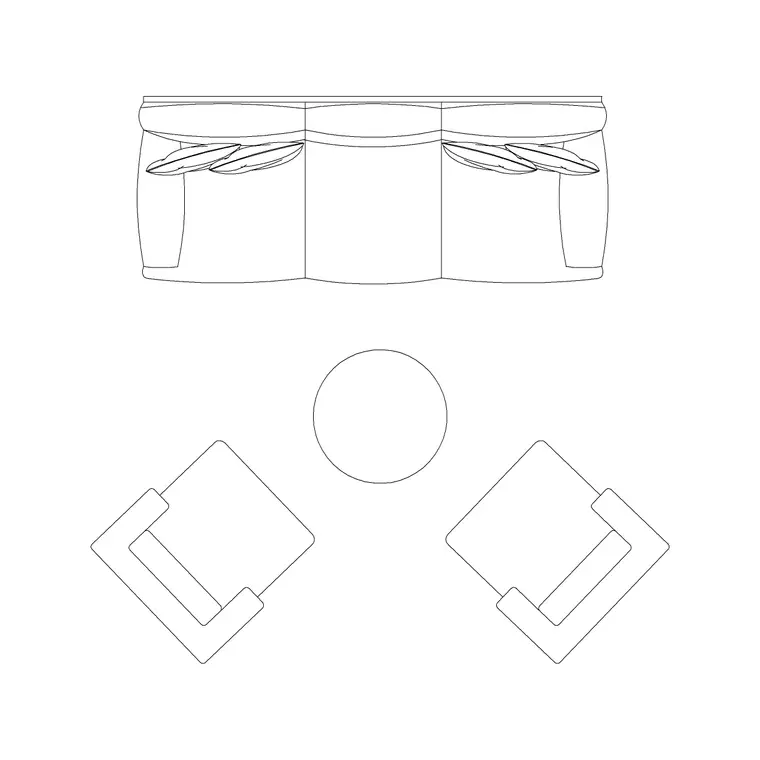
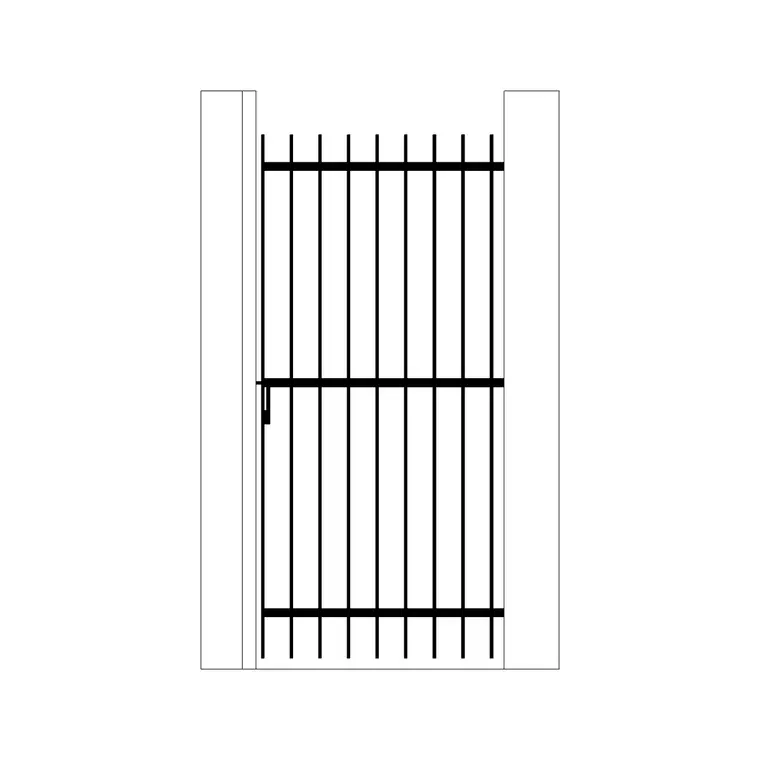
For a sofa block like Sofa Set Plan 1, drawn in plan, expect a bounding box that reads sensibly for a piece of seating, typically somewhere in the 1900 to 2200mm range on the long axis and 850 to 950mm on the depth axis, since that matches how real three-seater sofas are actually built. For a gate block like the Iron Gate, also plan view, the bounding box width should read like an actual opening, commonly 900 to 1200mm for a pedestrian gate and considerably wider, often 3000mm or more, for a vehicle entrance, so knowing which type of gate you're looking at tells you what width to expect before you even measure. For a wall-mounted lighting fixture like the Wall Lamp, drawn in elevation, expect a much smaller bounding box overall, commonly under 400mm in height and well under that in projection depth off the wall, since it's a compact fixture rather than a piece of furniture.
Checking the bounding box against the space it needs to fit
The bounding box check gets even more useful once you stop treating it as an isolated sanity check and start comparing it directly against the opening or space the block needs to occupy in your actual drawing. Before inserting a gate block into a boundary wall opening, for instance, I'll run DIST across the opening itself first, then compare that number against the gate block's bounding box width, because a gate drawn slightly wider than its opening is a problem you want to catch before insertion, not after you've already rotated and aligned it and it's overlapping the jambs. Same logic applies to a sofa going into a specific corner of a room, or a wall lamp being placed between two windows with a fixed gap between them. The bounding box isn't just telling you the block is a sensible size in the abstract, it's telling you whether it'll actually fit the specific gap you're planning to put it in, which is often the more useful question.
What it means when the bounding box doesn't fit
If a bounding box reads way outside the expected range for its category, there are basically two explanations. Either it's a genuine units mismatch, in which case the internal proportions are probably fine and you just need to scale by the right factor once inserted, or the block itself is drawn to the wrong real-world dimensions, in which case scaling won't fix it because the error isn't in the units, it's in the original drafting. The bounding box alone can't tell you which of the two you're facing, but it does tell you instantly that something needs a closer look before you trust the block in a live drawing, which is the whole point of a fast sanity check like this one.
A useful trick when you're unsure which explanation applies is to check whether the bounding box is off by a suspiciously round factor, roughly 1000 times too big or too small, or roughly 25.4 times off if it's an inches versus millimetres mismatch. A clean round multiple like that points strongly to a units issue. A number that's off by some odd, non-round factor, say one and a half times too wide, is much more likely to be an actual drafting error in the original block rather than anything a simple unit conversion would explain.
Using it alongside the true-to-scale check
The bounding box and the true-to-scale check from our other guide work well together as a two-step process. Bounding box first, because it's near instant and tells you if the block is even roughly the right size. Then, if that passes, a DIST measurement on one specific known feature to confirm the internal proportions are right too, not just the overall envelope. Together those two checks catch the great majority of scale and sizing problems before a block ever gets near a live drawing, and neither takes more than a few seconds once it's a habit.
Why this is worth doing even on a library you trust
At the end of the day even a well-maintained library can have the occasional outlier, a block drawn slightly off from a rushed reference, a units flag set wrong during export. The bounding box check costs almost nothing and catches almost everything obvious, so there's no real reason to skip it, even on blocks you've used before without issue. It's the CAD equivalent of a quick glance at a tape measure before you cut, cheap insurance against a mistake that's much more annoying to fix after the fact.
And because it takes so little time, there's real value in making it reflexive rather than something you only do when you suspect a problem. The blocks that turn out to be wrong are rarely the ones you were already suspicious of, they're the ones that looked fine enough not to warrant a second glance, which is exactly why a fast, habitual check catches problems that a purely case-by-case one would miss.
Further reading
Questions
Frequently asked
How do I check a CAD block's bounding box quickly?+
Select the block and open the Properties palette, which reports overall width, depth, and height directly under the Geometry section. You can also run MEASUREGEOM and choose the bounding box option for an explicit readout.
What size range should a plan-view sofa block fall in?+
Typically somewhere in the 1900 to 2200mm range on the long axis for a standard three-seater, with a seat depth usually landing between 850 and 950mm, though exact figures vary by specific furniture design.
What does it mean if a block's bounding box is way off?+
It's either a units mismatch, which you can correct with SCALE once inserted, or the block was drawn to incorrect real-world dimensions in the first place, which scaling won't fix. The bounding box tells you something's wrong; a follow-up dimension check tells you which.
Free downloads from this article

Free CAD block library
Download the blocks from this article — free, no signup