How to insert a downloaded toilet (WC) block in AutoCAD
Insert a free toilet / WC commode DWG into a bathroom plan — placing it against the wall, leaving proper clearances, and getting the orientation right.
Saumyajit MaityUpdated 21 May 20265 min read
Download a WC commode block
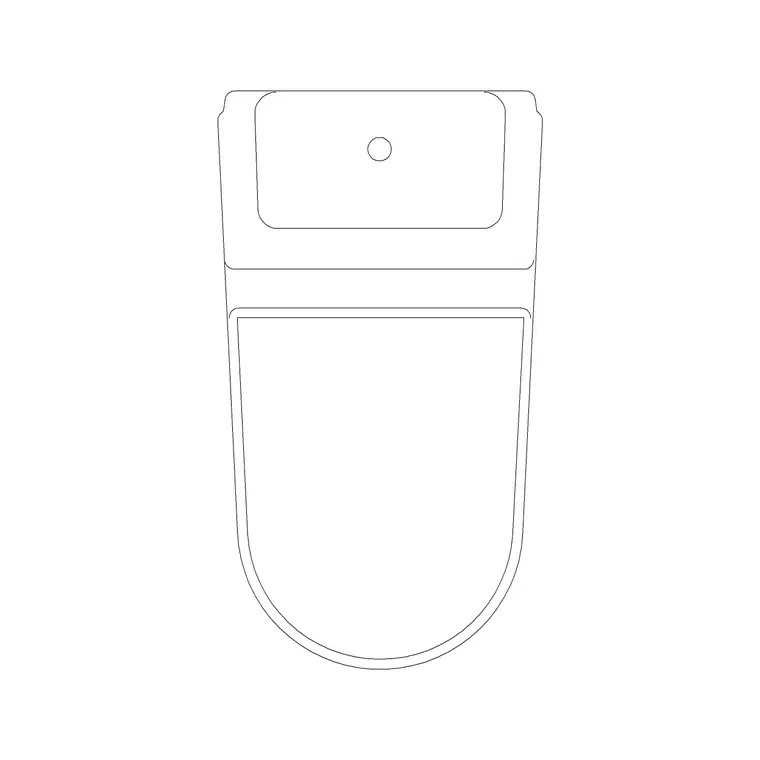
In the Bathroom category you will find toilet (WC) commode blocks drawn in plan — the top-down outline of the pan and cistern as you would see them looking down. Open the one that suits your scheme, whether a standard close-coupled commode or a different pan style, and download the DWG. It is free, needs no signup, and is cleared for commercial use, so it is ready for a real bathroom layout.
A plan WC block shows the bowl shape, the seat outline and the cistern at the back where it meets the wall. The cistern edge is your alignment reference — it sits flat against the wall — so when you insert, that back line is what you snap to the wall. Knowing which part of the block is the 'wall side' makes placement quick and avoids the common error of dropping the pan in facing the wrong way.
Place it against the wall
Open your bathroom plan, type I, Enter, Browse to the toilet DWG and select it. Turn on object snaps with F3. A WC is fixed to a wall via its cistern, so move the block so the back of the cistern sits flush against the wall line and snap it there. The base point of most WC blocks is at or near the cistern, which makes this alignment natural.
Leave scale at 1 — a standard commode footprint is roughly 700mm deep from wall to front of pan and about 400mm wide, so the block should already match real life. Click to place. If the pan comes in facing the wall (cistern pointing into the room), it has been mirrored or rotated; fix it with ROTATE or MIRROR so the cistern is against the wall and the front of the pan faces into the room where someone would sit.
Leave the right clearances
A toilet is unusable if it is crammed against a side wall or another fixture, so clearances are the real test of placement. Aim for a clear width centred on the pan — commonly about 400mm to each side from the centreline (so roughly 800mm total) — and a clear space in front of around 600mm so someone can stand and turn. For accessible WCs the clearances are considerably larger and governed by local standards, so check those if the bathroom is designed for wheelchair use.
A neat way to verify this is to draw a light rectangle representing the required clear zone around the pan and check nothing — a basin, a bath, a door swing — intrudes into it. Pay special attention to the door: a door swinging onto the toilet is a common planning mistake that a furnished plan makes obvious the moment you place both blocks.
Fix scale or orientation issues
If the toilet inserts at a wild size, it is the usual units mismatch — a millimetre block in a metre drawing or vice versa. Set INSUNITS consistently in both files for auto-scaling, or insert and then SCALE by 0.001 or 1000. Confirm with a DIST across the pan: about 700mm front-to-back is the figure to look for.
Orientation is the other thing to get right. A WC needs to face into the room with the cistern on the wall, so use ROTATE to spin it to the correct wall and MIRROR if you are placing it in a mirrored bathroom layout. Once it is the right size and facing the right way, the block reads exactly as a WC should and you can move on to the basin and bath with confidence that the toilet is correctly set out.
Layer and combine with other fixtures
Put sanitaryware on a sanitary or fixtures layer so all the bathroom fittings can be controlled together. Blocks built on layer 0 inherit the current layer, so set that layer current before you insert and the WC takes it on. This keeps the bathroom fittings tidy and separable from the architecture.
A toilet rarely sits alone, so the same INSERT workflow gets you the rest of the suite — basin, bath, shower — each snapped to its wall and checked for clearances against the others. Lay them out together and you can immediately see whether the room works: whether there is space to use each fixture, whether the door clears them, and whether the plumbing wall makes sense. That is the whole point of furnishing a bathroom plan with real, correctly-scaled blocks rather than rough boxes.
Think about the plumbing wall
A WC has to connect to a soil pipe, and that connection shapes where it can sensibly go. The pan's outlet — at the back for a close-coupled commode — needs to reach the drainage, so toilets are usually grouped on a 'wet wall' shared with the basin and any other plumbing, rather than scattered to opposite sides of the room. When you place the WC, putting it on the same wall as the basin keeps the pipework short and the construction simpler, which a builder and a client both appreciate.
It is worth showing this intent on the plan even at an early stage: align the WC, basin and bath so their services run to a common wall or duct, and the bathroom reads as something that can actually be plumbed economically. A toilet placed in isolation on a far wall might fit the clearances perfectly and still be an expensive nuisance to drain. Coordinating the fixtures around the plumbing wall is the difference between a layout that merely looks right and one that is genuinely buildable.
Questions
Frequently asked
How much clearance does a toilet need in plan?+
Aim for roughly 800mm total width centred on the pan (about 400mm each side) and around 600mm of clear space in front. Accessible WCs need considerably more — check local standards.
Which part of a WC block goes against the wall?+
The cistern. The back of the cistern sits flush against the wall line, with the front of the pan facing into the room. Snap that back edge to the wall and rotate or mirror if it comes in facing the wrong way.
What is the footprint of a standard toilet block?+
Roughly 700mm deep from wall to front of pan and about 400mm wide. Draw a DIST across the block to confirm; if it is wildly off, it is a units mismatch — set INSUNITS or scale by 0.001 / 1000.
Free downloads from this article
Free CAD block library
Download the blocks from this article — free, no signup