Toilet & WC CAD block dimensions explained (free)
WC pan sizes, the clearances a toilet block needs, and accessible-WC requirements — plus where to download free DWG toilet and commode blocks at real scale.
Saumyajit MaityUpdated 4 January 20264 min read
What a WC block has to get right
A toilet block is small, but the space around it is tightly governed, so the dimensions that matter most are the pan footprint and the clearance zone in front of and beside it. A standard WC pan is roughly 360-400mm wide and 600-700mm deep from the wall to the front of the bowl, with a close-coupled cistern adding 150-200mm of depth behind. Wall-hung pans project a little less because the cistern hides in the wall.
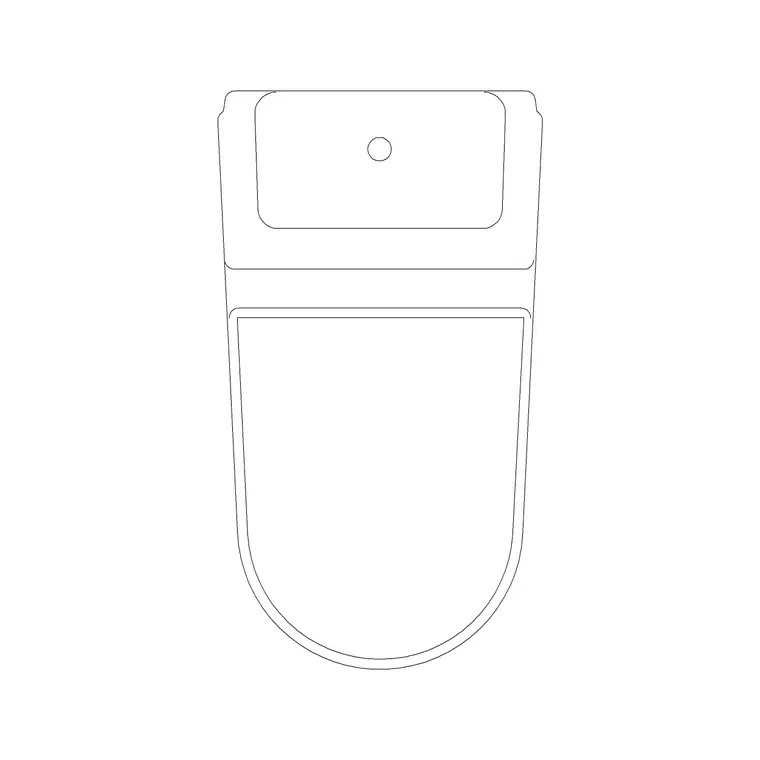
The Toilet Commode 1 block in the Bathroom category is drawn as a clean plan symbol you can drop into a layout. What you are really placing is not just the pan but the activity space it implies — the room a person needs to use it. Get the pan footprint right and you can lay out that activity space honestly, which is the whole point of putting a WC on a plan rather than just marking its position with a label.
Pan dimensions and cistern depth
Keep these figures as your scale check for a WC block:
- Pan width: 360-400mm (the bowl), with the seat a touch wider. - Pan depth (projection from wall): 600-700mm for a close-coupled WC including the cistern; 500-540mm for a wall-hung pan. - Cistern height: around 750-800mm for a close-coupled unit; concealed cisterns sit inside the wall. - Seat height: about 400-420mm above floor (430-480mm for an accessible WC), shown only in elevation.
In plan, the block reads as the bowl outline plus the cistern rectangle behind it against the wall. If a downloaded WC measures much wider than 400mm or much deeper than 700mm, suspect a units mismatch and check the scale before you build clearances around it.
The projection figure is the one that most affects a small room. A close-coupled WC at 700mm deep eats far more of a cloakroom than a back-to-wall or wall-hung pan at 500-540mm, and in a tight space that 150-200mm can be the difference between a door that closes and one that hits the pan. As a worked example, a downstairs cloakroom of about 900 x 1500mm only works with a shallow pan and a compact corner basin; specify a deep close-coupled WC and a full-size basin and the same room becomes unusable. Choosing the pan depth deliberately, with the real block in the plan, is what lets you make that call before the walls are built.
The clearances that actually govern the layout
The pan is small; the clearances are not, and they are what make or break a WC layout:
- Allow at least 600-700mm of clear space in front of the pan for a person to stand and turn. - Keep a minimum of 200mm each side of the pan centreline to the nearest wall or fixture — 400mm centreline-to-wall is comfortable. - A separate WC compartment is commonly about 800mm wide x 1500mm deep as a workable minimum.
Because the toilet block carries its true footprint, you can set out these zones and immediately see whether the door swings clear of the pan, whether a basin crowds it, and whether two people could never share the space. A WC that looks fine as a label often fails the moment you draw the real activity space around the actual pan size — which is exactly why you place the block rather than guess.
Accessible WC requirements
Accessible (wheelchair-usable) WCs have their own, larger geometry, and it is worth knowing even if your project is residential. A typical accessible WC compartment is around 1500 x 2200mm to allow a wheelchair to turn and to give space for a side or oblique transfer. The pan centreline usually sits about 450-500mm from the side wall to leave room for a grab rail and transfer space, and the seat is higher (around 450-480mm) to ease transfer.
You will not always need an accessible WC, but when you do, the clearance zone — not the pan — is the design driver, and it dwarfs a standard WC. Lay the activity space out with the real pan position and you can check the turning circle and transfer space honestly. As ever, the block is a setting-out tool: its value is letting you test whether the room genuinely works, not just whether the fixture fits on the page.
Downloading and placing a toilet block
Open the Bathroom category, pick the WC or commode block you need, and download the free DWG (no signup; DXF where your software prefers it). Insert it with the cistern snapped against the wall and the pan projecting into the room. These are drawn at real-world size, so scale 1 in a millimetre drawing, or set INSUNITS / scale by 0.001 in a metre drawing; verify by dimensioning the pan depth (about 650mm for a close-coupled WC).
Put sanitaryware on a "Sanitary" or "Bathroom" layer so it reads distinctly from walls and furniture and can be isolated for a plumbing drawing. The blocks are built on layer 0, so set that layer current before inserting and the WC inherits it. Pair the WC with a basin and, if there is one, a bath or shower from the same category to assemble a complete, correctly scaled bathroom in a few insertions.
Questions
Frequently asked
How much space does a toilet need in front of it?+
At least 600-700mm of clear space in front of the pan to stand and turn, plus around 400mm from the pan centreline to the nearest side wall or fixture for comfort.
What is the footprint of a standard WC pan?+
About 360-400mm wide and 600-700mm deep including a close-coupled cistern; a wall-hung pan projects around 500-540mm because the cistern is concealed in the wall.
Are the toilet blocks free to download?+
Yes — the WC and commode blocks in the Bathroom category are free DWG downloads (often DXF too), no signup, free for commercial use.
Free downloads from this article
Free CAD block library
Download the blocks from this article — free, no signup