DWG vs DXF for tree & plant blocks: which to download
Tree and planting blocks are simple geometry, so format rarely matters — until you push them into landscape or GIS software. Here is which to download and why.
Sumana KumarUpdated 28 June 20264 min read
Short answer: take the DWG, switch to DXF for odd software
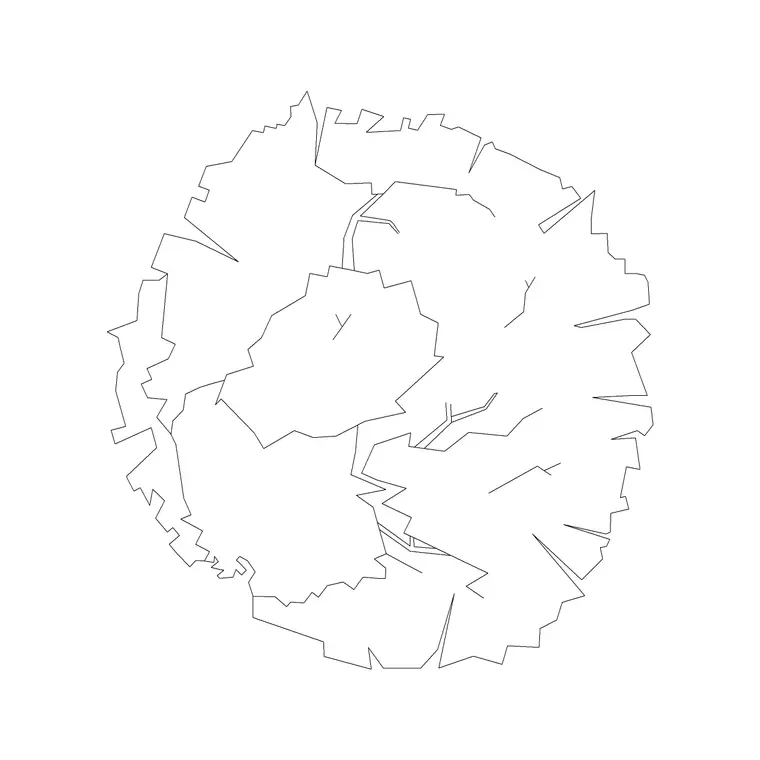
A plan-view tree canopy or an elevation tree silhouette is light vector geometry — a circle with some radial texture, or a trunk-and-canopy profile. That opens fine as DWG in essentially every CAD program, so the DWG is the default download for planting work. Our Trees & Plants category serves DWG with no account and free commercial use, which covers the great majority of landscape drawings.
The exception worth knowing is that landscape work more often than most disciplines crosses into non-AutoCAD territory — GIS packages, terrain and site tools, older landscape-specific software. Those are exactly the environments where DXF, the open exchange format, sometimes reads more reliably than DWG. So the rule is: DWG by default, DXF when your planting geometry needs to leave the AutoCAD world.
The geometry is identical — only portability differs
Whether you download a tree as DWG or DXF, the canopy spread, the trunk position and the linework are the same. Both will measure the same, plot the same, and sit on whichever planting layer you insert them onto. There is no sharper or higher-resolution version; vector geometry does not work that way.
DWG is binary, compact and native, so a folder of fifty tree blocks stays small. DXF is text-based and larger, but maximally portable because its specification is open and almost universally implemented. For planting blocks specifically — which are rarely dynamic or parametric — there is essentially no feature loss converting to DXF, so the only practical trade-off is file size. That makes the format choice purely a question of what your downstream software is happiest reading, not a quality decision.
When DXF helps a landscape drawing
Reach for DXF if you are moving planting into a GIS environment to overlay it on survey or site data, into a terrain-modelling tool, or into an older landscape package that predates good DWG support. In those cases a DXF tree imports cleanly where a DWG might fail or arrive scrambled. DXF is also the right format if you are sending a planting layout to a consultant whose software you cannot confirm — it is the closest thing to a universal handshake.
There is one more landscape-flavoured case: if you ever want to feed a planting symbol to a CNC or laser tool to make a physical model or a routed sign, DXF is the fabrication-friendly format. For ordinary sheet-based landscape drawings in AutoCAD or a DWG-native tool, though, none of this applies and the DWG is simpler.
Placing planting blocks regardless of format
Download the tree, then INSERT it into your site plan and snap the base point to a planting position or grid line. Crucially, match the view to the drawing: a plan-view canopy belongs on a site plan or masterplan, an elevation silhouette belongs on a street elevation or section. Mixing them — a flat plan circle floating in an elevation — reads as wrong to anyone trained, and the format you chose has nothing to do with it.
Scale matters more for trees than almost any other block, because canopy size carries real meaning about shade and spacing. Draw canopies at their real mature or design-year spread — roughly three to four metres for small ornamentals, six to eight for medium street trees, ten to fifteen-plus for large specimens. If a downloaded tree comes in at a strange size, that is a units issue: fix INSUNITS or SCALE it, not the file format. Then vary and rotate instances so the planting reads as natural rather than stamped.
Planting rarely travels alone on a site plan
A site plan is almost never just trees. The same drawing usually carries paving, people for scale, parked vehicles, and the building footprint, and the format decision applies across all of them consistently. If the whole site plan is staying in AutoCAD, keep everything as DWG; if the drawing is heading into GIS or a site-modelling tool, you will likely export the lot as DXF together, planting included.
This is worth thinking about up front, because mixing formats within one site plan creates needless friction. Decide where the drawing is ultimately going, then download the planting, paving and entourage blocks in the format that matches that destination. For trees specifically, the only extra care is the view and the canopy scale — get those right alongside a consistent format choice for the whole sheet, and the planting integrates cleanly with everything else on the site plan.
What to download in practice
For nearly all planting work, download the DWG tree or shrub block, drop it onto its planting layer, and confirm the canopy measures sensibly. Keep DXF in reserve for the landscape-specific moment when geometry has to leave AutoCAD — GIS, terrain tools, legacy software or fabrication. Because the planting geometry is identical in both, you lose nothing by switching when the situation calls for it.
If a tree block ever refuses to open in an unusual program, the fix is a thirty-second round-trip through a free converter to the other format. That, plus matching the view and scaling the canopy honestly, is the whole of what you need to use planting blocks well — the format question is the smallest part of getting a landscape drawing right.
Questions
Frequently asked
Should I download trees as DWG or DXF for a site plan?+
DWG for ordinary AutoCAD or DWG-native landscape work — it is smaller and native. Switch to DXF only if you are pushing planting into GIS, terrain tools or older software that reads DXF more reliably.
Does converting a tree block to DXF lose detail?+
No. Planting blocks are simple, non-parametric geometry, so they round-trip between DWG and DXF cleanly. The canopy and trunk linework come through intact.
My tree block is the wrong size — is that the format?+
No, it is a units mismatch. Set INSUNITS the same in the block and your drawing, or SCALE the tree by 0.001 or 1000. Draw canopies at real mature spread so shade and spacing read honestly.
Free downloads from this article

Free CAD block library
Download the blocks from this article — free, no signup