Staircase CAD block dimensions explained (free download)
Stair rise, going, width and headroom explained, plus straight, dog-leg and spiral layouts — and where to download free DWG staircase blocks at the right scale.
Sumana KumarUpdated 20 May 20264 min read

A staircase is governed by rules, not taste
Stairs are the most rule-bound element in this list. Their dimensions are set by regulation for safety, so a staircase block is only useful if it respects the real geometry of rise, going, width and headroom. A stair drawn with steps too steep or too shallow is not just ugly — it is unbuildable. That is why understanding the numbers matters more here than for any furniture block.
The Stairs category carries plan and section blocks for the common layouts: straight flights, dog-leg (half-landing) stairs, U-shaped and L-shaped flights, and circular and spiral staircases. The Circular Stairs Type 1 block is one of several circular options. When you place a stair block, you are really setting out a vertical journey between two floors, so the rise per step and the going of each tread are the numbers that have to be right, in plan and especially in section.
Rise, going and the pitch rule
Two dimensions define every step, and together they fix how comfortable and how legal a stair is:
- Rise (the height of each step): typically 150-190mm. Around 175mm is comfortable for a domestic stair; lower (150-165mm) suits public buildings. - Going (the depth of each tread, front to back): typically 220-300mm. Around 250mm is comfortable; deeper goings suit gentler public stairs. - A common comfort rule is that twice the rise plus the going should land around 550-700mm (often written 2R + G = 600-630mm), which keeps the stair at a walkable pitch. - Pitch (the overall angle) is usually kept at or below about 42 degrees for domestic stairs and shallower for public ones.
To size a flight, divide the floor-to-floor height by your chosen rise to get the number of steps. A 2800mm floor height at 175mm rise gives 16 risers. The going then sets how far the flight travels in plan — 15 treads at 250mm is 3750mm of horizontal run, which is often why a straight stair simply does not fit and you turn to a dog-leg or spiral.
Stair width, headroom and landings
Three more dimensions complete the staircase:
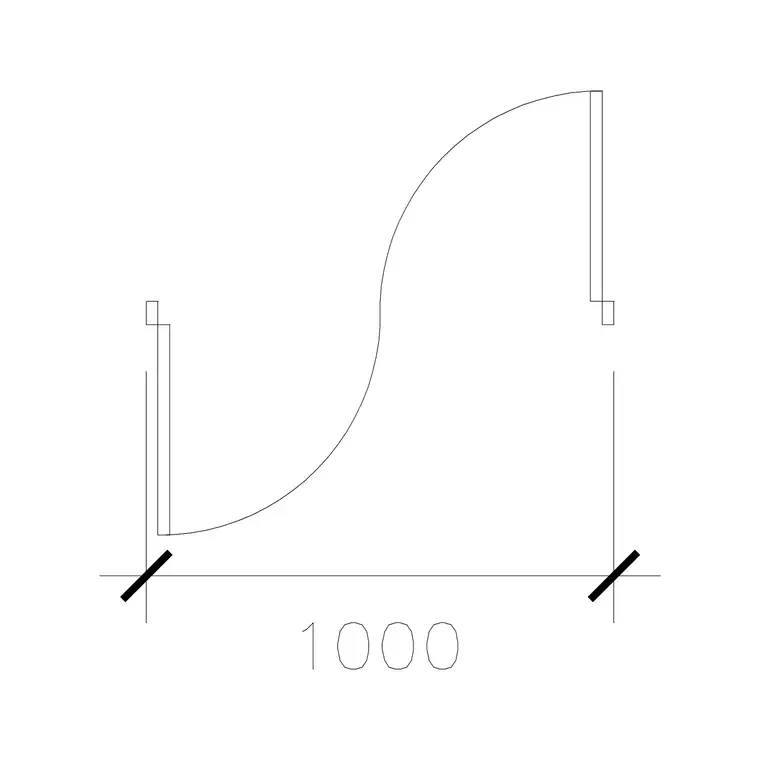
- Width: about 900mm minimum for a domestic stair, 1000mm comfortable; public and escape stairs are wider (1100-1200mm and up) to suit the number of people using them. - Headroom: at least about 2000mm of clear height measured vertically above the pitch line, so people do not hit their heads — this only shows in section, which is why stairs always need a section drawing. - Landing: at least the width of the stair (so 900mm-plus) as a flat resting and turning area, required at the top and bottom and at any change of direction. Where a door opens onto a landing, keep its swing clear of the top step — a standard door at the head of a flight needs its full leaf width of flat landing before the steps begin.
The headroom check is the one that catches people out, because it depends on what is above the stair — a floor edge or a sloping ceiling can intrude into the 2000mm zone. That is exactly why the section block matters: it reveals the vertical clash that plan and elevation both hide.
Straight, dog-leg, U-shape and spiral layouts
The layout you choose is mostly about fitting the required run into the available footprint:
- Straight flight: simplest, but needs the full horizontal run in one line — often 3500-4000mm, which many plans cannot spare. - Dog-leg (half-turn): two flights with a half-landing, doubling back so the stair fits a roughly square stairwell — the most common domestic arrangement. The catalogue has dog-leg plans. - U-shape and L-shape: variations on turning the flight to suit the plan. - Spiral / circular: the smallest footprint, fitting into a circle as little as 1400-2000mm in diameter, at the cost of being harder to use and to move furniture up. The circular stairs blocks suit feature stairs and tight spaces.
The catalogue also includes metal staircase blocks (dog-leg, U-shape, with-well and straight) in plan, section and elevation for steel stairs. Pick the layout that fits your stairwell while still delivering the rise, going and headroom the regulations demand.
Downloading and inserting a staircase block
Open the Stairs category, pick the layout and view you need (plan for the layout, section/elevation to show rise and headroom), and download the free DWG (no signup; DXF where supported). Insert the plan block into your stairwell and align it to the floor edges and the landing; insert the section block onto your section drawing aligned to the floor levels.
These blocks are drawn at real-world size, so insert at scale 1 in a millimetre drawing, or set INSUNITS / scale by 0.001 in a metre drawing. Verify by dimensioning a tread going (about 250mm) or the overall width (about 1000mm). Put the stair on a "Stairs" or appropriate building-fabric layer; the blocks are built on layer 0, so set that layer current before inserting and the stair inherits it. Always confirm the block's step count and floor height match your actual storey height — adjust if your floor-to-floor differs from the block's assumption.
Questions
Frequently asked
What are standard stair rise and going dimensions?+
Rise (step height) is typically 150-190mm, with about 175mm comfortable for a domestic stair; going (tread depth) is 220-300mm, with about 250mm comfortable. A common rule is 2R + G around 600-630mm.
How much headroom does a staircase need?+
At least about 2000mm of clear vertical height above the pitch line, measured in section. It is the dimension most often missed, because a floor edge or sloping ceiling above the stair can intrude into it.
Are the staircase blocks free to download?+
Yes — straight, dog-leg, spiral and metal staircase blocks in the Stairs category are free DWG downloads (often DXF too) in plan, section and elevation, no signup, free for commercial use.
Free downloads from this article
Free CAD block library
Download the blocks from this article — free, no signup