How to insert a downloaded sofa block in AutoCAD
Downloaded a free sofa DWG? Here is how to insert it in AutoCAD — finding the file, running INSERT, setting scale, and placing it cleanly in a living-room plan.
Sumana KumarUpdated 5 May 20265 min read
Where to grab a free sofa block first
Before you can insert anything you need the file on your machine. Head to the Furniture category on CADBlockDWG, open a sofa you like — a two-seater, three-seater or full sofa set — and download it. Every sofa here ships as a DWG (the native AutoCAD drawing format), with no account, no email and no paywall, and the licence covers commercial work, so you can drop it straight into a paid project.
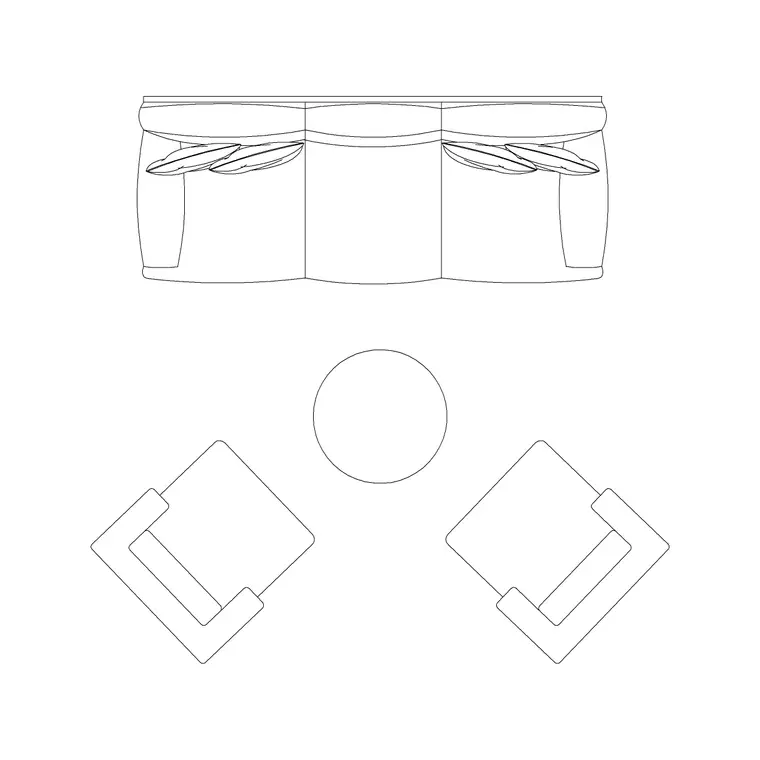
Most of the living-room sofa blocks are drawn in plan view — the top-down outline you want for a furniture layout — with the seat cushions, arms and back all shown as you would see them looking down from the ceiling. Note where the file lands; on Windows and Mac that is almost always your Downloads folder. You do not need to unzip anything: the .dwg is ready to open or reference as-is.
The fastest way: INSERT the DWG as a block
Open your working drawing — the floor plan you are furnishing — and type INSERT, then press Enter. (The shortcut is simply I.) The Blocks palette opens. Click the small Browse / three-dots button at the top, navigate to your Downloads folder, and pick the sofa DWG you just saved. AutoCAD adds it to the palette as a single named block.
Keep three options in mind on the way in. Leave 'Insertion point — Specify On-screen' ticked so you can click where the sofa goes. Leave Scale at 1 and Rotation at 0 for now — the sofa was drawn at real-world size, so 1 is correct in the vast majority of cases. Then click the sofa thumbnail and move your cursor into the drawing.
Inserting the whole DWG this way keeps the sofa as one tidy object you can move, copy and count, rather than a loose pile of lines. If you furnish a lot of plans, drag the sofa onto a Tool Palette once and it becomes a one-click placement from then on.
Snap it to the wall and get the rotation right
As you move the cursor, the sofa ghosts under the crosshairs. This is the moment to place it precisely instead of roughly. Press F3 to switch on running object snaps, then hover near a wall and AutoCAD will lock to endpoints and midpoints. A sofa usually wants its back against a wall, so snap the back edge to the wall line and the seat faces into the room.
If the sofa comes in facing the wrong way, you have two easy options. Set the rotation while inserting — type R during the command and enter an angle such as 90 or 180 — or place it first and run ROTATE afterwards, which is often easier because you can judge the angle once you see the sofa in context. To flip it so the arms swap sides, use MIRROR. A three-seater against the long wall with a coffee table in front reads as a living room instantly.
Fix the size if the sofa lands huge or tiny
If your sofa appears as a vast box that fills the screen, or vanishes until you type ZOOM then E (Extents), the cause is almost never a broken block — it is a units mismatch. A sofa drawn in millimetres dropped into a drawing set to metres lands 1000 times too big; the reverse makes it microscopic.
The clean fix is to set INSUNITS in both files so AutoCAD auto-scales on insertion (4 = millimetres, 6 = metres). If that is not an option, insert anyway, select the sofa, run SCALE, click its corner as the base point, and type the factor — 0.001 to take millimetres into a metre drawing, or 1000 the other way. To sanity-check, draw a quick DIST across the seat: a two-seater sofa is roughly 1500mm wide and 900mm deep, a three-seater about 2100mm wide. If your block measures close to that, the scale is right.
Put it on a furniture layer so it plots cleanly
A sofa belongs on a furniture layer, not on layer 0 by accident. Well-built blocks are drawn on layer 0 specifically so they adopt whatever layer you insert them onto — so the trick is to make your furniture layer current before you insert. Then the sofa inherits that layer's colour and lineweight automatically and you have nothing else to do.
If the sofa is already placed and sitting on the wrong layer, select it and use the layer dropdown (or the Properties palette) to move it onto your furniture layer. Keeping all the soft furnishings together on one layer means you can dim them back for a structural drawing or recolour them for a presentation in a single click, instead of wrestling each block individually. That small habit is what keeps a furnished plan looking deliberate rather than messy.
Build a living-room set around it
A sofa is the anchor of the seating group, so once it is placed you can build the rest of the room around it with the same INSERT workflow. Add a coffee table about 400 to 450mm in front of the sofa, an armchair or two angled toward it, and a rug under the group to tie it together visually. Each goes in as its own block, snapped into a sensible relationship with the sofa.
The payoff of laying out the full group is that you can check it works as a room, not just as a single object. Is there a walking route around the seating? Does the arrangement leave space for a TV unit on the facing wall, and does the door swing clear of the sofa? Because every piece is a block on the furniture layer, you can shuffle the whole group as you test arrangements — drag the sofa, rotate the chairs, nudge the table — until the living room reads as a place someone would actually want to sit, then move on knowing the layout genuinely works.
Questions
Frequently asked
What size should a sofa block be in plan?+
A two-seater is about 1500mm wide and 900mm deep; a three-seater around 2100mm wide. Draw a quick DIST across the seat to confirm the block measures roughly that before you trust it for clearances.
Why is my downloaded sofa block coming in the wrong size?+
It is a units mismatch between the DWG and your drawing. Set INSUNITS the same in both (for example both millimetres), or after inserting run SCALE with a factor of 0.001 or 1000 to correct it.
Are the sofa blocks free for commercial projects?+
Yes. Every sofa on CADBlockDWG is free in DWG with no signup and no attribution required, so you can use it in client and commercial drawings.
Free downloads from this article
Free CAD block library
Download the blocks from this article — free, no signup