How to insert a downloaded office desk block in AutoCAD
Insert a free office desk DWG and lay out a workspace — placing desk and chair, leaving circulation behind, and arraying workstations across an open-plan floor.
Saumyajit MaityUpdated 13 February 20265 min read
Download a desk for the workspace
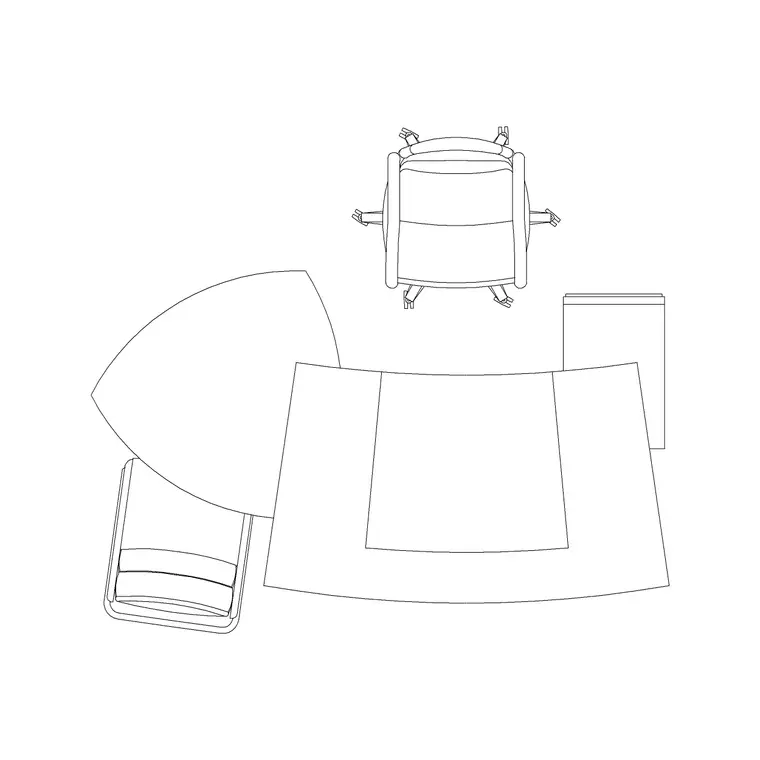
Whether you are fitting out a home study or a full office floor, the desk is the anchor of every work zone. The Office category has desks and tables drawn in plan — the top-down rectangle of the worktop, often with the chair shown — that drop straight into a workspace layout. Open the desk or table that suits your scheme and download the DWG: free, no signup, commercial-cleared.
A plan desk block is essentially a rectangle at the worktop dimensions, sometimes with a return for an L-shaped desk and a chair outline tucked under it. Standard desk worktops run about 1200 to 1600mm wide by 600 to 800mm deep. Knowing those dimensions lets you check the block is right before you build a whole floor around it, and lets you judge how the desks will pack into the space you have.
Place the desk and chair
Open your plan, type I, Enter, Browse to the desk DWG and select it. Turn on snaps (F3) and place the desk against a wall or in its workstation position — for a private office the desk often faces the door with the back to a wall; in open plan it sits within a cluster. Snap a corner of the desk to a wall corner or a grid line for a tidy alignment.
Leave scale at 1; the desk is drawn at real size. Click to place. If the chair is a separate block, insert it on the working side of the desk, pulled out slightly as someone would leave it. Position the desk so the user faces a sensible direction — into the room or toward a window rather than into a blank wall corner where possible — and so the chair has room to roll back without hitting anything behind it.
Leave room to sit and move
A desk is only usable with space around it, so clearances are the real test. Allow about 600mm of clear depth behind the chair so it can roll back and the person can stand up — more, around 1000mm, if it is also a circulation route where people walk past. Between facing desks in a bench arrangement, leave enough for two chairs back to back plus a passing gap, commonly around 1500mm or more.
A neat check is to draw the chair pulled out at its working position and confirm nothing — a wall, a cabinet, another desk — sits within the roll-back zone. In a private office, also check the door swing does not clash with the desk or chair. Getting these clearances right is the difference between a layout that looks fine on paper and one where people can actually work without bumping into each other.
Array workstations across open plan
For an open-plan floor, you place one workstation correctly and then multiply it. Group the desk and chair (and any screen or pedestal) and use ARRAY — rectangular — to repeat the workstation across the floor at your chosen desk spacing and row spacing, so the whole office populates in one operation. Set the column spacing to the desk width plus the gap, and the row spacing to the desk depth plus the circulation behind.
Because the workstation is built from blocks, every position is identical and you can restyle them all at once. Leave the main circulation spines clear — the routes to the exits, kitchen and meeting rooms — and break the array where corridors run. Add a few meeting tables (the Office category has multi-seat conference and meeting tables) at the appropriate spots, and the floor plate reads as a real, workable office rather than an undifferentiated grid of desks.
Layer it and refine
Put desks and office furniture on a furniture or workstations layer so they can be controlled separately from the architecture and the services. Blocks built on layer 0 inherit the current layer, so set that layer current before inserting and the desks adopt it. You might keep loose furniture (chairs, pedestals) and built-in joinery on separate layers if you need to distinguish them.
With the desks on their own layer you can dim them back for a power-and-data plan that the electrical engineer needs, or bring them forward for a space-planning presentation. Refine the layout by checking sightlines, daylight access to the desks, and the balance of workstations to circulation. A well-laid-out floor, built from correctly-scaled desk blocks with honest clearances, tells the client exactly how many people the space holds and how it will feel to work in.
Tie desks to power and data
A desk is useless without power and a network point, so a workstation layout is only finished when it coordinates with the services. Each desk position implies a floor box or a wall outlet nearby for power and data, so as you place desks, keep in mind where the cabling will reach — desks marooned far from any outlet or floor box are a problem the electrical drawing will expose. Benches and back-to-back arrangements are popular partly because they let several desks share one floor box between them.
Because your desks are blocks on their own layer, you can hand a clean copy of just the workstation layout to the services engineer to set out the floor boxes against, then bring the power-and-data layer back to check every desk is served. Watch for desks that sit over a structural beam or a column where a floor box cannot easily go. Coordinating the furniture with the power and data early means the finished office actually plugs in where people sit, rather than sprouting trailing extension leads across the floor.
Questions
Frequently asked
What size is a standard office desk in plan?+
About 1200 to 1600mm wide by 600 to 800mm deep. Draw a DIST across the worktop to confirm the block matches before you build a floor layout around it.
How much space should I leave behind an office chair?+
About 600mm of clear depth so the chair can roll back and the person can stand, or around 1000mm if it doubles as a walkway. Check nothing sits within that roll-back zone.
What is the quickest way to lay out an open-plan office?+
Place one desk-and-chair workstation correctly, group it, then use rectangular ARRAY at your desk and row spacing to populate the floor. Leave circulation spines clear and break the array at corridors.
Free downloads from this article
Free CAD block library
Download the blocks from this article — free, no signup