Free vs paid tree CAD blocks: what's worth downloading
Free tree and planting blocks suit nearly every landscape drawing. Here is the rare case for paid botanical libraries, and how to vet a free tree block fast.
Sumana KumarUpdated 3 May 20264 min read
Free trees handle almost all landscape work
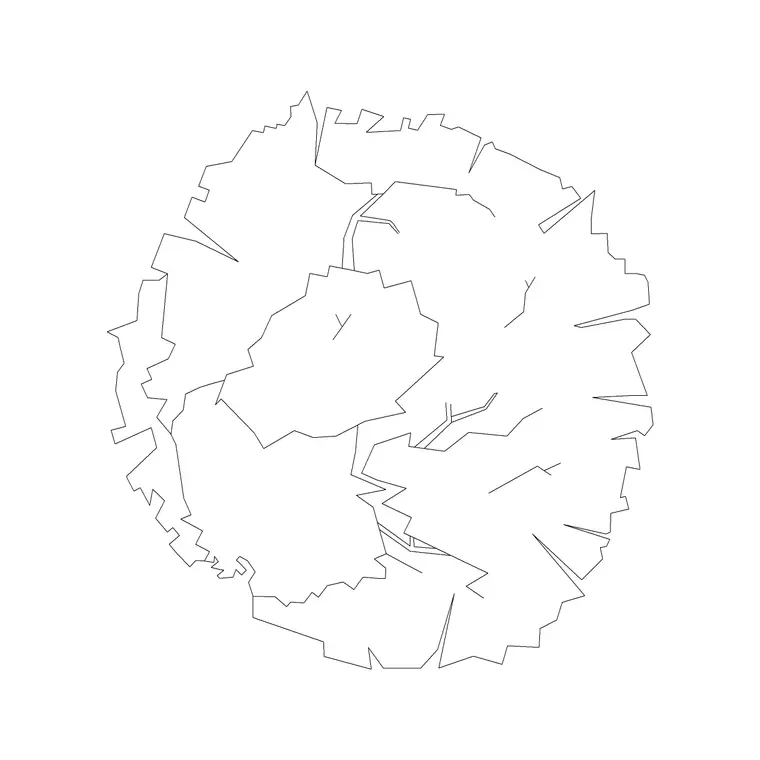
Planting on a site plan is rarely about a precise botanical specimen and almost always about communicating scale, shade, spacing and character. For that, free tree and plant blocks — plan canopies and elevation silhouettes — are more than enough. A landscape drawing reads as professional when the canopies are scaled honestly and the planting is varied, not because the blocks were paid for.
Our Trees & Plants category offers a deep set of free DWG planting blocks with no account and free commercial use, which covers site plans, masterplans, street elevations and sections. Paid botanical libraries exist, but the situations where they genuinely add value are narrow, and most landscape architects furnish the vast majority of their drawings entirely from free planting blocks plus their own variation.
Vet a free tree block in seconds
Trees need a slightly different check from furniture because scale carries so much meaning. First, the view: is it a plan canopy (top-down circle with texture) or an elevation silhouette (trunk and canopy in profile)? Match that to your drawing — a flat plan circle in an elevation is an instant tell. Second, the canopy spread: does it match a real size for the species role? Small ornamentals spread three to four metres, medium street trees six to eight, large trees ten to fifteen-plus. Third, cleanliness and layer: no stray geometry, ideally built on layer 0 so it inherits your planting layer.
A tree block that has the right view and a believable canopy is production-ready, free or paid. One stamped at an arbitrary size will quietly mislead everyone about shade and spacing, so it is worth dimensioning the canopy before you trust a planting layout to it.
When a paid botanical library helps
Paid planting content earns its cost in two mainly specialist cases. The first is when a project genuinely needs species-accurate representation — a detailed planting design or a presentation where particular tree forms, by species and at specific growth stages, must read correctly. Some paid libraries offer large, carefully drawn botanical sets organised by species that go beyond generic canopies.
The second is when you want rich rendered or 3D planting for visualisations rather than 2D plan and elevation symbols. For photoreal or model-based work, paid 3D plant libraries can save real time. But for the 2D planting plans, site layouts and elevations that make up most landscape documentation, generic free blocks plus deliberate variation produce results that are indistinguishable in practice from paid equivalents, and far cheaper.
Make free planting look designed
The thing that actually separates good planting from bad is not the source of the block but how you use it. The fastest way to make planting look fake is the copy-paste grid — one identical tree stamped at regular intervals. The fix costs nothing: use two or three different tree blocks in a planting area, rotate and mirror individual instances so no two match, and vary sizes within a sensible range for the species. Even small randomness reads as natural.
Keep planting on its own layer — or a few layers for trees, shrubs and groundcover — so you can produce a clean planting-only sheet and keep the busy canopy geometry off structural plans. Draw every canopy at its real mature or design-year spread so the drawing honestly shows overshadowing and screening. Done this way, free planting blocks carry a landscape drawing to a fully professional standard.
Build a small palette, not a giant collection
It is tempting to hoard hundreds of tree blocks, but planting reads better when you work from a small, deliberate palette. A handful of well-drawn species blocks — two or three plan canopies at different sizes, a couple of elevation silhouettes, a shrub and a groundcover — is enough to compose almost any planting plan convincingly, because realism comes from how you vary and arrange them, not from sheer block count. A free, curated palette beats a sprawling paid library you cannot navigate.
Keep that palette organised: separate plan and elevation versions clearly so you never drop the wrong view, name the files by species and size, and put planting on dedicated layers for trees, shrubs and groundcover. Blocks built on layer 0 inherit whichever planting layer you insert them onto. With a tidy free palette and the habit of rotating, mirroring and resizing instances, you can produce planting plans that read as designed — which is the whole game, and one that paid blocks do not win for you.
Bottom line on tree blocks
For nearly all landscape drawings, download free tree and plant blocks, vet each for view and believable canopy spread, and confirm the licence allows commercial use — which on this site it does, with no attribution. Spend the saved budget nowhere; the result is the same. Reserve paid botanical or 3D libraries for the genuinely specialist cases of species-accurate planting design or rendered visualisation.
The real craft is in application: right view, honest canopy spread, deliberate variation, and disciplined layering. Get those right with free blocks and your planting plans read as considered and professional. The format and the price are the smallest parts of getting a landscape drawing to look like a designed environment rather than stamped clip art.
Questions
Frequently asked
Are free tree CAD blocks good enough for landscape drawings?+
Yes, for almost all work. Planting communicates scale, shade and character, which free blocks do well when scaled to real canopy spread and varied. Confirm the licence permits commercial use.
When is a paid tree library worth it?+
When you need species-accurate planting for a detailed design or presentation, or rendered/3D plants for visualisations. For standard 2D plan and elevation planting, free blocks plus variation are indistinguishable in practice.
How do I make free planting look natural?+
Use two or three different tree blocks, rotate and mirror instances, vary sizes within a species range, and draw canopies at real mature spread. Avoid stamping one identical block in a regular grid.
Free downloads from this article

Free CAD block library
Download the blocks from this article — free, no signup