Free pantry & storage DWG files (and how to use them)
Find free pantry and kitchen storage DWG blocks, the larder and tall-unit sizes that work, and how to draw shelving and a walk-in pantry in your plan.
Saumyajit MaityUpdated 16 June 20264 min read
Finding pantry and storage blocks
Pantry and storage in a kitchen is drawn from cabinet and tall-unit blocks, so the Kitchen category is where you start. Grab the cabinet block — free to download as DWG, no account and free for commercial use — and use it to build larder units, tall storage and the shelving of a walk-in pantry. Storage is the family people most often under-provide on a plan, and it is exactly where a layout quietly fails when there is nowhere to put the food, the appliances and the everyday clutter of a real kitchen.
There are a few storage types to keep distinct. A tall larder cabinet is a full-height pull-out or shelved unit in the run; a pantry can be a dedicated tall cabinet or a small walk-in room off the kitchen; and base and wall cabinets provide the everyday storage. Drawing generous, well-placed storage is part of what separates a kitchen that works in real life from one that only looks tidy on paper.
Larder and tall storage dimensions
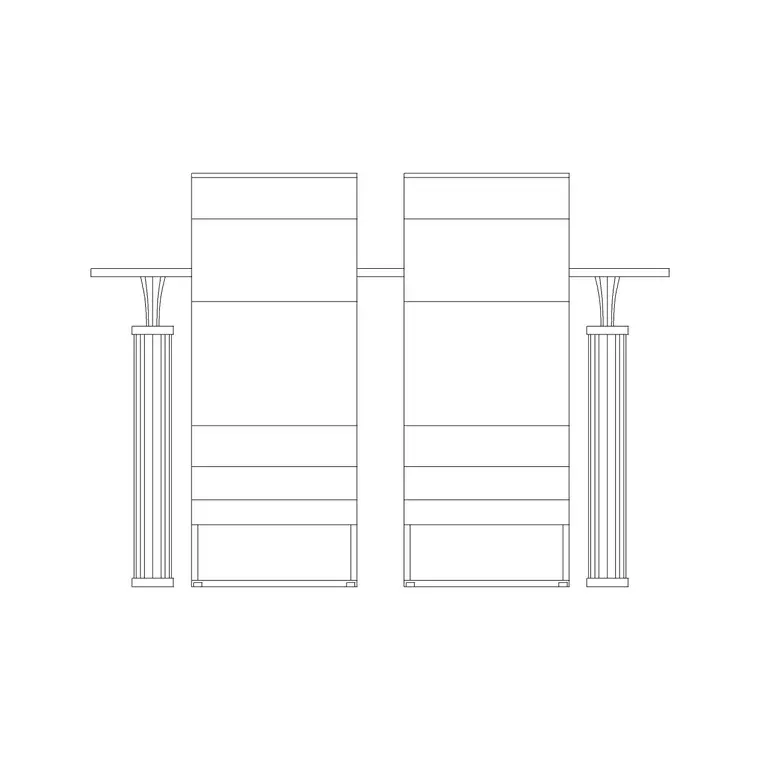
A tall larder cabinet matches the kitchen module: 600mm wide and 600mm deep, running the full height at around 2000–2100mm. Wider larders exist at 600mm twinned into a 1200mm bank. In plan a tall unit reads as a 600mm-deep rectangle like a base cabinet, but you label it as full-height storage so it is not mistaken for a worktop unit — and on the elevation it shows as a tall door or a stack of doors.
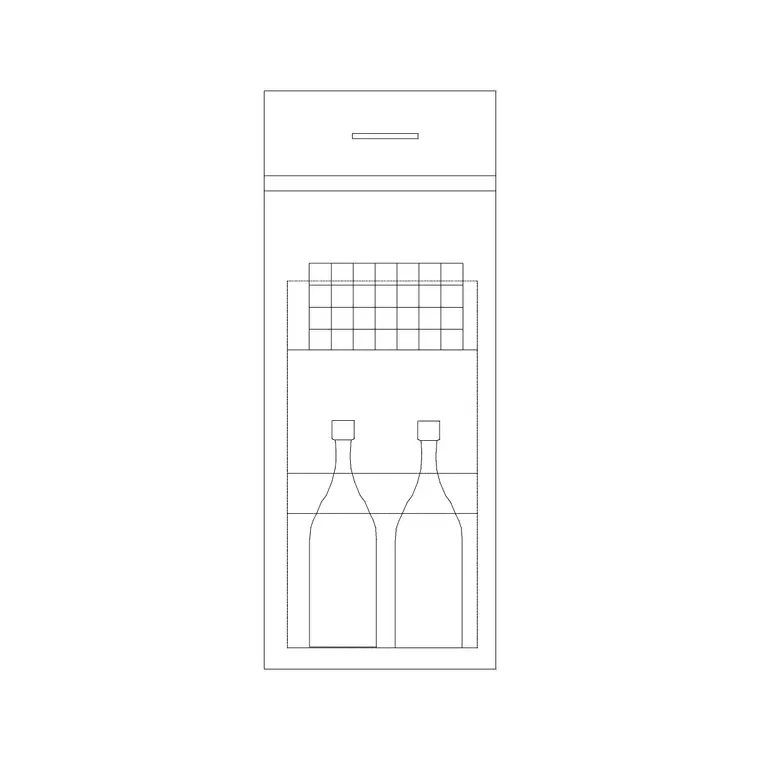
Internally, a larder might be drawn with shelf lines, or as a pull-out with the runners indicated, depending on how much detail the drawing needs. Wall cabinets at 300mm deep and base cabinets at 600mm deep make up the rest of the storage, and showing them honestly — a 300mm wall unit set back above a 600mm base — keeps the plan truthful about how much the storage projects into the room.
Building tall storage in the run
Place a tall larder by inserting the cabinet block, snapping its back to the wall and its side against the neighbouring units, and labelling it as a full-height larder. Group the tall units together where you can — larder, oven housing and fridge housing in a bank — so the run reads cleanly and the worktop cabinets are not interrupted by a lone tall unit breaking the counter line.
Keep all the casework on a single cabinets/joinery layer so the storage ties into the rest of the kitchen and can be styled or dimmed together. Because the blocks here are built on layer 0, set that layer current before inserting and every unit adopts it. A coherent bank of tall storage, drawn at the real 2000mm+ height on the elevation, is what gives the client confidence there is somewhere for everything to live.
Drawing a walk-in pantry
A walk-in pantry is a small room rather than a cabinet, and it is one of the most requested features in larger kitchens. Draw it as an alcove or small room off the kitchen, then line the walls with shelving. Represent the shelves in plan as a band of parallel lines set in from the wall — typically 300–400mm deep, which is the comfortable depth for reaching items at the back without losing them.
Leave a clear floor area in the middle for a person to stand and turn, at least 900mm wide if the pantry is single-sided and around 1000–1100mm if it has shelves on both sides so two people are not blocked. Show the door, and check it swings sensibly — outward into the kitchen is usual, so it does not foul the shelving. A sliding or pocket door is worth considering where a swing would be tight. A walk-in pantry drawn with honest shelf depths and standing room is far more useful than a vaguely labelled box, and it lets the client see exactly how much they will be able to store.
Scale checks and integrating the storage
Open the cabinet block on its own and confirm a unit reads 600mm deep before you build larders and tall storage from it. If it imports at metre scale, set INSUNITS to millimetres in both files or SCALE by 1000, and run AUDIT and PURGE to keep the parts clean.
Finally, integrate the storage with the working kitchen rather than treating it as an afterthought. A larder near the worktop and the fridge keeps food preparation efficient; a pantry off the cooking zone is most useful close to where meals are made. Check that the tall units and pantry door do not foul appliance doors or pinch the gangways you established for the rest of the layout. It is also worth labelling the storage clearly on the plan — larder, broom cupboard, appliance garage — so the function is obvious and the joiner fits out each unit correctly. Storage drawn at the right size, in the right place, and tied into the same layers as the cabinets is what makes a kitchen genuinely liveable — not just photogenic on the presentation sheet.
Questions
Frequently asked
What size is a tall larder unit in CAD?+
A tall larder matches the kitchen module — 600mm wide and 600mm deep — running full-height at around 2000–2100mm. Two can be banked into a 1200mm larder.
How deep should pantry shelves be?+
Typically 300–400mm, the comfortable depth for reaching items at the back. Leave at least 900mm of clear standing floor (1000–1100mm if shelved both sides).
How do I draw a walk-in pantry?+
As a small room or alcove off the kitchen, with shelving bands lining the walls, a clear floor for standing and turning, and a door that swings out into the kitchen clear of the shelves.
Free downloads from this article
Free CAD block library
Download the blocks from this article — free, no signup