Free cooktop & stove DWG files (and how to use them)
Find free cooktop, hob and stove DWG blocks, the burner layouts and 600mm module to expect, and how to place a cooktop with the hood it needs.
Sumana KumarUpdated 18 May 20264 min read
Finding cooktop and stove blocks
Cooktop, hob and stove blocks live in the Kitchen category. Search any of those terms — 'cooktop', 'hob', 'stove' or 'cooking range' — and you will reach the cooking-appliance blocks, free to download as DWG with no account and free for commercial use. The terminology varies by region (hob in the UK, cooktop in the US, stove or gas range elsewhere) but the block is the same idea: the cooking surface with its burners, so search whichever word comes naturally to you.
It is worth being clear about what you are drawing. A built-in cooktop is just the hob surface dropped into the worktop, with the oven separate below or elsewhere. A freestanding range or cooker is a single tall unit combining the hob on top and the oven beneath. Pick the block that matches the appliance you are actually specifying, because the two occupy the kitchen run very differently — a built-in hob sits in the worktop over a base cabinet, while a freestanding cooker takes a full slot of its own with a door on the front.
Burner layouts and the module to expect
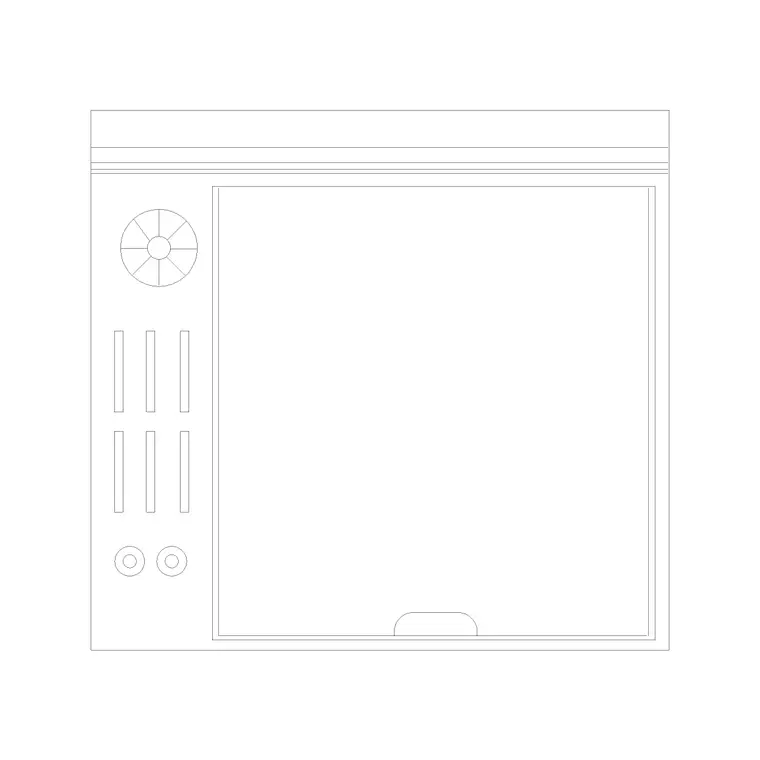
In plan a cooktop reads as a rectangle with circles or squares marking the burners or zones — four is standard, with five- and six-burner versions for larger kitchens. That burner pattern is the visual signature that tells anyone reading the drawing this is a hob, not a blank counter. A standard four-burner cooktop is around 600mm wide and 520–600mm deep, sitting in the same 600mm module as the base cabinets so it drops into the run cleanly.
Larger cooktops step up to 700, 900 or even 1100mm wide for five and six burners or a built-in griddle. A freestanding cooker is typically 600mm wide too, but reads as a full appliance in plan with the oven door on the front. For an elevation, the hob surface sits at the 900mm worktop line; a freestanding cooker shows its control panel and oven door down the front face.
Placing the cooktop in the run
Insert the cooktop with I and Browse, scale 1, rotation 0, and snap it into the worktop so its 600mm width aligns with the base cabinets either side. Convention is to keep clear worktop on both sides of the hob — at least 300mm, ideally 400mm — as a landing zone for hot pans, so position the adjacent cabinet blocks to leave that space. Do not push a cooktop hard into a corner or right against a tall unit; pans and handles need room.
Keep the hob away from the sink with a stretch of worktop between them — having wet and hot zones immediately adjacent is poor practice and a contractor will query it. A worktop run of at least 300mm, and ideally 400mm or more, between the sink and the hob is the usual guidance. Put the cooktop on your appliances layer; because the block is built on layer 0 it inherits whichever layer you make current before inserting, so set that first and it lands correctly.
Every cooktop needs a hood above it
The non-negotiable companion to a cooktop is extraction. A hob produces steam, heat and cooking smells, so it needs a range hood or chimney directly above it, and your drawing should show both. Drop the cooktop in plan, then place a range hood block centred over it on the same centreline, drawn at least as wide as the hob below — a hood narrower than the cooktop will not capture what rises off the outer burners.
Show the hood with a dashed (hidden) linetype on the plan if your office convention treats overhead items that way, since it sits above head height. On an elevation, the hood appears at its mounting height above the worktop. A cooktop drawn without its hood is an incomplete kitchen design that will come back at the services-coordination stage, so make the pairing a habit.
Scale checks and labelling the fuel
Open the cooktop DWG on its own and measure the width — a four-burner hob should read 600mm. If it comes in at 0.6 it is in metres; set INSUNITS to millimetres in both files or SCALE by 1000. If the units are unlabelled, divide the 600 you want by whatever the burner spread measures to get the exact factor. Run AUDIT and PURGE to keep the block clean before it enters your kitchen drawing.
Because a hob block looks broadly similar whatever its fuel, add a short text label stating the type — gas, induction or electric ceramic — and the number of burners. That note matters: a gas hob needs a gas supply and different clearances from an induction one, and the contractor reads the label, not your intention. Show the gas or electrical supply on the services layer to back the label up. With the right module, a centred hood and a clear label, the cooktop block does its job as the heart of the kitchen.
Questions
Frequently asked
What size is a standard cooktop block?+
A four-burner cooktop is about 600mm wide and 520–600mm deep — the same module as a base cabinet. Five- and six-burner versions step up to 700–1100mm.
Do cooktop and stove blocks need a range hood?+
Yes. Place a range hood at least as wide as the hob directly above it on the same centreline. A cooktop drawn without extraction is an incomplete kitchen design.
How much clearance goes beside a cooktop?+
Keep at least 300mm, ideally 400mm, of clear worktop on each side as a landing zone for hot pans, and keep the hob separated from the sink by a stretch of counter.
Free downloads from this article
Free CAD block library
Download the blocks from this article — free, no signup