Free DWG blocks for a kitchen layout — what to download
Build a kitchen plan from free DWG blocks: base and wall cabinets, sink, hob and appliances. What to download, the work-triangle rule, and how to insert it all.
Saumyajit MaityUpdated 30 April 20264 min read
A kitchen is mostly cabinets and appliances
Unlike a living room, a kitchen layout is driven by fixed runs of cabinetry and a handful of appliances that have to be plumbed, vented or wired. So the blocks you download are less about decoration and more about getting the modules right. Base cabinets, wall cabinets, a sink, a hob, an oven, a fridge and a worktop line — assemble those accurately and the kitchen plan is essentially done.
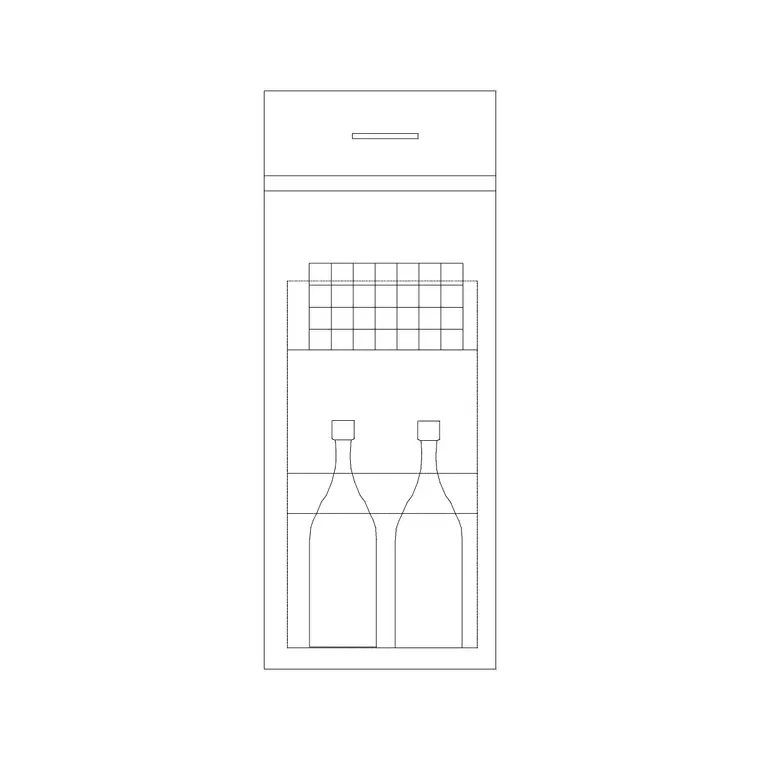
Every block here is a free DWG (and usually DXF), no login, straight to your Downloads folder. The Kitchen category is deep — hundreds of cabinet, sink and appliance blocks — so it is the single richest aisle for this job. Start by grabbing a cabinet block, since cabinetry forms the backbone that the sink and hob then sit within.
The download list for a working kitchen
A standard kitchen plan needs roughly this set:
- Base cabinet modules in 300, 450, 600 and 900mm widths, 600mm deep, to make up the bottom run. - Wall cabinet modules, usually 300 to 350mm deep, for the upper run. - A sink block dropped into its base unit — single or double bowl. - A hob / cooktop, typically 600mm for four burners. - An oven, a fridge footprint (about 600mm square), and optionally a dishwasher and washing machine at 600mm each. - A tall larder unit if the layout has one.
Grab a general cabinet block as your starting module and copy it along the run, then swap in the sink and appliance blocks where services allow. Worktop is usually just a continuous polyline 600mm off the wall, capping the base run.
Respect the work triangle as you place blocks
The reason to furnish a kitchen plan at all is to test the work triangle — the path between sink, hob and fridge, the three points a cook moves between constantly. As you insert the sink, hob and fridge blocks, keep each leg of that triangle within a sensible range (roughly 1.2 to 2.7m per leg) and make sure no leg is blocked by an island or a door swing.
Leave at least 900mm of clear floor in front of every run so drawers and the oven door can open and someone can stand at the counter, and widen that to about 1.2m in a galley where two runs face each other. Furnishing the plan with real cabinet and appliance blocks makes these clearances visible — you can literally see whether the fridge door fouls the route to the sink before anything is installed.
Mind the corners and the dead zones too. An L-shaped run loses usable cupboard space in the corner unless you allow for a carousel or a corner unit, and a hob should never sit hard against a return wall — leave a margin of at least 300 to 400mm beside it so a pan handle is not over a wall and there is somewhere to set a hot pan down. Placing the blocks at real size is what surfaces these problems early; a hob crammed into a corner is obvious on the plan but expensive to discover after the worktop is templated.
Inserting cabinet runs efficiently
Download your cabinet and appliance blocks, then INSERT the first base cabinet against a corner. Because the blocks are drawn at real size, keep scale at 1 — and if a block arrives wrongly sized, it is a units issue: align INSUNITS (millimetres here) or scale by 0.001 / 1000. Snap each successive module to the previous one's endpoint so the run stays gap-free, then drop the sink and hob into their positions along it.
A fast trick: once you have one base cabinet placed, use COPY or array along the run rather than re-inserting each time, then swap individual modules for the sink or a different width as needed. Put the whole kitchen on a dedicated layer so you can isolate it for a joinery sheet later. Keep the appliances on a sub-layer if you want to schedule them separately.
Finishing the kitchen sheet
Once the runs and appliances are in, add the worktop polyline, a tap symbol at the sink, and — if you are presenting it — a couple of bar stools at any island or breakfast bar. A pendant or two over an island from the Lighting category lifts a presentation plan. Dimension the cabinet widths and the critical clearances so the drawing reads as a buildable layout, not just a sketch.
If the kitchen is going to a joiner, it helps to show the unit module sizes as text on each cabinet, so the run reads as 300 plus 600 plus 900 rather than one undifferentiated counter. That makes the plan double as a rough cut list and lets you sanity-check that the modules actually add up to the wall length you have — a surprisingly common source of a redesign late in the day.
Because the catalogue is free for commercial use with no attribution, you can save your preferred cabinet module, sink and appliance blocks as a personal kitchen kit and reuse them across every job. That is the real time-saver: the second kitchen you draw is far faster than the first, because you are inserting trusted blocks rather than hunting for them.
Questions
Frequently asked
What blocks do I need for a kitchen layout?+
Base and wall cabinet modules, a sink, a hob, an oven, a fridge footprint and optionally a dishwasher and tall larder — all free in the Kitchen category in DWG and DXF.
What clearance should I leave in front of kitchen cabinets?+
At least 900mm of clear floor so drawers and the oven door open and someone can stand at the counter; about 1.2m in a galley where two runs face each other.
How do I keep a cabinet run gap-free in AutoCAD?+
Snap each cabinet module to the previous one's endpoint with object snaps, or place one and COPY it along the run, then swap in the sink and appliance blocks.
Free downloads from this article

Free CAD block library
Download the blocks from this article — free, no signup