10 must-have furniture CAD blocks for floor plans in 2026
The furniture blocks that turn an empty plan into a readable, sellable layout — sofas, beds, dining sets, desks and more — plus the real-world dimensions to look for in each.
Saumyajit MaityUpdated 25 May 20268 min read

Why furniture blocks earn their keep
A floor plan with furniture reads instantly. A client sees a home, not a set of walls, and that emotional shift is often what wins the work. Furnishing a plan also forces you to test it: does the sofa actually fit, can a door swing past the bed, is there real clearance around the dining table for chairs to pull out?
Keeping a small, trusted set of furniture blocks on hand means you can lay out a room in minutes and catch circulation problems before they reach a wall — when they are still cheap to fix. Below are ten families worth having in every architect's and interior designer's kit, each with the real-world dimensions you should be able to measure on the block. If a downloaded block does not match these, it is mis-scaled and worth correcting before you rely on it.
1–3: Seating — sofas, armchairs, dining chairs
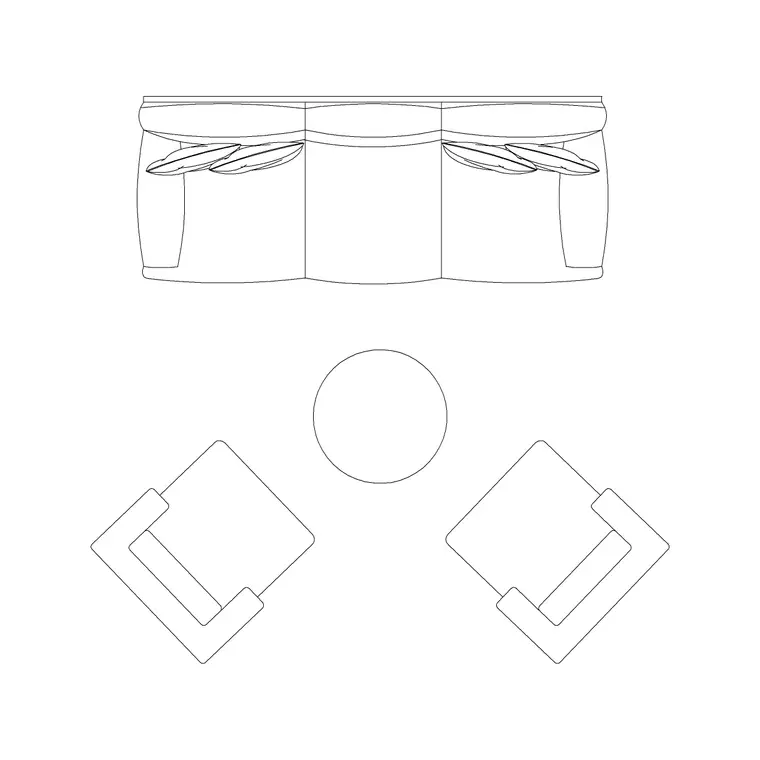
Seating is where a living space comes to life on the page. A two-seater sofa is roughly 1500 by 900mm and a three-seater around 2100 by 900mm; armchairs sit near 850 by 850mm. Dining chairs are about 450 by 450mm at the seat, but plan for roughly 600mm of footprint each once someone is sitting in them and the chair is pulled out.
Grab plan-view versions of each so they read correctly from above. Our furniture category has clean two-person and three-person sofa blocks that drop straight into a living-room layout, plus armchairs to anchor a reading corner. With just these three seating types you can furnish the social heart of almost any residential plan and immediately communicate how the space is meant to be used.
4–5: Tables — dining and coffee
Tables set the rhythm of a room. A four-person dining table is typically 1200 by 800mm, with round versions around 1100mm in diameter; a six-person table runs about 1800 by 900mm. Coffee tables are smaller, around 1100 by 600mm, and pair naturally with the sofas above.
The critical move with any dining table is to keep at least 900mm of clear circulation around it so chairs can pull out and people can pass behind seated diners. A furnished block makes that gap visible at a glance — you can literally see whether the table crowds the route to the kitchen. Both round and rectangular dining sets are in the catalogue, so you can match the table shape to the room's proportions.
6–7: Beds — single and double
Bedrooms live or die on clearances, so accurate bed blocks matter. A single bed is 900 by 1900mm, a double 1350 by 1900mm, a queen 1500 by 2000mm and a king 1800 by 2000mm. Always allow about 600mm on at least one long side for access and a bedside table; two-sided access is better where the room allows it.
A good bed block includes pillows and a turned-down throw line so the plan reads as a bedroom instantly, rather than as a plain rectangle that could be anything. That small amount of internal detail does a lot of communicative work, helping a client picture the room and helping you confirm the bed actually fits with the wardrobe and the door swing all coexisting.
8–9: Desks and office furniture
Whether you are laying out a home study or a full office floor, desks anchor the work zones. A standard desk is 1200 to 1600mm wide by 600 to 800mm deep, and an office chair needs around 600mm of swing clearance behind it so it can roll back.
For shared and commercial layouts, the office category has multi-seat meeting and conference tables — round, rectangular and curved — sized for eight to ten people. These are a huge time-saver, letting you fit out an open-plan floor or a boardroom without drawing each table from scratch. Place the conference block, confirm the surrounding circulation, and the meeting room is done in a single insertion rather than a tedious manual build.
10: Storage — wardrobes and shelving
Storage is the family people forget, and it is exactly where layouts quietly fail. Wardrobes are commonly 600mm deep with widths in 600mm modules; bookshelves are around 300mm deep. Showing storage on a plan matters more than it first appears — a 600mm-deep wardrobe placed without thought can eat the clearance a doorway needs, and you will only notice if the wardrobe is actually drawn.
Round out your kit with a couple of storage blocks and you can furnish virtually any residential plan from this handful of trusted pieces: seating, tables, beds, desks and storage. Master these ten families, keep them correctly scaled, and you will rarely need to draw a piece of furniture by hand again — you will simply insert, check the clearances, and move on.
Questions
Frequently asked
What size is a standard sofa block for a floor plan?+
A 2-seater is about 1500x900mm and a 3-seater about 2100x900mm in plan. Always verify the block measures these before relying on it for clearances.
How much clearance should I leave around a dining table?+
Aim for at least 900mm of clear space on each side so chairs can pull out and people can pass behind seated diners.
Where can I download these furniture blocks free?+
All ten families are in the Furniture and Office categories on CADBlockDWG, free in DWG and DXF with no signup.
Free CAD block library
Download the blocks from this article — free, no signup