Bathtub CAD block sizes & dimensions explained (free)
Standard, corner, oval and freestanding bath sizes in plan, plus the clearances a tub needs — and where to download free DWG bathtub blocks at the right scale.
Sumana KumarUpdated 15 April 20264 min read
Bath blocks are mostly a plan-view family
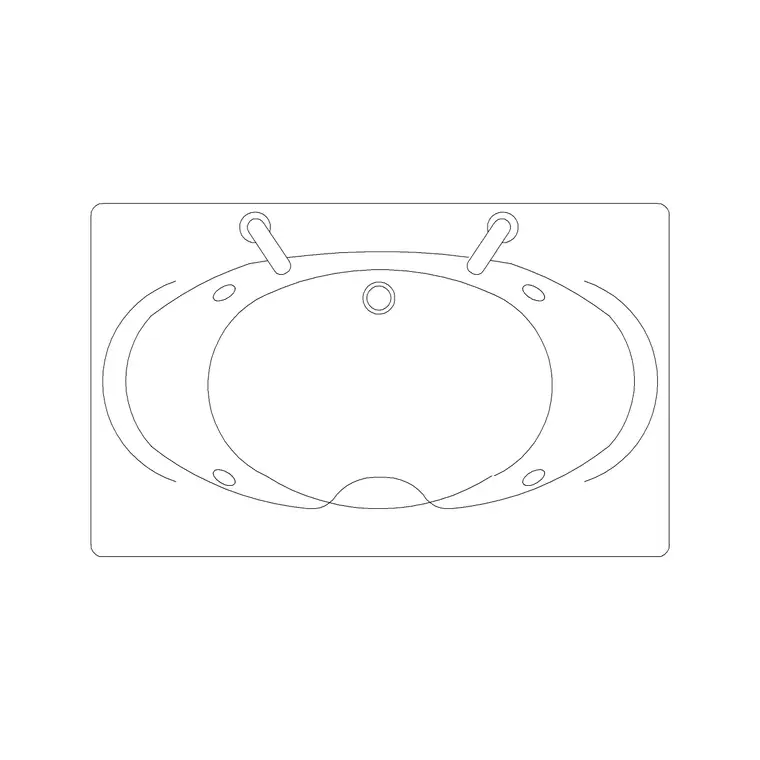
Most bathtub blocks you will use are plan views — the top-down outline of the tub, often with the tap position and sometimes the internal bathing well drawn inside the rim. That is because the bath's job on a drawing is usually about fit: does this tub size suit the room, and is there space to stand beside it and clean around it? The Bathroom category carries a wide spread of bath shapes, from rectangular to oval, corner, round and curved.
The Bath Oval Shape block is a good example of a non-rectangular tub where the plan outline genuinely matters — an oval bath occupies its space differently from a rectangle and needs more width at the centre. When you pick a bath block, start from the room: a small bathroom usually takes a standard rectangular tub against a wall, while a larger space can carry an oval or freestanding bath as a centrepiece. The plan outline is what tells you which will fit.
Standard bath sizes by shape
Use these plan footprints as your scale check:
- Standard rectangular bath: 1700 x 700mm is the most common size worldwide; compact baths are 1500 x 700mm and small-space tubs go down to 1200mm. - Larger rectangular: 1800 x 800mm for a more generous soak. - Corner bath: typically 1200-1500mm along each wall, fitting into a 90-degree corner and freeing the rest of the room. - Oval / freestanding: around 1700 x 800mm overall, but the widest point is at the centre and it needs clear space all around rather than sitting against walls. - Round bath: 1500-1800mm in diameter, a large-room luxury.
Bath height (rim above floor) is about 500-600mm and only shows in elevation or section. For the plan, length and width govern the layout, so those are what you measure to verify a downloaded block is at the right scale.
One practical point on the standard 1700 x 700mm tub: if it doubles as a shower (an over-bath shower is common in smaller bathrooms), the bather stands at the tap end, so keep that end away from a sloping ceiling and make sure there is full standing headroom of about 1900-2000mm above the rim. The internal bathing well is also narrower than the overall outline — the rim and apron take up 50-80mm each side — so the usable width inside a 700mm bath is more like 500-550mm. Drawing the real outline, rather than assuming the full 700mm is bathing space, keeps your expectations of comfort honest, especially in compact 1500mm tubs where every centimetre counts.
Freestanding vs built-in — different clearance logic
Whether a bath sits against walls or stands free changes how you space it. A built-in rectangular tub usually tucks into an alcove or against one or two walls, so you mainly need clear access along the open long side — about 700-900mm to kneel, wash a child or get in and out. A freestanding or oval bath is meant to be seen and approached from more than one side, so it needs a clear margin all around, ideally 150-200mm minimum off any wall just to clean behind it, and much more if it is a feature.
Because the bath block shows the true outline, you can test this directly: drop a freestanding oval into a tight room and you will see immediately that it strands itself against the walls and loses its whole reason for being. Switch to a built-in rectangular tub and the same room works. The block lets you make that call honestly rather than discovering the problem after the tiling is set out.
Downloading and inserting a bath block
Open the Bathroom category, choose the bath shape and size that suit the room, and download the free DWG (no signup; DXF where supported). Insert the plan block and snap it into position — against a wall for a built-in tub, or freely placed with clearances for an oval or freestanding one. Note the tap end and orient the tub so the taps reach the supply wall.
These blocks are drawn at real-world size, so insert at scale 1 in a millimetre drawing, or set INSUNITS / scale by 0.001 in a metre drawing. Verify by dimensioning the length: a standard tub should read about 1700mm. Put the bath on a "Sanitary" or "Bathroom" layer (the block is built on layer 0, so it inherits it) so the sanitaryware reads as a set and can be isolated for plumbing drawings.
Assembling a complete bathroom
A bath rarely sits alone, so the real test is how it co-exists with the WC, basin and any shower. Lay them out together using correctly scaled blocks and check the circulation between them: can someone reach the basin while the bath is in use, does the WC door swing clear, is there a towel-drying spot? A 1700mm bath plus a basin and WC is a tight fit in a 1700 x 2100mm bathroom and comfortable in a 2000 x 2400mm one.
Because every fixture block carries its true footprint, you can assemble the whole room from a handful of free downloads and trust that what reads as workable on the plan will be workable in tiles and plumbing. That is the quiet advantage of dimensionally honest blocks: the bathroom you draw is the bathroom you can build, clearances and all.
Questions
Frequently asked
What is the standard size of a bathtub?+
1700 x 700mm is the most common rectangular bath worldwide. Compact tubs are 1500 x 700mm and larger ones 1800 x 800mm; corner baths run 1200-1500mm along each wall.
How much space does a freestanding bath need?+
A clear margin all around — at least 150-200mm off any wall just to clean behind it, and more if it is a feature, since it is meant to be approached from several sides.
Are the bathtub blocks free and to scale?+
Yes — the bath blocks in the Bathroom category are free DWG downloads drawn at real-world size, no signup, free for commercial use.
Free downloads from this article
Free CAD block library
Download the blocks from this article — free, no signup