20 best free bathroom CAD blocks to download in 2026
Twenty free bathroom DWG blocks for 2026 — WCs, basins, baths, showers and vanities — with the fixture sizes and clearances a sanitary plan needs.
Sumana KumarUpdated 20 March 20264 min read
Why bathroom blocks are about clearances
A bathroom is one of the smallest, most code-driven rooms you will draw, and it is almost entirely about clearances: the activity space in front of a WC, the door swing that must not foul the basin, the turning circle an accessible layout demands. So accurate sanitary blocks matter more here than almost anywhere else. Every block in this roundup is free, available as DWG, needs no signup, and can be used commercially.
The 20 below are grouped by fixture type, which is how a bathroom plan gets built: the WC and bidet, the basins, the bath, the shower, and the storage and finishing pieces. Browse them in the bathroom category, where each fixture shows a plan thumbnail. As always, the discipline that protects your drawing is to measure what you download — a WC pan should read about 700mm deep, a basin about 550 by 450mm — and confirm it before you rely on the clearances around it.
WCs and bidets (1–5)
The WC sets the rest of the room. A close-coupled pan is roughly 700mm deep by 360 to 400mm wide, and needs about 600mm of clear activity space in front and 200mm either side of the centreline. Wall-hung and back-to-wall variants save floor depth and read cleaner on the plan. A bidet, where specified, sits beside the WC at a similar footprint and wants its own activity space.
Five blocks cover this zone: a close-coupled WC, a wall-hung WC, a back-to-wall pan, a bidet, and a compact cloakroom WC for a powder room. Insert each against the wall it serves, then draw the activity rectangle in front so the plan proves the fixture is usable rather than merely present. Keeping these on a sanitary layer lets you check the room against the architecture without the fixture geometry cluttering a structural sheet.
Basins and vanities (6–11)
Basins range widely, so the block you pick changes the plan. A pedestal or wall-hung basin is about 550 to 600mm wide by 400 to 450mm deep; a countertop or vanity basin sits within a unit 600 to 1200mm wide. Leave roughly 700mm of standing space in front and around 200mm clearance to any side wall so the basin is comfortable to use. An oval or counter-set bowl reads differently in plan from a rectangular one, so match the shape to the design.
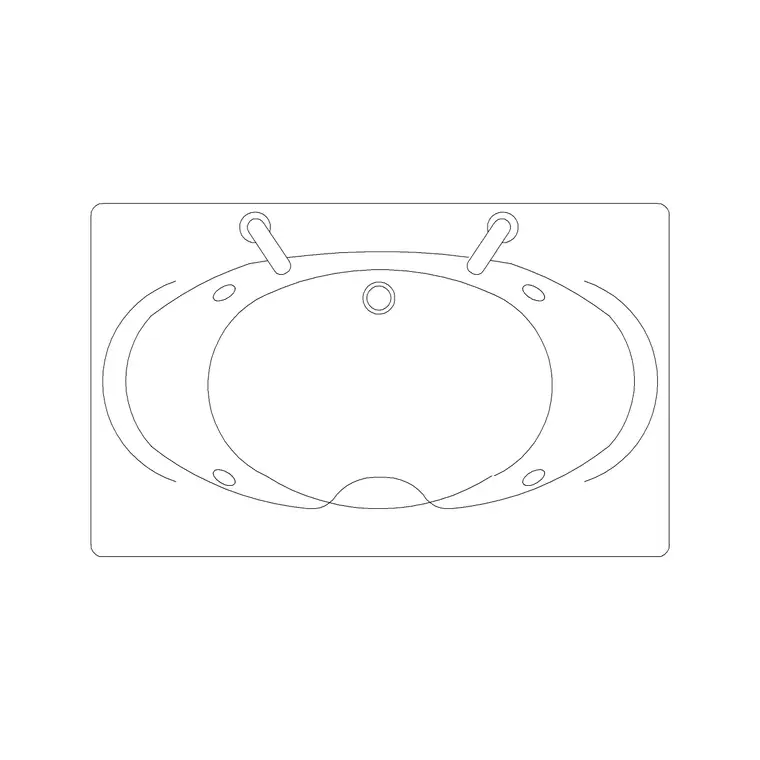
Six blocks handle washing: a pedestal basin, a wall-hung basin, an oval countertop basin, a single vanity unit, a double vanity for a shared ensuite, and a compact corner basin. The oval-shape bath-and-basin family on this site is a useful reference for the curved plan profiles. Insert the basin centred on its run, draw the standing space, and you have proved the layout works before a wall moves.
Baths and showers (12–17)
The bath is the largest fixture and dictates the room's proportions. A standard rectangular bath is 1700 by 700mm; compact baths run 1500 by 700mm, and corner and oval baths take a larger footprint but soften the plan. Allow about 700mm of clear access along the open side. A shower tray is commonly 800 by 800mm, 900 by 900mm or 1200 by 800mm for a walk-in; draw the tray and the enclosure line so the plan shows the door or opening.
Six blocks cover bathing: a standard rectangular bath, a compact bath, a corner bath, an oval bath, an 900-square shower tray and a 1200 walk-in tray. The oval-shape bath block is a clean, ready-to-place plan profile for the curved option. Place the bath first in a small bathroom because everything else negotiates around it, then fit the WC, basin and shower into what remains, checking each activity space as you go.
Storage, fittings and downloading the set (18–20)
Finish with the pieces that make the room real: a tall storage or linen unit, a heated towel rail (commonly 500 to 600mm wide), and a mirror cabinet over the basin. Three blocks bring the set to 20 and let you draw a complete, usable bathroom — sanitaryware, bathing, and storage — from one trusted collection rather than redrawing fixtures on every project. If the brief is an accessible bathroom, the same fixtures still apply but the clearances grow: an accessible WC needs a generous transfer space to one side, and the room as a whole has to accommodate a clear turning circle, which the drawn fixtures let you test honestly.
Downloading is friction-free: open the bathroom category, click the fixture, and grab the DWG or DXF, no account needed. Insert each fixture with INSERT at scale 1, snapping the base point to the wall face it sits against, and keep the whole room on a sanitary layer. If your fixtures come in the wrong size it is almost always a units mismatch — set INSUNITS consistently, or scale by 0.001 (mm into a metre drawing) or 1000 the other way — and the plan will read at real size every time.
Questions
Frequently asked
What size is a standard WC block in plan?+
A close-coupled WC pan is about 700mm deep by 360 to 400mm wide and needs roughly 600mm of clear activity space in front. Measure the block after downloading to confirm it matches before relying on the clearance.
What are the standard bath dimensions for a CAD plan?+
A standard rectangular bath is 1700x700mm; compact baths are 1500x700mm. Allow about 700mm of clear access along the open side, which a drawn block makes easy to check.
Are the bathroom CAD blocks free to download without signup?+
Yes. The bathroom category on CADBlockDWG offers WCs, basins, baths and showers free in DWG and DXF, with no login and full commercial use.
Free downloads from this article
Free CAD block library
Download the blocks from this article — free, no signup