How to scale a downloaded door block to the right width
Door blocks come at a nominal width like 900mm — but your opening may differ. Here is how to scale a free DWG door to the exact width you need in AutoCAD.
Saumyajit MaityUpdated 6 June 20264 min read
Doors are sized by leaf width
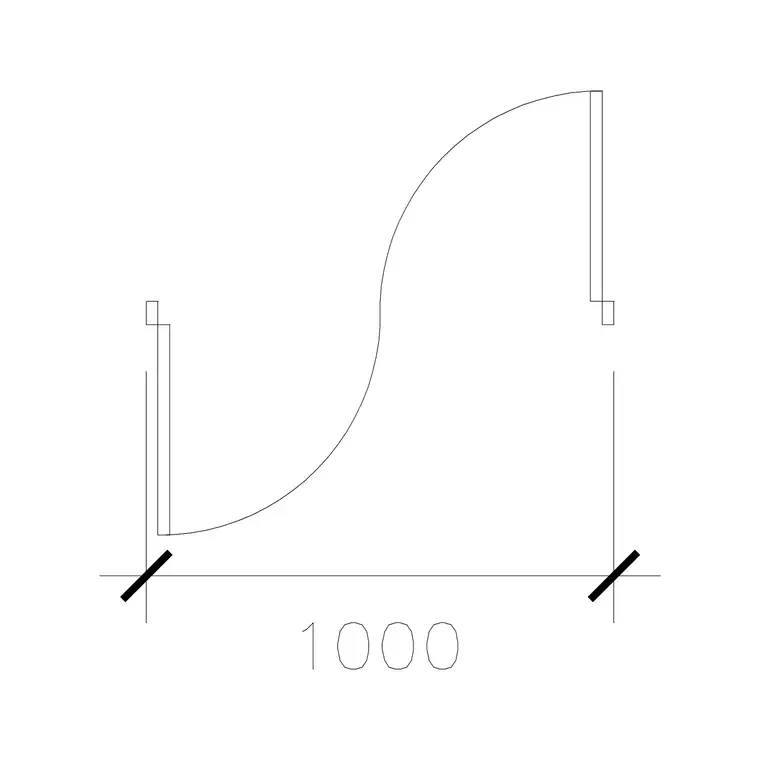
A door block is defined by one number above all others: the leaf width, measured at the opening. Common residential widths are 750, 800, 900 and 1000mm; bathrooms and utility doors are often narrower, main entrances and accessible doors wider. The free 1000 Mm Door Type 1 block in the Doors category is, as the name says, a 1000mm single-leaf door drawn in plan with its swing arc shown. Download it as DWG (no signup, free for commercial use) and you have a clean, correctly proportioned door to fit straight into a wall.
The key insight with doors is that you rarely want to free-scale them by an arbitrary factor — that distorts the leaf thickness and the frame. Instead you scale to hit a specific target width, keeping the door's proportions intact, which is exactly what the methods below do. A door's swing arc is also a clearance tool, so getting the width right is not cosmetic: it changes whether the open leaf fouls a fixture, a wall or another door.
Decide: re-scale or grab the right size
Before scaling, ask whether you even need to. This library lists doors at several nominal widths, so if you need an 800mm door, the cleanest route is often to download the 800mm block rather than shrink the 1000mm one. A block drawn at the target width has correct leaf thickness and frame detail with no distortion at all.
Scale when the width you need is non-standard — say a 950mm opening — or when you already have the 1000mm door in your drawing and do not want to fetch another file. In those cases, scaling the existing door to the exact opening is faster than hunting for a perfect match. Just be aware that uniformly scaling a door also scales its leaf thickness slightly, which is invisible at plan-drawing scales but worth knowing if you are working at large detail scales where a few millimetres of leaf thickness would actually show.
Scale to an exact opening width with Reference
To take the 1000mm door down to a 900mm opening, the Reference option is the precise tool. Type SCALE, select the door, pick a base point at the hinge side of the opening, type R for Reference, then click from the hinge jamb to the strike jamb to tell AutoCAD the current opening width (1000). Finally type 900 and the whole door — leaf, swing and frame — resizes to a true 900mm opening, anchored at the hinge.
Anchoring at the hinge matters: it keeps the hinge edge fixed so the door still aligns with the wall you drew it against, and only the strike side moves in. If you instead want the door centred in the opening, pick the centre of the opening as the base point before running Reference. This is the same technique you would use to take a 900mm door up to a 1100mm accessible door — pick the jambs, state the current width, type the new one, and the proportions follow the size faithfully.
Fix a door that came in at the wrong units
If the door inserts absurdly large or vanishes, that is a units mismatch, not a width problem. A door drawn in millimetres dropped into a metre drawing is 1000 times too big; the reverse makes it a near-invisible speck. Correct the units first, then worry about width.
The durable fix is INSUNITS: set it to 4 (millimetres) in your template so millimetre door blocks auto-scale on insertion. If a legacy door is unitless and will not auto-scale, insert it and apply a plain factor — 0.001 to bring millimetres into a metre drawing, 1000 the other way — and only then use Reference to dial in the precise leaf width. Doing units first and width second keeps the two corrections from tangling together, which is the single most common reason people get stuck: they try to fix an apparent width problem that is really a units problem, and the numbers never come right until the units are sorted.
Seat the door cleanly in the wall
With the width right, placement is about snapping accurately. Use object snaps (F3) to lock the hinge point onto the jamb so the swing arc sits inside the opening, not floating near it. Most door blocks are drawn so the leaf shows open at 90 degrees, which is the convention for reading clearances — you can see at a glance whether the door fouls a fixture or another door swing.
Keep doors on a sensible layer (often the wall or a dedicated 'Doors' layer) so they plot with the right lineweight, and because the block inherits its host layer, setting that layer current before insertion does the work for you. Get into the habit of confirming leaf width against the opening you drew, and your plans will always show honest, code-checkable clearances. The same width discipline carries straight over to windows, where the block has to match the structural opening just as precisely, so a tidy door workflow tends to make your window workflow tidy too.
Questions
Frequently asked
How do I change a door block to a different width?+
Use SCALE with the Reference option: pick the hinge and strike jambs to set the current width, then type the width you want (e.g. 900). The door resizes to that exact opening without distorting its proportions noticeably.
Should I scale a 1000mm door or download an 800mm one?+
For standard sizes, download the block already drawn at that width for correct leaf and frame detail. Scale the 1000mm door only for non-standard openings or when it is already in your drawing.
Why does my door block come in far too big?+
Units mismatch — a millimetre door in a metre drawing is 1000x oversized. Set INSUNITS to millimetres so it auto-scales, or scale it by 0.001, then set the exact width.
Free downloads from this article
Free CAD block library
Download the blocks from this article — free, no signup