How to insert a downloaded door block in AutoCAD
Insert a free door DWG into your wall openings — placing it at the hinge, getting the swing direction right, and matching the door width to the opening.
Saumyajit MaityUpdated 17 May 20264 min read
Download the right door width
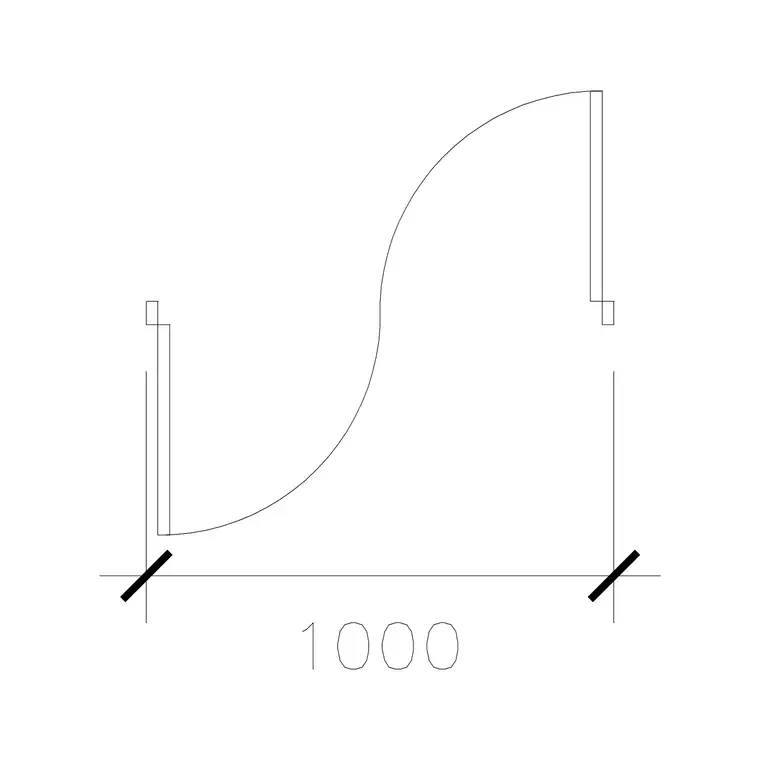
Doors are sized by the opening they fit, so start by knowing your gap. In the Doors category you will find blocks named by nominal width — 700, 800, 900, 1000mm and so on — each drawn in plan as the leaf plus its swing arc. Open the size that matches your wall opening and download the DWG. It is free, needs no login, and is cleared for commercial use.
A plan door block has three readable parts: the door leaf (a single line or thin rectangle), the quarter-circle swing arc showing where the door sweeps, and the jamb position where it meets the wall. That swing arc is doing real work — it tells anyone reading the drawing which way the door opens and how much floor space it claims, which is exactly what you need to check clearances against furniture and other doors.
Insert it into the wall opening
In your plan, type I and Enter to open the Blocks palette, Browse to the downloaded door DWG, and select it. Before you click to place, turn on object snaps with F3 — a door has to land precisely on the jamb, not floating near it. Most door blocks use the hinge point or a jamb corner as their base point, so snap that to the corner of your wall opening.
Leave scale at 1 if you downloaded the correct nominal width; the block is already drawn to that real-world size. Click to place. The leaf should sit in the opening and the swing arc should sweep into the room. If the opening in your wall is not yet cut, place the door first, then use it as a guide to TRIM the wall lines back to the jamb so the door reads as a real opening rather than a symbol stuck on a solid wall.
Get the swing direction right
Door swing is the detail people get wrong most often, and it matters: a door that opens the wrong way can clash with a light switch, a wall, or another door. AutoCAD gives you two mirror axes to play with. Use MIRROR to flip the door left-to-right (changing which side the hinge is on) and again top-to-bottom (changing whether it swings into or out of the room).
Between rotation and two mirrors you can achieve all four standard hand/swing combinations from a single block, so you never need four separate files. Place the door, look at where the arc lands, and mirror until the swing is into the space you intend and the hinge is on the correct side. A quick rule: the door should not swing into the path of circulation or onto another opening — if the arc overlaps a corridor or a second door, flip it.
Match the width if it is non-standard
If your opening is an odd width that no downloaded block matches exactly, you do not have to redraw the door. Insert the nearest standard size, then stretch it to fit. The cleanest method is to insert with a non-uniform scale: during INSERT, untick uniform scale and set the X factor to (your width ÷ the block's nominal width) while leaving Y at 1, so the leaf and arc widen without changing the leaf thickness.
Alternatively, place the standard door and use STRETCH with a crossing window over the latch side to lengthen the leaf and arc to the new jamb. Either way, draw a DIST across the finished leaf afterwards to confirm it reads the width you wanted. Keep in mind the difference between nominal and actual sizes — a '900 door' leaf is often a touch under 900mm once frame and clearances are accounted for, so measure against the real opening, not the label.
Layer and final checks
Put doors on a doors (or openings) layer so they can be controlled separately from walls and furniture. As with most blocks here, doors built on layer 0 inherit whatever layer is current when you insert, so set your doors layer current first and the block adopts it. If it arrived on the wrong layer, select and move it.
Finish with three quick checks. One: the swing arc does not collide with another door, a wall return, or a fixture. Two: the leaf width matches the opening. Three: the door sits flush in the jamb with the wall trimmed back, not pasted over a solid wall. Get those right and the door reads correctly to a builder and to anyone checking accessibility clearances on the plan.
Repeat doors across the plan efficiently
Most buildings have many doors of the same size, so once you have one placed and swinging correctly you can reuse it across the whole plan instead of re-inserting from the file each time. The quickest route is to keep your most-used door widths on a Tool Palette: drag the placed door onto a palette once, and from then on every internal door is a single click followed by a snap to the opening.
For identical doors in a repetitive layout — a hotel corridor, a row of offices, an apartment block — place one door, then COPY it to each opening, mirroring the swing per door so each leaf opens into its own room sensibly. Because they are all instances of one block, you can change every door in the building at once by redefining the block: swap a single-leaf for a vision-panel door, say, and the whole plan updates. That single-source behaviour is exactly why inserting doors as blocks beats drawing each one by hand.
Questions
Frequently asked
How do I change which way a downloaded door swings?+
Use MIRROR. Flipping the door left-to-right moves the hinge side; flipping it top-to-bottom changes whether it swings into or out of the room. Two mirrors plus rotation give you all four standard combinations.
My opening is a non-standard width — do I need a different door block?+
No. Insert the nearest size and set a non-uniform X scale (your width ÷ the block's nominal width), or use STRETCH on the latch side to widen the leaf and arc to fit.
Where is the insertion point on a door block?+
Most plan door blocks use the hinge point or a jamb corner as the base point. Snap that to the corner of your wall opening with object snaps (F3) on for an exact fit.
Free downloads from this article
Free CAD block library
Download the blocks from this article — free, no signup