Where to find free standing people DWG files (and how to use)
Free standing people DWG files for elevations and sections. Where to find them, why front-view figures suit face-on drawings, and how to place and scale them.
Saumyajit MaityUpdated 28 March 20265 min read
What standing figures are for
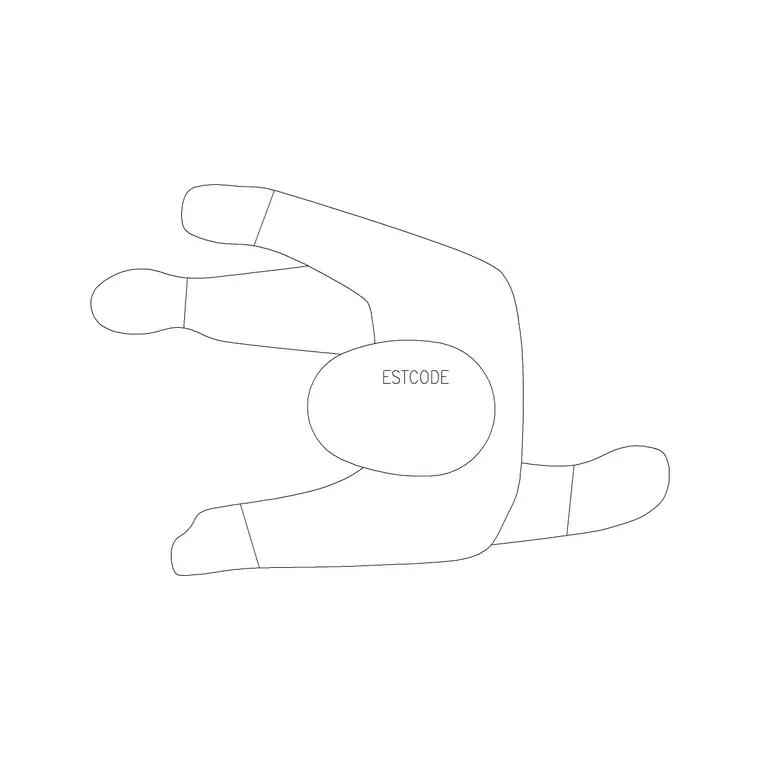
A standing person, drawn front-on at full height, is the workhorse scale figure of any face-on drawing. On a street elevation it gives the facade a believable height. In a section it shows the headroom and the relationship between floors. In a presentation perspective it adds life and tells the viewer, instantly, how tall the doors and windows really are. Where a plan figure is the symbol you look down on, a standing figure is the silhouette you look straight at.
The standing people on this site are free standing people DWG files, supplied as DWG with no signup and free for commercial use. They are part of the wider People category and are exactly the figures you line up along an elevation or scatter through a perspective. Because they carry no licensing strings, you can populate a client's presentation drawing with them without a second thought.
Where to find them
Open the People category from the main navigation. It gathers every figure on the site, and the search box is the fastest way to the upright ones. Try "standing", "elevation" or "human figure" and the front-view people surface; you will also find seated, walking and family figures nearby if you want to mix poses.
Every figure has its own page with a preview image, the DWG format and a download button — no cart, no email gate, one click to your Downloads folder. Because a convincing elevation needs variety, grab several different figures in one session: a couple of upright adults, perhaps a walking figure and a seated one, so that when you line them along a facade no two are identical. A small library of varied standing people, kept in a personal folder, pays off on every elevation you draw afterwards.
Why front-view figures suit elevations
The reason to use a standing front-view figure on an elevation is the same reason you would not use a plan figure there: the view has to match. An elevation is drawn as if you stood directly in front of the building with no perspective, so the people in it must also be drawn front-on, standing upright on the ground line. A plan figure — the top-down blob — dropped into an elevation reads as an obvious error.
Set each figure's feet on the same ground line as the building so the heights line up honestly. A standing adult at roughly 1.75 metres next to a 2.1-metre door immediately tells the viewer the door is a little taller than head height, which is exactly the scale information an elevation exists to convey. Match the view, anchor the feet, and the figures do their job.
Insert, place and scale
Download the figure, then in your drawing type INSERT (shortcut I), Browse to the DWG in the Blocks palette, and place it with the insertion point on-screen. Snap the figure's feet to the ground line, keep scale at 1 and rotation at 0, and click. For a row of people along a facade, place one and copy it along, then swap in different figures so the line is not a row of clones.
A standing adult should measure about 1.7 to 1.8 metres tall. If a figure inserts oversized or invisible, the cause is units, not the block — keep INSUNITS consistent so AutoCAD auto-scales, or run SCALE by 0.001 to bring a millimetre figure into a metre drawing. Dimension head to toe to confirm it reads about 1750mm. Drop your favourite figures onto a Tool Palette and placing them along an elevation becomes a quick series of clicks.
Spacing and overlap for a natural look
An elevation populated with people looks real when the figures are arranged the way people actually stand — not evenly spaced like fence posts. Cluster two or three near an entrance, leave a gap, place a lone figure further along. Let some overlap slightly, with a nearer figure partly in front of one behind, which reads as depth even on a flat elevation.
Vary heights a little — an adult, a shorter figure, a child where it suits — and mirror some so they do not all face the same way. Keep every figure on a dedicated entourage layer so you can dim or freeze them for a clean technical elevation and restore them for the presentation version. Arranged with this light, irregular touch, standing figures lift an elevation from a flat technical drawing to a scene a client can picture themselves walking into.
Mix in cars and planting
Standing figures rarely work alone on a street elevation — they read best as part of a wider cast. Add a parked car or two at the kerb for vehicular scale, an elevation tree behind the people to give the scene depth and soften the facade, and perhaps a cyclist to suggest movement. The combination of people, vehicles and planting is what turns a technical elevation into a believable streetscape.
The vehicles and trees are in their own categories on this site and download the same way — free DWG, no signup — so you can assemble the whole scene from one source. Place the taller elements (trees, the building) first, then the cars, then the people in front so the layering reads front-to-back correctly. Keep each family on its own layer — people, vehicles, planting — so you can tune or hide any group independently. Built up this way, the elevation gains the richness of a real place while every element stays under your control, ready to strip back to a clean line drawing whenever the technical sheet needs it.
Questions
Frequently asked
Where can I download free standing people DWG files?+
In the People category on CADBlockDWG — search 'standing' or 'elevation'. The figures download instantly as DWG with no signup and are free for commercial use.
Why use a standing figure instead of a plan figure on an elevation?+
An elevation is a face-on view, so the people in it must be front-on too. A plan (top-down) figure dropped into an elevation reads as an error; a standing figure on the ground line gives honest height.
How do I make figures on an elevation look natural?+
Avoid even spacing. Cluster a few near an entrance, leave gaps, overlap some for depth, vary heights, and mirror figures so they do not all face the same way.
Free downloads from this article
Free CAD block library
Download the blocks from this article — free, no signup