Where to find free people-in-plan DWG files (and how to use)
Free people-in-plan DWG files for floor and site plans. Where to find the top-down figures, why view matters, and how to place them for scale without clutter.
Sumana KumarUpdated 28 May 20265 min read
What a plan-view figure looks like and does
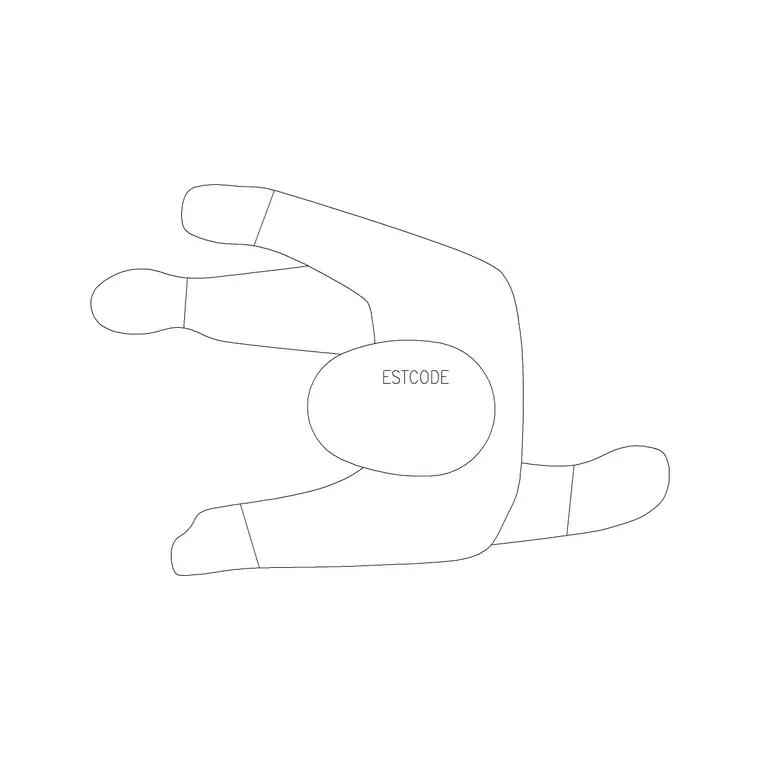
A people-in-plan block is a person seen from directly above — typically a rounded shape suggesting shoulders and a head, with no facial detail because you are looking down at the top of someone. It is the figure you use in floor plans, site plans, masterplans and layouts, where every object is drawn as if seen from the top. Its job is scale and occupancy: it shows that a space is sized for people and how many it comfortably holds.
The plan figures on this site are free people-in-plan DWG files, supplied as DWG with no signup and free for commercial use. They live in the People category and are the right tool for populating a layout from above — a waiting room, a plaza, a circulation route. Because they carry no licensing strings, you can use them across a project's plans without any concern about commercial terms.
Where to find them
Open the People category from the main menu and use the search box to jump to the top-down figures. Searching "plan" surfaces the plan-view people — there is a dedicated human-figure-plan block among them — while "human figure" shows the wider family if you want to compare plan and elevation versions side by side.
Each figure has its own page with a preview, the DWG format and a one-click download. No cart, no email gate: the file lands in your Downloads folder. Since a believable plan uses a few different figures rather than one repeated, grab two or three plan-view people in a single session and keep them in a personal folder. That small set will cover most of your layout needs — a couple of standing figures and a seated one are usually enough to populate a room convincingly.
Match the view — plan figures only in plans
The single rule that keeps plan figures looking right is to use them only in plan drawings. A plan figure is drawn for the top-down view; dropped into an elevation or a section it reads as a flat blob lying on the ground, which is an obvious mistake to anyone trained. Conversely, an upright standing figure laid into a plan looks equally wrong.
This site labels each figure by view on its page, so you can confirm before you place. The discipline is simple: if your drawing is the view from above — a floor plan, a site plan, a roof plan — reach for plan figures; if it is a face-on view, reach for standing ones. Get the view right and the figures reinforce the drawing instead of undermining it, which is exactly what scale entourage is supposed to do.
Place for scale and occupancy
Download the figure, then in your drawing type INSERT (shortcut I), Browse to the DWG, and place it with object snaps where a person would actually be — seated at a table, standing at a counter, walking a corridor. Keep scale at 1 and rotation at 0 to start, then rotate individual figures so they are not all oriented the same way; a plan full of identically aligned people looks stamped.
A plan figure should occupy roughly the footprint of a standing person, about 0.5 to 0.6 metres across the shoulders. If it inserts oversized or tiny, that is a units mismatch — keep INSUNITS consistent so AutoCAD auto-scales, or SCALE by 0.001 to bring a millimetre figure into a metre drawing. Use the figures to test occupancy too: drop people around a table or into a waiting area and you can see at a glance whether the space really holds the number you intend.
Keep it readable
Plan figures are most effective in moderation. Their purpose is to communicate scale and use, not to fill every square metre — a layout buried under dozens of figures becomes harder to read, not clearer. Place a few where they explain something: a cluster in a seating area, one or two at a counter, a couple on a main route to show circulation.
Keep all the figures on a dedicated entourage or people layer so you can dim or freeze them for a clean dimensioned plan and restore them for a presentation version. With a light touch — a handful of varied, rotated figures on their own layer — people-in-plan blocks give a layout instant human scale while leaving the geometry, dimensions and annotations perfectly legible underneath.
Testing capacity and circulation
Beyond scale, plan figures are a quick way to sanity-check how many people a space really holds and whether they can move through it. In a restaurant, seat a figure at each cover and you can see whether diners at adjacent tables would knock elbows; in an office, place figures at workstations and along the routes between them to confirm the desks are not packed so tightly that nobody can get past. A waiting room or lobby tells you at a glance whether the seating you have drawn matches the occupancy you are claiming.
The figures also expose circulation pinch points that bare dimensions hide. Drop people on the main route through a space and any spot where two figures cannot pass comfortably — generally you want around 1.2 metres of clear width for two people to pass — stands out immediately. This turns the plan from a static layout into something you can interrogate: does it seat the numbers, and can people actually circulate? Catching an overcrowded layout at the drawing stage, when it is a five-second figure placement to test, is far cheaper than discovering it once the furniture is installed.
Questions
Frequently asked
Where can I download free people-in-plan DWG files?+
In the People category on CADBlockDWG — search 'plan' to find the top-down figures. They download instantly as DWG with no signup and are free for commercial use.
How big is a plan-view person block?+
Roughly 0.5 to 0.6 metres across the shoulders, the footprint of a standing adult seen from above. Dimension it after inserting to confirm scale before relying on it for occupancy.
Can I use a plan figure on an elevation?+
No. Plan figures are drawn for the top-down view and look wrong in an elevation or section. Use a standing front-view figure for face-on drawings instead.
Free downloads from this article
Free CAD block library
Download the blocks from this article — free, no signup