DWG vs DXF for furniture blocks: which to download
Sofas, beds and tables look identical in DWG or DXF — but one inserts cleaner and one travels further. Here is which format to grab for furniture blocks.
Sumana KumarUpdated 25 May 20264 min read
The one-line answer for furniture
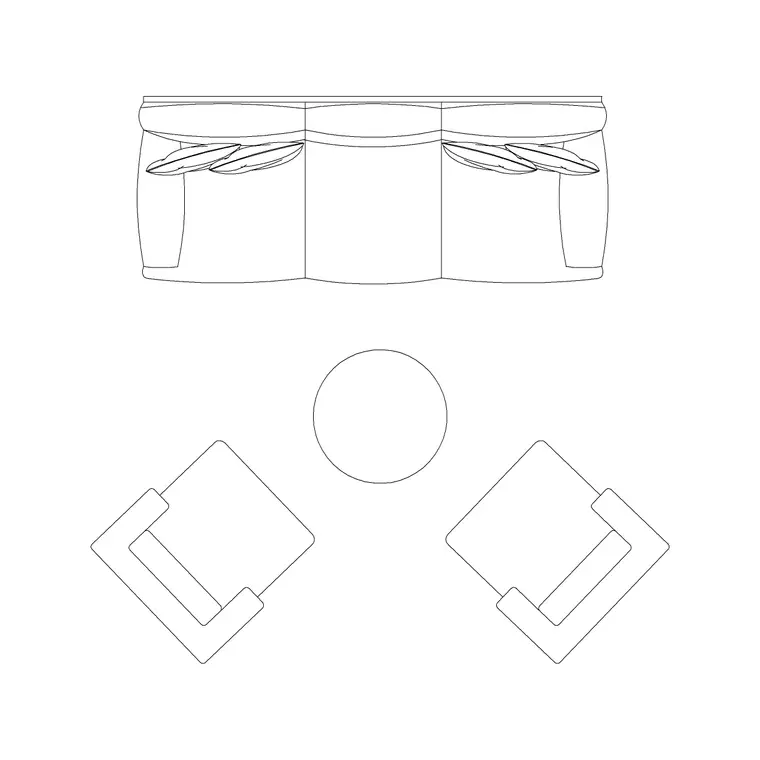
Download the DWG. A sofa, a bed, a dining set or a wardrobe is ordinary 2D geometry, and DWG is the format that geometry was drawn in — compact, native to AutoCAD, and opened without complaint by every mainstream CAD tool. You only reach for DXF when the program you are inserting into cannot read DWG, which for furniture in a floor plan is rare.
Every furniture block in our Furniture category downloads as a DWG with no signup and no licence fine print, and you can use it in commercial work. So for ninety-plus percent of readers the decision is already made: take the DWG, drop it into your living-room or bedroom layout, and move on. The rest of this guide is for the cases where your software surprises you, and for understanding why the geometry is the same either way.
What changes between the two formats — and what doesn't
Nothing about the furniture itself changes. The outline of a three-seater sofa, the pillows on a bed, the chairs around a dining table — all of it is the same vector lines, arcs and hatches whether the file says DWG or DXF. Both measure identically, sit on the same layers, and print the same. There is no 'higher quality' version.
What differs is the container. DWG is a binary file: small, native, and able to carry advanced AutoCAD features without loss. DXF is usually a plain-text exchange file: larger, human-readable, and understood by almost any vector program ever written. For a coffee table that is a few dozen lines, the size gap is trivial and the feature gap is nonexistent — neither cost bites. For a heavy parametric furniture block with dynamic-block stretch grips, DWG preserves that behaviour where a DXF round-trip might flatten it, which is the one furniture-specific reason to prefer DWG beyond habit.
When a furniture DXF is the smarter download
Pick DXF when your tool is not in the AutoCAD family and chokes on DWG. Some older or lighter 2D drafting apps, certain space-planning and furniture-layout packages, and a few free editors read DXF far more reliably than they read DWG. If a sofa block opens as garbage or throws an 'unsupported format' error, converting to or downloading DXF usually fixes it instantly.
DXF is also the safer choice if you are handing furniture geometry to someone whose software you do not know — a client, a fabricator cutting a bespoke joinery piece, or a colleague on an unusual toolchain. Because the DXF specification is open and documented, it is the closest thing to a universal handshake between dissimilar programs. The trade-off is a slightly larger file and the small risk that a very advanced furniture feature gets simplified, neither of which matters for a standard plan-view chair or bed.
Inserting a furniture block once you've picked a format
The workflow is the same for both. Download the file, note where it saved, then in your working drawing type INSERT (shortcut I) and Browse to the downloaded DWG or DXF. Leave 'Specify On-screen' ticked for the insertion point so you can click where the sofa lands, keep scale at 1 and rotation at 0 to start, and snap the base point to a wall or grid line with object snaps (F3).
If the sofa comes in the size of a room or vanishes until you Zoom Extents, that is a units mismatch, not a format fault — a millimetre block dropped into a metre drawing is 1000 times too big. Set INSUNITS consistently in both files, or SCALE the block by 0.001 or 1000 to correct it. A standard two-seater should measure roughly 1500 by 900mm and a three-seater about 2100 by 900mm; dimension across the block to confirm before you trust it for clearances around doors and circulation.
Version matters more than DWG vs DXF
There is a quieter compatibility issue that trips up more people than the DWG-versus-DXF choice itself: both formats are themselves versioned. There are AutoCAD 2018, 2013, 2010, 2007 and 2004 format generations, and a furniture block saved in a newer generation can refuse to open in much older software. So a sofa that 'won't open' is often a version problem, not a DWG-versus-DXF problem at all.
The blocks here are saved to a widely compatible generation, which opens cleanly in virtually any recent CAD program, free or paid. If you ever receive a furniture file from elsewhere that your software rejects, the fix is usually to ask the sender to SAVEAS an older version, or to round-trip the file through DXF, which frequently shakes a version incompatibility loose. Keeping that distinction in mind saves you from blaming the format when the real culprit is the generation it was saved in.
A simple rule you can keep
Default to DWG for every furniture block, because it is smaller, native, and universally supported across modern CAD. Switch to DXF only when a non-AutoCAD program refuses the DWG, or when you are sending furniture geometry into software you do not control. There is no quality penalty either way — the chair is the same chair — so the choice is purely about what your software reads most happily.
If you ever do hit a stubborn furniture file, the escape hatch is to round-trip it: open it in any free converter and re-save as the other format. That alone shakes loose most version and compatibility problems. Knowing that, you can stop second-guessing the download button on a sofa or a bed and spend your attention on the part that actually matters — whether the furniture fits the room.
Questions
Frequently asked
Is a furniture block better in DWG or DXF?+
Neither is higher quality — both hold the same geometry. DWG is smaller and native to AutoCAD; DXF is a larger, more universally compatible exchange format. For most floor-plan furniture, download the DWG.
Why did my downloaded sofa block come in the wrong size?+
Almost always a units mismatch, not the format. A millimetre block in a metre drawing is 1000x too big. Set INSUNITS the same in both files, or SCALE the block by 0.001 or 1000.
Can I convert a furniture DWG to DXF myself?+
Yes. In AutoCAD use SAVEAS and choose a DXF type, or use a free tool like the ODA File Converter or LibreCAD. The furniture geometry round-trips cleanly for ordinary 2D blocks.
Free downloads from this article

Free CAD block library
Download the blocks from this article — free, no signup