Free DWG blocks for a classroom — what to download
Lay out a classroom with free DWG blocks: desks, chairs and the teaching wall. What to download, how to space rows for circulation, and how to insert them.
Saumyajit MaityUpdated 30 March 20264 min read
A classroom is desks, a teaching wall and sightlines
Laying out a classroom is about fitting the right number of student desks in with clear sightlines to the teaching wall, sensible circulation between rows, and room for the teacher to move. The blocks you download are mostly desks and chairs in quantity, plus a teaching wall (board and teacher's desk) and some storage. Get the desk module and the spacing right and the room essentially lays itself out.
Everything here is free DWG and DXF, no account. Student and teacher desks come from the Office and Furniture categories, with planting and storage to finish. Start by choosing your student desk-and-chair block, because that single unit, repeated in rows, fills the room and sets the spacing that everything else works around.
What to download for a classroom
A standard classroom plan needs:
- A student desk with chair — single desks around 600 by 600mm, or paired/twin desks, depending on the layout. - A teacher's desk, larger, at the front near the teaching wall. - The teaching wall itself: a whiteboard/marker line and possibly a screen or interactive display. - Storage: cupboards, shelving and lockers along a wall. - Optionally a reading corner, a sink (for primary/lab rooms) and planting.
Grab a desk-and-chair block as your repeating student unit and a larger desk for the teacher. The student desk, arrayed into rows, is the load-bearing block; the teaching wall and storage are quick additions once the seating grid is down. Size the desk to the age group — primary tables and chairs are noticeably lower and smaller than secondary or adult ones — and check the block matches, since a plan drawn with the wrong-sized furniture will misjudge how many fit and how much circulation is left.
Space the rows for circulation and sightlines
The reason to lay out a classroom with real desk blocks is to test capacity against comfort. Keep clear aisles between rows — roughly 500 to 900mm so students reach their seats and the teacher can circulate — and a generous clear zone at the front so the teacher can move along the teaching wall. Make sure every desk has an unobstructed sightline to the board, with no column or cupboard blocking it.
Keep the route to the door clear for orderly exit, and allow wider circulation if the room must be accessible. Placing real desk and chair blocks makes the trade-offs visible — you can see whether squeezing in another row destroys the aisles or whether the back row can still see the board. That balance of capacity, circulation and sightlines is exactly what a classroom layout exists to resolve.
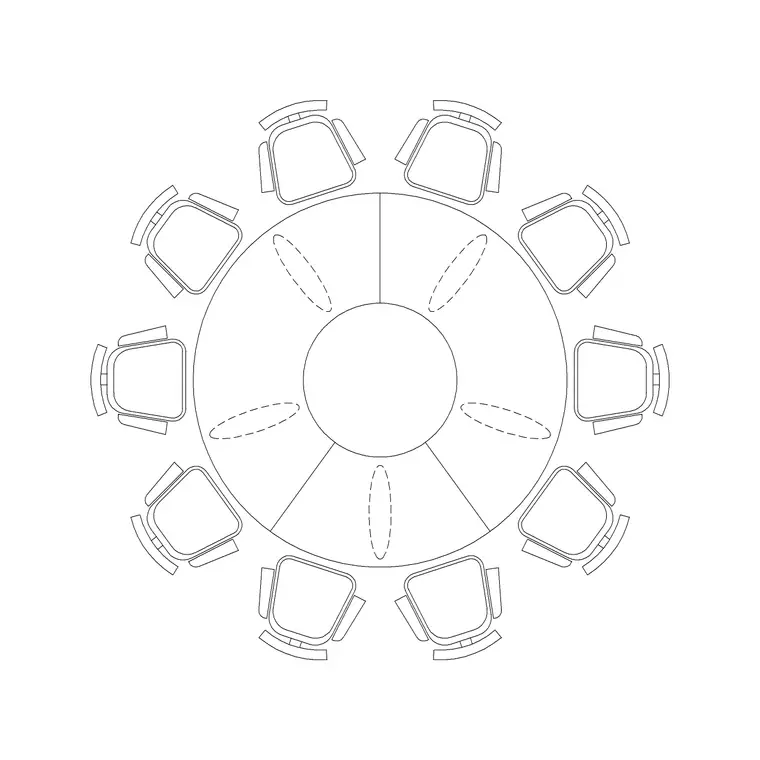
The layout you choose changes the feel of the room. Rows facing the board suit a lecture style; clusters of four to six desks suit group work; a horseshoe puts every student in eye contact for discussion. Try more than one arrangement with the same desk block — it is just a re-array — and check each against the sightlines and aisle widths. At least one desk position should also be sized for a wheelchair user, with a clear approach and the right knee clearance, so the room is genuinely usable by every student rather than accessible only on paper.
Inserting and arraying classroom furniture
Download the desk-and-chair block and the teacher's desk. INSERT one student desk, then use a rectangular array (ARRAYRECT) to build the rows and columns at your chosen spacing — far quicker than placing each desk, and it keeps the grid even. The blocks are real-world sized, so keep scale at 1; correct any wrong-sized insert through units (INSUNITS to millimetres, or scale 0.001 / 1000).
Place the teacher's desk and the teaching wall at the front, then line the storage along a side wall. Put student furniture, the teaching wall and storage on separate layers so you can produce a clean furniture plan and, if needed, a separate plan showing power and data for any displays. If the desk block is on layer 0 it adopts your furniture layer when you array it onto that layer current.
Finishing the classroom drawing
Add the finishing detail: a reading or group-work corner, a sink and worktop for primary or science rooms, display boards on the walls, lighting suited to study, and planting to soften the room. Dimension the desk grid and the front clear zone so the classroom sets out correctly and meets any capacity or accessibility requirements for the building type.
Because the catalogue is free for commercial use with no attribution, a classroom kit — student desk-and-chair, teacher's desk, teaching wall and a storage unit — is well worth saving. Education projects repeat the classroom layout across a whole school, so a vetted, correctly-scaled set lets you lay out the next room or the next floor quickly and consistently. Keep both a primary-sized and a secondary-sized desk in the kit, and you can drop the right one into any room and trust that the capacity and circulation you read off the plan are real.
Questions
Frequently asked
What blocks do I need to lay out a classroom?+
Student desks with chairs, a teacher's desk, a teaching wall (board/screen) and storage — desks and chairs are free in the Office and Furniture categories in DWG and DXF.
How wide should classroom aisles be?+
Roughly 500 to 900mm between rows so students reach their seats and the teacher can circulate, with a wider clear zone at the front along the teaching wall.
How do I lay out rows of desks quickly in AutoCAD?+
Insert one student desk-and-chair block, then use a rectangular array (ARRAYRECT) to build the rows and columns evenly, rather than placing each desk by hand.
Free downloads from this article
Free CAD block library
Download the blocks from this article — free, no signup