How to download free human figure CAD blocks for AutoCAD
A practical walkthrough to download free human figure CAD blocks in DWG, find them on the site, insert them in AutoCAD, and scale a person to the right height.
Sumana KumarUpdated 10 June 20265 min read
What a human figure block gives you
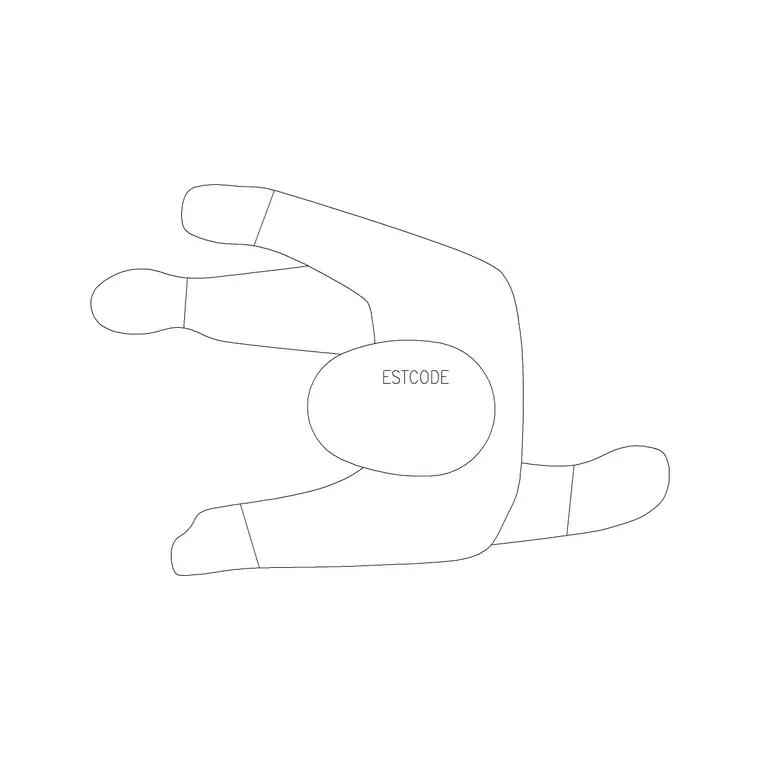
A human figure CAD block is a small DWG that contains the outline of a person — sometimes seen from above for a plan, sometimes drawn in profile for an elevation. Architects and drafters call these scale figures or entourage, and they do one job better than almost anything else on a drawing: they tell the viewer how big everything is. Drop a figure beside a reception desk and the desk reads as furniture; leave it out and the same drawing could be a doll's house or a hangar.
The blocks on this site are free human figure CAD blocks supplied as DWG, with no signup and free for commercial use, so you can put them straight into client work. Some are plan symbols (a rounded shoulder-and-head shape seen looking down), and many are full-height standing people for elevations and sections. None of them carry licensing strings, which is exactly what you want for a figure that will appear on dozens of sheets across a project.
Where to find them on the site
Everything lives in the People category. Open the main menu, choose People, and you land on the hub that gathers all 174-odd human figures in one place — standing people, seated people, plan-view figures, couples, families, children and accessibility figures.
If you know the kind of person you need, the search box is faster than scrolling. Type "human figure" to see the whole family, or narrow it: "human figure plan" surfaces the top-down symbols for furnishing a layout, while a search for "standing" or "elevation" brings up the upright people you would line up along a street view. Each result is its own product page with a preview image, the available formats, and a download button. There is no cart and no email gate — you click, the DWG saves to your Downloads folder, and you are ready to insert.
Download and open the DWG
On any figure's page, hit the download button and the DWG arrives in seconds. If you only need the geometry quickly, you can open that file directly in AutoCAD, select the figure, copy it with Ctrl+C, switch to your working drawing, and paste with Ctrl+V. That is the fastest route for a one-off.
For anything you will reuse, the cleaner route is the INSERT command, covered next, because it keeps the person as a single named block you can re-place, count and edit from one definition rather than a loose tangle of lines. Before you insert, it is worth opening the file once just to see what view it is — a plan symbol and a full-height elevation figure look completely different, and you want the one that matches the drawing you are building.
Insert and place the figure in AutoCAD
In your working drawing, type INSERT (or the shortcut I) and press Enter to open the Blocks palette. Click the Browse button, point it at the human figure DWG you just downloaded, and the block appears ready to drop. Leave the insertion point set to 'Specify On-screen', keep scale at 1 and rotation at 0 to start, and click into the drawing.
Use object snaps so the figure lands where you mean it to — at a door threshold, beside a counter, on the edge of a path. For an elevation, set the figure's feet on the ground line; for a plan, place the rounded body shape where a person would actually stand or sit. If you intend to use the same figure many times, drag it onto a Tool Palette once and every future placement becomes a single click, which is how you populate a busy plan or a street elevation without it feeling like a chore.
Get the height right
A scale figure is only useful if it is the right size, so check the height after inserting. A standing adult should measure roughly 1.7 to 1.8 metres tall in elevation; an eye-level figure used to judge a view sits a little under that. If the person comes in absurdly large or vanishes until you Zoom Extents, that is a units mismatch, not a broken block — a figure drawn in millimetres dropped into a metre drawing lands 1000 times too big.
The reliable fix is to keep INSUNITS consistent between the block and your drawing so AutoCAD auto-scales on insertion. If the figure is legacy and unitless, insert it anyway, run SCALE, and apply 0.001 to bring millimetres into a metre drawing or 1000 the other way. A quick sanity check is to dimension the figure head to toe — if it reads about 1750mm or 1.75m, you are correct, and every desk, door and wall the figure stands next to will now read at believable human scale.
Keep it as a block, and on its own layer
Once the figure is placed and sized, resist the urge to explode it. Keeping it as a single named block means a drawing with twenty identical figures stays barely larger than one with a single figure, and you can swap the definition or recolour every instance from one place. Only explode a figure if you genuinely need to edit its underlying lines for a one-off, which is rare for entourage.
Put all your people on a dedicated 'entourage' or 'people' layer too. That lets you dim, freeze or hide every figure at once — invaluable when you need a clean dimensioned plan without the figures cluttering it, then the populated version for a presentation. Well-built figures drawn on layer 0 will inherit whichever layer you insert them onto, so simply make your people layer current before inserting and the figures adopt it automatically. A quick AUDIT and PURGE after importing an unfamiliar figure also strips any stray layers or junk the file may have carried in, keeping your drawing clean.
Questions
Frequently asked
Are the human figure blocks free for commercial drawings?+
Yes. Every human figure on CADBlockDWG is free for personal and commercial use, supplied as DWG with no signup and no attribution required, so you can place them in client deliverables freely.
How tall should a scale figure be in AutoCAD?+
Around 1.7 to 1.8 metres for a standing adult. Dimension the figure head to toe after inserting; if it reads about 1750mm (or 1.75 in a metre drawing) it is correctly scaled.
My figure inserted far too big — what went wrong?+
Almost always a units mismatch. Set INSUNITS the same in the block and your drawing so it auto-scales, or run SCALE by 0.001 to take a millimetre figure into a metre drawing.
Free downloads from this article
Free CAD block library
Download the blocks from this article — free, no signup