15 best free vehicle CAD blocks to download in 2026
Fifteen free vehicle DWG blocks for 2026 — cars, SUVs, vans and bikes in plan and elevation — sized to real footprints for parking layouts and streetscapes.
Sumana KumarUpdated 8 April 20264 min read
Vehicle blocks have to be the right size
Vehicles do two jobs on a drawing: they populate parking layouts and access drawings where the footprint must be correct, and they add scale and realism to streetscapes and site plans. Both jobs demand accurate sizes — a parking bay drawn around an undersized car is worse than useless. Every block in this roundup is free, available as DWG, needs no signup, and cleared for commercial use.
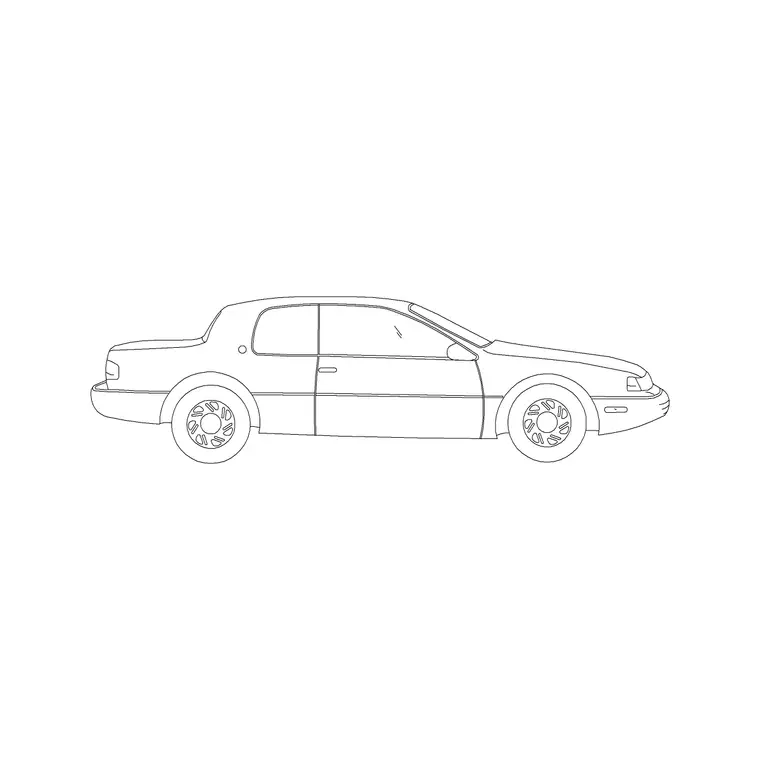
The 15 below are grouped by what they are for: cars in plan for parking and site layouts, cars in elevation for streetscapes, larger vehicles (SUVs, vans, trucks) for access and servicing, and two-wheelers. Browse them in the vehicles category. The two-door sedan block here is a clean elevation car ready for a streetscape. A standard car footprint is roughly 4500 by 1800mm and a parking bay around 2400 by 4800mm, so always measure a downloaded vehicle against these before you lay out bays around it.
Cars in plan for parking and site layouts (1–6)
Plan cars are the top-down footprint, and they are the blocks you reach for when accuracy matters most — parking layouts, drop-off zones, driveway and garage checks. A typical car is about 4500 by 1800mm in plan; a compact runs nearer 4000 by 1750mm and a large saloon or estate longer. A standard perpendicular parking bay is around 2400 by 4800mm with a 6000mm aisle behind it, so the car footprint has to be honest for the bay layout to be valid.
Six blocks cover the plan cars: a standard saloon, a compact car, an estate/wagon, a small city car, a parked car with open-door swing for clearance checks, and a generic car footprint for repeating across a car park. Array these into your bays to confirm the layout actually works — that doors can open between cars, that the aisle clears, that the corner bays are reachable. This is the use where a mis-scaled vehicle block does real damage, so verify the size first.
Cars in elevation for streetscapes (7–10)
Elevation cars are the side profile, and they belong on streetscapes, site sections and renders where you are conveying scale and character rather than parking geometry. A car parked along a street elevation instantly sets the scale of the storefronts and the kerb; a couple of different models read as a real street, while repeating one identical car reads as a stamp. Vary the models and mirror a few so they face different ways.
Four blocks cover the elevation cars: a saloon profile, a hatchback profile, an SUV profile, and a classic/coupe for variety. The two-door sedan block here is a clean side elevation ready to place at the kerb line. Add a scale figure beside the car and the streetscape becomes immediately legible. As with people and trees, the realism comes from variety and honest size — a street of identical cloned cars undercuts the very scale the figures are meant to provide.
Larger vehicles — SUVs, vans and trucks (11–13)
Servicing and access drawings need the big vehicles, because they set the hardest constraints. An SUV or pickup runs around 4800 by 1900mm; a delivery van nearer 5500 by 2000mm; a rigid truck or refuse vehicle longer and wider again, with swept-path turning circles that often govern a site's road geometry. Drawing these honestly is what proves a bin lorry can reach the stores or a delivery van can turn in the yard.
Three blocks cover the larger vehicles: an SUV/4x4, a panel van, and a rigid truck. Place these on access and servicing layouts and check them against your road widths, turning heads and gate openings. The footprint is the whole point here — an undersized truck block that fits where a real one would not is exactly the kind of error that surfaces expensively on site, so verify the dimensions against the real vehicle class before you rely on the access design.
Two-wheelers and downloading the set (14–15)
Finish with the two-wheelers that complete a streetscape and a cycle-parking layout: a bicycle (roughly 1800mm long) and a motorcycle/scooter. Two blocks bring the set to 15 and let you handle cycle stores, bike racks and the smaller-scale life of a street that cars alone miss. Cycle parking is increasingly required, so an honest bicycle footprint helps you lay out stands at realistic spacing — a common arrangement gives each cycle a stand at around 1000mm centres with a clear access aisle behind, which the drawn bike makes easy to set out.
To download any vehicle, open the vehicles category, click the block, and grab the DWG or DXF free with no account. Insert with INSERT at scale 1, snapping plan vehicles to your bay or grid lines and elevation vehicles to the kerb or ground line. Keep them on an entourage or vehicles layer so you can dim them for a technical sheet that does not need the scale dressing. If a vehicle comes in the wrong size, match INSUNITS or scale by 0.001 or 1000. With these 15 blocks, parking layouts stay valid and streetscapes read as real, busy places rather than empty diagrams.
Questions
Frequently asked
What is the standard car footprint for a parking layout?+
A typical car is about 4500x1800mm and a standard perpendicular bay around 2400x4800mm with a 6000mm aisle behind. Measure any downloaded vehicle block against these before laying out bays.
Should I use plan or elevation car blocks?+
Use plan-view cars where the footprint matters — parking, access, driveways — and elevation cars on streetscapes, sections and renders for scale and realism. Vary the models so a street does not read as cloned.
Where can I download free vehicle CAD blocks in DWG?+
The vehicles category on CADBlockDWG has cars, SUVs, vans and bikes in plan and elevation, free in DWG and DXF, no signup, with commercial use allowed.
Free downloads from this article

Free CAD block library
Download the blocks from this article — free, no signup