12 best free bedroom CAD blocks to download in 2026
Twelve free bedroom DWG blocks for 2026 — beds, wardrobes, bedside tables and dressers in plan and elevation — with the clearances a bedroom layout depends on.
Saumyajit MaityUpdated 31 January 20264 min read
Bedrooms are won on clearances
A bedroom looks easy to lay out and is surprisingly easy to get wrong, because everything hinges on clearances: the access down the side of the bed, the swing of the wardrobe doors, the path from the door to the window. Accurate bedroom blocks let you test all of that fast, the moment the bed and wardrobe are on the page. Every block in this roundup is free, available as DWG, needs no signup, and cleared for commercial use.
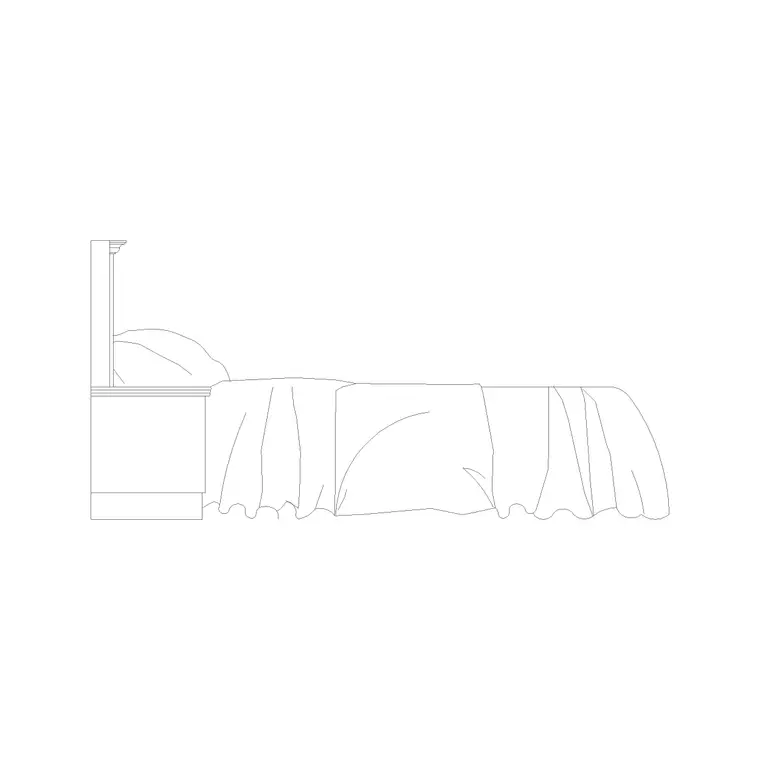
The 12 below are grouped the way a bedroom gets furnished: the beds themselves, the wardrobes and closets, the bedside and dressing furniture, and the finishing pieces. Browse them in the bedroom category. The low-height bed side-elevation block here carries plan, elevation and side views, which is exactly what a bedroom drawing needs. Allow about 600mm of clear access down at least one long side of the bed and confirm any downloaded bed measures to the standard size for its type before you trust the clearances around it.
Beds — single to king (1–5)
The bed dominates the room and sets every clearance, so its size has to be right. A single bed is 900 by 1900mm, a double 1350 by 1900mm, a queen 1500 by 2000mm and a king 1800 by 2000mm. Allow about 600mm down at least one long side for access and a bedside table; two-sided access is better where the room allows it. A good bed block draws the pillows and a turned-down throw line so the plan reads as a bedroom at once rather than as a plain rectangle.
Five blocks cover the beds: a single, a double, a queen, a king, and a low-height platform bed. The low-height bed block here gives you the plan plus the elevation and side views, so you can show the bed on a furniture plan and on an interior elevation that agree. Place the bed first — usually headboard to a solid wall, clear of the door swing and the window — and the rest of the room negotiates around it, which is exactly how a real bedroom layout develops.
Wardrobes and closets (6–8)
Storage is where bedroom layouts quietly fail, because a 600mm-deep wardrobe placed without thought eats the clearance a door or a walkway needs. A standard wardrobe is 600mm deep in 600mm-wide modules; a sliding-door wardrobe avoids the door swing in a tight room; a walk-in closet wants its own footprint and a clear internal aisle of around 1000mm. Drawing the wardrobe — and its door swing where it has one — is what catches the clash.
Three blocks cover the storage: a hinged-door wardrobe (with swing), a sliding-door wardrobe, and a walk-in closet layout. Place the wardrobe along a wall where its doors clear the bed and the room door, and in a tight room reach for the sliding version to recover the swing space. The walk-in block lets you test whether a dressing area actually has room to use, rather than assuming it does — a common optimistic error on a bedroom plan.
Bedside and dressing furniture (9–11)
The supporting furniture makes the room real and tests the finer clearances. A bedside table is around 450 to 500mm square and sits in the 600mm access zone beside the bed; a dressing table with a stool needs knee space and a clear approach; a chest of drawers wants drawer-pull clearance in front. These pieces are small but they are exactly where a bedroom either flows or feels cramped.
Three blocks cover this group: a bedside table/nightstand, a dressing table with stool, and a chest of drawers. Place a bedside table on each accessible side of the bed, set the dressing table where it gets daylight from the window, and keep the chest of drawers where its drawers can open fully. Drawing these confirms the room works in use, not just on paper — that someone can actually reach the bedside lamp and pull out a drawer without hitting the bed.
Finishing the room and downloading (12)
Round the set out with a finishing piece — an upholstered bench or ottoman at the foot of the bed, common in larger and hotel bedrooms — which brings the collection to 12 and completes a furnished bedroom from one trusted set. It also tests the clearance at the foot of the bed, between the ottoman and the wardrobe or the wall, which is easy to forget.
To download any block, open the bedroom category, click the piece, and grab the DWG or DXF free with no signup. Insert with INSERT at scale 1, snapping the bed and wardrobe to the walls they sit against, and keep the furniture on a dedicated layer so you can isolate it for a furniture or services sheet. If a piece comes in the wrong size, match INSUNITS or scale by 0.001 or 1000. With these 12 blocks you can furnish any bedroom — beds, storage, bedside and dressing pieces — and prove every clearance on the drawing.
Questions
Frequently asked
What are the standard bed sizes for a CAD plan?+
A single is 900x1900mm, a double 1350x1900mm, a queen 1500x2000mm and a king 1800x2000mm. Allow about 600mm of clear access down at least one long side, and verify the block measures to its standard size.
How much clearance do I need around a bed?+
Aim for about 600mm down at least one long side for access and a bedside table; two-sided access is better where the room allows. A drawn bed and wardrobe let you check this and the door swings together.
Where can I download free bedroom CAD blocks?+
The bedroom category on CADBlockDWG has beds, wardrobes, bedside tables and dressers in plan and elevation, free in DWG and DXF, no signup, with commercial use allowed.
Free downloads from this article
Free CAD block library
Download the blocks from this article — free, no signup