Explainer · what is a floor plan
What is a floor plan?
By Saumyajit Maity · Published 1 Jun 2025 · Updated 11 Jan 2026
A floor plan is the drawing everyone recognises even if they have never opened CAD: the top-down map of a building's interior, with rooms, walls, doors and windows laid out as if you sliced the building horizontally and looked down inside. It is the single most-used drawing in the whole construction process, because it answers the first question anyone asks of a building — what goes where.
This explanation covers what a floor plan actually is, the imaginary cut that defines it, the symbols and conventions that fill it, and how to read one with confidence. Because populating a floor plan is exactly what CAD blocks are for — furniture, fixtures, doors, windows and trees all dropped into the layout at true scale — understanding the drawing also tells you why scaled blocks save so much time.
A floor plan, defined
A floor plan is a scaled diagram of a room or building viewed from above, showing the arrangement of spaces. Technically it is a horizontal section: imagine slicing the building with a flat horizontal plane and lifting the top half away, then looking straight down at what remains. Walls appear as the solid shapes they cut through; door and window openings appear in those walls; the floor itself spreads out below.
Because you are looking straight down, every distance across the floor is true to the drawing's scale. That is what makes a plan measurable — you can scale off a room's length, a corridor's width or the gap between two walls, which is why the floor plan is the backbone of setting out a building.
The cut height — why doors and windows show
The horizontal cut for a floor plan is taken at a conventional height, usually around 1.2 m above the floor. That height is chosen deliberately: it passes through doors and windows so their openings show, but sits below most worktops and high-level features. Walls are cut and drawn solid; doors are shown with their leaf and swing arc; windows appear as a break in the wall with the glazing line.
Things below the cut — furniture, fittings, floor patterns — are drawn as seen from above. Things above the cut, like high-level cabinets or a beam, are conventionally shown dashed to signal 'this is overhead.' Understanding the cut explains at a glance why a plan shows what it shows.
What a floor plan includes
A complete floor plan carries more than walls. Expect to find: room names and sometimes areas; door and window positions with swings; built-in fixtures like kitchen units and sanitaryware; stairs (with an up/down arrow and a break line); dimensions setting out walls and openings; and often furniture to show how the space is used.
Many of these elements are placed as CAD blocks. A WC, a basin, a bed, a sofa, a dining table, a tree in a courtyard — each is a scaled plan-view block dropped onto the layout. Drawing them as blocks rather than loose lines keeps the plan consistent, lets you array repeated items quickly, and makes it easy to count fixtures for a schedule.
Common floor plan symbols
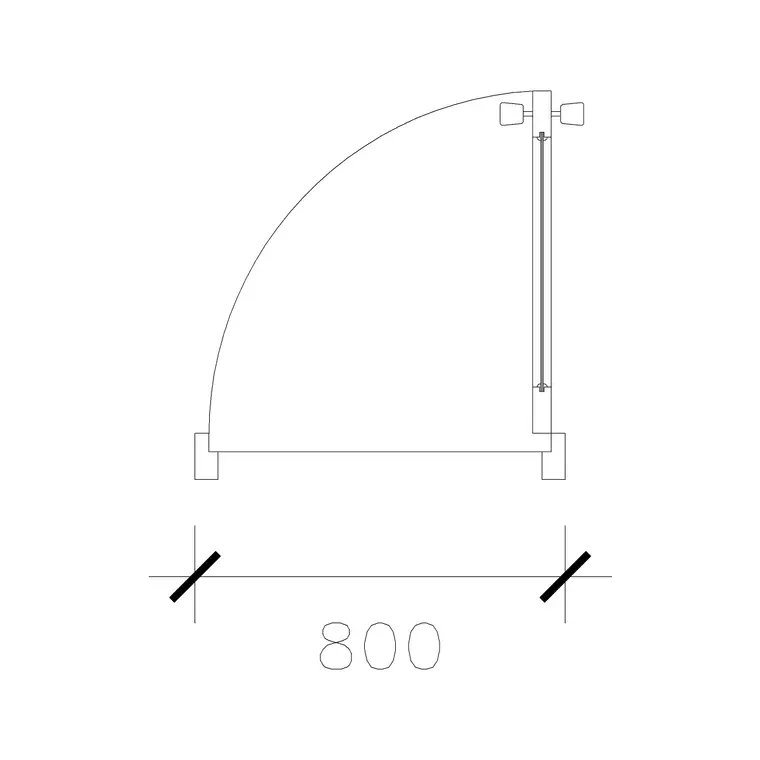
Floor plans use a shared visual shorthand so anyone in the industry can read them. A door is a line for the leaf plus a quarter-circle arc for the swing. A window is a thin break in the wall with one or more lines for the glass. A stair is a run of parallel treads with a direction arrow and, where it passes the cut, a diagonal break line. Walls vary in thickness to show structure versus partition.
Furniture and fixtures follow recognisable outlines — the oval of a bath, the rounded square of an armchair, the canopy circle of a tree. Because these symbols are conventional, a well-chosen CAD block reads instantly as what it represents, which is part of why downloading a proper scaled block beats sketching an approximation.
How to read a floor plan
Start by finding the scale and the north point so you know how big things are and which way the building faces. Then trace the walls to understand the room layout, and follow the doors to see how you move through the space — the swing arcs show which way each door opens and whether it will clash with anything.
Next read the windows to see where light and views come from, and check the dimensions to confirm room sizes. Finally, read the furniture and fixtures to understand how each space is meant to be used. With practice this becomes instant: a glance tells you the layout, the circulation and the function of every room. Placing scaled blocks correctly is what makes a plan this readable in the first place.
How a floor plan differs from other drawings
It is easy to confuse a floor plan with its neighbours in the set. A floor plan shows the inside of one storey, cut horizontally. A site plan zooms out to show the whole plot — the building footprint, boundaries, access and landscaping — rather than the interior layout. A reflected ceiling plan looks up instead of down, showing lights and ceiling features. Elevations and sections, by contrast, are vertical views: faces and slices rather than top-down layouts.
A building usually has one floor plan per storey — ground floor, first floor and so on — because each level has a different layout. Together with the elevations and sections, those plans describe the building completely. The floor plan is simply the one most people read first, because the question 'what goes where?' comes before every other.
Free download
Browse the full library — DWG & DXF, no signup.
Questions
Frequently asked
At what height is a floor plan cut?+
By convention, around 1.2 m above the floor. That height passes through doors and windows so their openings show, while staying below most worktops and high features. Anything above the cut is usually drawn dashed to indicate it is overhead.
What is the difference between a floor plan and a site plan?+
A floor plan shows the interior layout of one storey, cut horizontally. A site plan is a wider top-down view of the whole plot, showing the building footprint, boundaries, access, parking and landscaping rather than the rooms inside.
Why are some lines on a floor plan dashed?+
Dashed lines usually represent features above the cut plane — high-level cabinets, a beam, an overhead change in ceiling — that you would not otherwise see looking down. Dashing them signals 'this is overhead' without cluttering the plan.
Do I need a separate floor plan for each storey?+
Yes. Because each level of a building has a different layout, you draw one floor plan per storey — ground floor, first floor, and so on. They share the same scale and external walls so they stack and coordinate correctly.
Related downloads
Blocks for this guide

Related categories
Related guides
Explainer
Plan vs Elevation vs Section Explained
Plan vs elevation vs section explained simply — what each architectural view shows, how they differ, when to use each, and how they read together in a drawing set.
Explainer
2D vs 3D CAD Blocks Explained in 2026
2D vs 3D CAD blocks explained — what each is, file size and performance differences, when to use flat blocks vs solid models, and which to download for your drawing.
Explainer
What Is an Elevation Drawing? Explained
What is an elevation drawing? A clear explanation of what it shows, exterior vs interior elevations, how it differs from a plan, and how to read one.