Block landing · under cabinet hood cad block
Under-cabinet cooker hood CAD blocks for AutoCAD
By Sumana Kumar · Published 13 Nov 2023 · Updated 28 Feb 2026
An under-cabinet hood is the quiet alternative to a chimney extractor — a slim visor, telescopic or fully integrated unit that mounts under a wall cabinet instead of standing proud as a feature. It keeps a kitchen elevation clean and lets the wall-unit run continue uninterrupted, which is why designers reach for it in galley and compact kitchens. This page collects free under-cabinet hood CAD blocks in DWG and DXF, drawn to true millimetre sizes for AutoCAD 2004 or later, free for personal and commercial use with no signup and no watermark.
The whole point of an under-cabinet hood is that it disappears into the cabinetry, so on the drawing the coordination is with the wall unit above it, not with the ceiling. Drawn to scale, the block proves the hood fits the cabinet, sits at the right clearance over the hob and keeps the wall-unit line continuous.
How an under-cabinet hood differs from a chimney hood
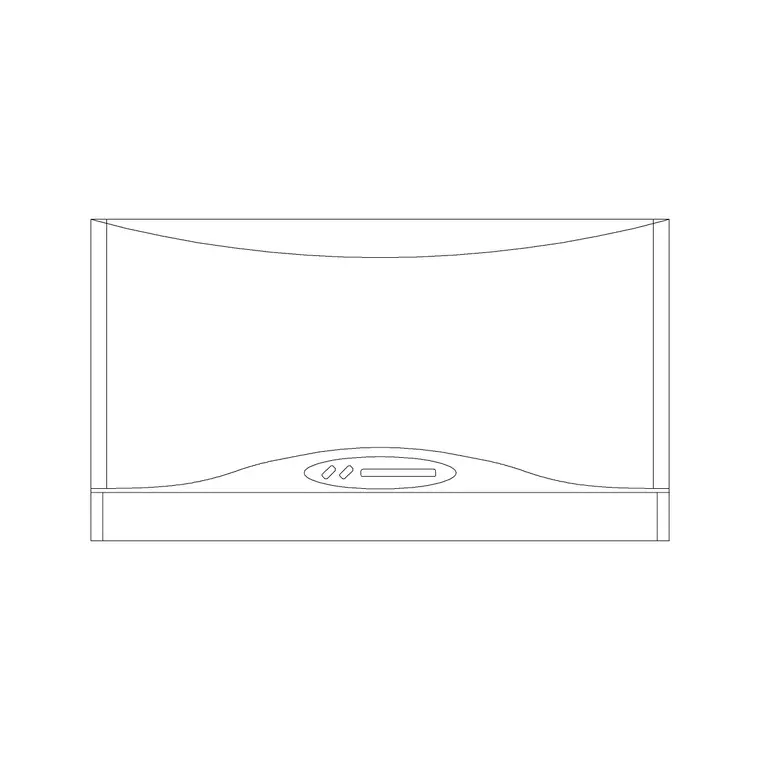
Where a chimney hood rises to the ceiling as a feature, an under-cabinet hood tucks beneath a wall cabinet so the wall-unit run reads as one continuous band. That changes what the block has to show. The elevation draws a slim unit on the underside of the cabinet — a visor that hinges out, a telescopic drawer that pulls forward, or a flat integrated panel concealed entirely behind a matching cabinet door.
Because it mounts to the cabinet, the block's job is to confirm it fits the wall unit above and sits at the right level over the hob. There is no chimney to draw, and in plan the hood is usually shown as a dashed footprint under the wall cabinet. The visor or telescopic front and the body sit on separate layers so the elevation can show it open or closed.
Elevation and section, with a dashed plan
For an under-cabinet hood the elevation is the main drawing, because the design decision is how the unit reads within the wall-cabinet run. The elevation block sits the hood on the cabinet underside at the correct height above the hob, and shows whether it is a visor, a pull-out or a concealed integrated panel.
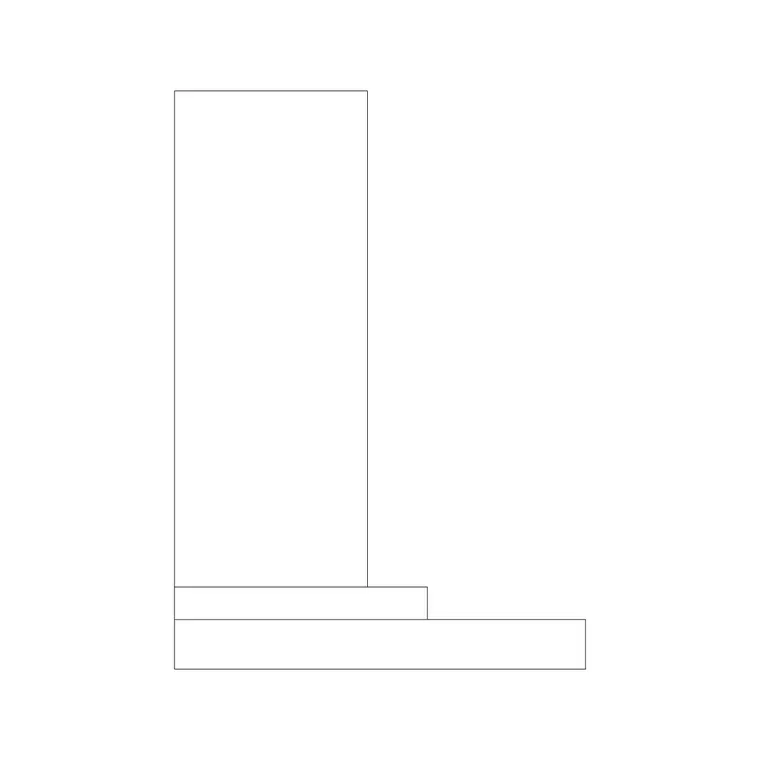
The section confirms the clearance over the hob and the depth the hood projects, especially for a telescopic unit that pulls forward when in use. In plan the hood is a dashed rectangle under the wall cabinet, centred on the hob, with the duct route to the external wall or a recirculating filter noted. Many downloads carry all three in one DWG.
Typical under-cabinet hood sizes
Design around these and confirm against the model. Under-cabinet hoods are sized to the wall cabinet they mount in — most commonly 600 mm wide to match a standard wall unit, with 500 mm, 700 mm and 900 mm options. Depth front-to-back matches the wall-cabinet depth, typically 300 to 350 mm, so the hood does not project beyond the cabinet face when closed.
The clearance above the hob follows the same rule as any hood — around 650 to 750 mm for gas, a little less for induction — which in turn helps set the height of the wall cabinet the hood lives in. The body of an under-cabinet hood is slim, often only 100 to 200 mm deep vertically, which is exactly why it preserves cabinet storage above.
Inserting and fitting it to the wall unit
The blocks are full size in millimetres. Insert at scale 1 in a millimetre drawing, 0.001 in a metre template, or set INSUNITS to millimetres so AutoCAD rescales on insertion. The key step is to mount the hood to the underside of the wall cabinet block in elevation, aligning its width to the cabinet and its level to the correct clearance above the hob.
In plan, centre the dashed footprint on the hob and under the wall unit, and note the duct route — to an external wall if ducted, or back into the kitchen if recirculating through a charcoal filter. Keep the hood on its own layer so you can show it open or closed, and freeze it for a cabinet-only plan.
Where under-cabinet hoods suit the design
Under-cabinet hoods are specified in galley and one-wall kitchens, compact apartment kitchens, and any scheme where a continuous, uninterrupted wall-unit line is the design intent. Interior designers favour them for minimalist and handleless kitchens where a chimney hood would break the run; architects and developers use them in space-efficient residential schemes.
Pair the under-cabinet hood with the wall-cabinet, hob and worktop blocks in the kitchen category so the hood width matches the cabinet, the clearance over the hob is correct, and the wall-unit run reads as one clean band across the elevation.
Keeping the wall-unit line continuous
The reason to choose an under-cabinet hood is almost always the elevation, so that is where the block proves its worth. A chimney hood interrupts the wall-cabinet run with a tall feature; an under-cabinet hood lets the run continue as an unbroken line, with the extractor hidden beneath. To draw that convincingly you need the hood width to match the cabinet width exactly and the hood body to tuck within the cabinet depth, both of which the scaled block lets you confirm.
For a fully integrated hood, the coordination goes a step further: a matching cabinet door fronts the hood so it vanishes entirely into the run, and the block lets you check the door height aligns with the neighbouring cabinets. The recirculating option also matters here — where there is no easy external duct route, an under-cabinet hood can recirculate through a charcoal filter, which keeps the elevation clean at the cost of less effective extraction. Drawing the hood, the cabinet and the duct route to scale lets you weigh that trade-off on the drawing and present a continuous, considered wall-unit line to the client.
Free download
Browse the full library — DWG & DXF, no signup.
Questions
Frequently asked
How is an under-cabinet hood different from a chimney hood?+
An under-cabinet hood mounts beneath a wall cabinet so the wall-unit run stays continuous, while a chimney hood rises to the ceiling as a feature. The under-cabinet type can be a hinged visor, a pull-out telescopic drawer or a panel concealed behind a matching cabinet door.
What width should an under-cabinet hood be?+
Match it to the wall cabinet it mounts in — most commonly 600 mm, with 500 mm, 700 mm and 900 mm options. Depth matches the cabinet, typically 300 to 350 mm, so the hood does not project beyond the cabinet face when closed. Confirm against the model.
Can an under-cabinet hood work without an external duct?+
Yes. Where there is no easy duct route, an under-cabinet hood can recirculate through a charcoal filter, keeping the elevation clean at the cost of less effective extraction. Note the chosen mode — ducted or recirculating — on the plan.
Are these under-cabinet hood blocks free for commercial use?+
Yes. They download free in DWG and, where available, DXF, with no signup, no watermark and no attribution requirement, and they are cleared for commercial project use.
Related downloads
Blocks for this guide
Popular blocks to download
Related categories
Related guides
Block landing
Free Bathroom Fixtures CAD Blocks — DWG Download
Download free bathroom fixtures CAD blocks in DWG and DXF — toilets, wash basins, bathtubs, showers and vanities drawn in plan and elevation. No signup, commercial OK.
Block landing
Free Gas Stove / Cooktop CAD Blocks — DWG
Free gas stove and cooktop CAD blocks in DWG and DXF — drawn in plan and elevation at true kitchen-module sizes for AutoCAD 2004+. No signup, commercial-use OK.
Block landing
Single Burner Hob CAD Block — Free DWG
Free single burner hob CAD blocks in DWG and DXF for compact kitchens and studios — plan and elevation, true sizing for AutoCAD 2004+. No signup, commercial OK.