Block landing · single burner hob cad block
Single burner hob CAD blocks for compact kitchens
By Saumyajit Maity · Published 3 Oct 2024 · Updated 12 Apr 2026
A single burner hob is the block you reach for when space is tight — studio kitchenettes, office tea points, holiday lets, boats and granny-flat kitchens where a full four-burner cooktop would never fit. This page collects free single burner hob CAD blocks in DWG and DXF, drawn at true millimetre sizes and ready to insert into AutoCAD 2004 or later. Everything is free for personal and commercial use, with no signup and no watermark.
Because a single hob takes so little worktop, the design challenge is rarely the appliance itself — it is the landing space either side of it and the extract above. Working from a correctly scaled block lets you prove that a one-burner cooking point genuinely fits the narrow run you are designing, rather than discovering the clash on site.
Why a single burner block earns its place
On a small-kitchen plan, the difference between a single and a double hob can decide whether a worktop has any usable prep space left at all. A single burner hob — sometimes called a domino hob or a one-zone cooktop — is the most compact cooking block in the kitchen set, and dropping the real footprint in tells you immediately how much worktop survives beside it.
The plan view shows the single burner ring, the pan support and the control knob, set into the worktop cut-out. Keeping it scaled means the prep zone, the splashback and the extract above all measure correctly the moment the block lands, which matters far more in a 1.5 metre kitchenette than in a generous family kitchen.
Plan and elevation views
For the layout you work in plan: the single hob seen from above, set into the worktop and aligned with whatever sits below — often just a cupboard or an under-counter fridge rather than a full base cabinet. The plan block fixes the cooking point and the extract centreline.
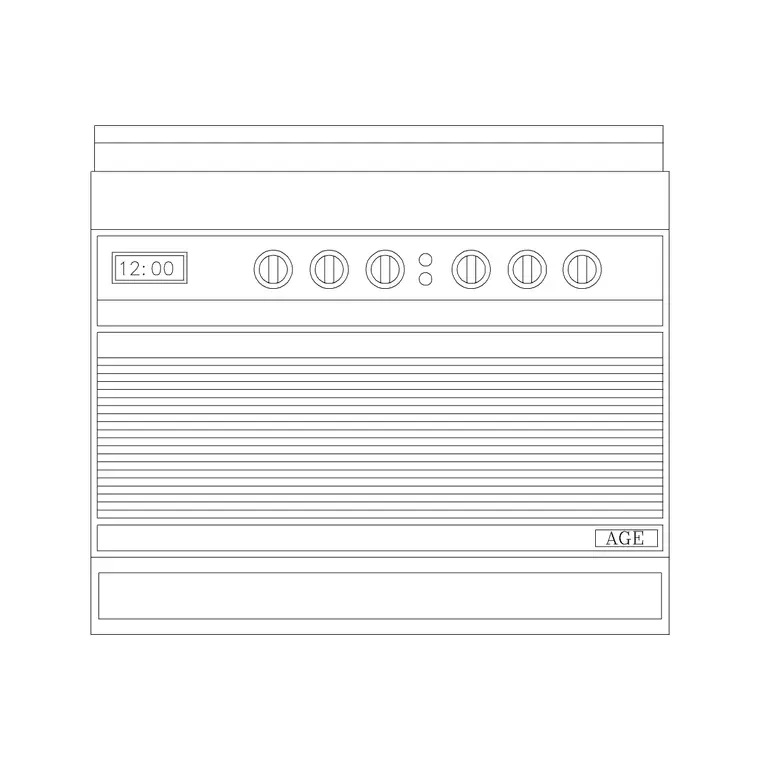
For the elevation you draw the hob face-on with its control knob and the splashback behind, at the grate height above the worktop. Because a single hob is frequently used in a one-wall kitchen, the elevation is often the drawing a client actually sees, so it is worth carrying the real proportions through. Many downloads ship both views in one DWG.
Typical single burner hob sizes
Use these as a guide and confirm against the appliance datasheet. A domino-style single burner hob is commonly around 300 mm wide and 500 mm deep, sitting half the standard 600 mm module so two can pair side by side. Portable single-ring gas burners and induction plates are smaller again, often 250 to 300 mm square. The worktop cut-out is typically 20 to 30 mm smaller than the appliance trim on each side.
Even with such a small appliance, keep at least 300 mm of worktop landing space beside the burner for a pan handle to turn into safely, and allow the same hood or extract clearance overhead as any cooking point — a single ring still produces steam and grease.
Inserting and pairing single hobs
The blocks are drawn full size in millimetres. Insert at scale 1 in a millimetre drawing, 0.001 in a metre template, or set INSUNITS to millimetres so AutoCAD rescales automatically. Run INSERT, snap to the centre of the cut-out, and rotate the knob to the front of the run.
A neat trick with domino-format single hobs is to insert two side by side to build a custom cooking line — a gas single beside an induction single, say — which a fixed two- or four-burner block cannot give you. Because each is a separate block reference on its own layer, you can mirror, array and re-space them freely, then freeze the whole cooking line for a clean cabinet plan.
Where single burner hobs are specified
Single burner hobs appear in studio and micro-apartment kitchens, office and breakout tea points, hotel suites, holiday lets, mobile and modular units, and secondary or utility kitchens. Interior designers use them to keep a kitchenette compact; architects use them in serviced-apartment and HMO schemes where every cooking point must fit a tight envelope.
Pair the single hob with the compact sink, under-counter fridge and microwave blocks in the kitchen category to fit out a complete kitchenette from one consistent library, all sitting on the same module so the run reads cleanly.
Designing the landing space around a single hob
The single biggest mistake on small-kitchen plans is treating a one-burner hob as if it needs no surrounding space. It does. A pan on a single ring still has a hot handle that has to turn somewhere, and a cook still needs a spot to set down a lid, a chopping board or a plate. Use the scaled block to protect a minimum landing zone on at least one side, and ideally both.
Because the appliance is so small relative to the room, it is tempting to push it into a corner — but a hob hard against a return wall leaves no room for a pan to one side and bakes the wall finish. Snap a centreline through the burner, dimension the gap to any return wall, and keep the extract centred on that same line. Drawn from a scaled block, those small clearances are easy to honour, and they are exactly what turns a cramped kitchenette from unusable into genuinely workable.
Free download
Browse the full library — DWG & DXF, no signup.
Questions
Frequently asked
How wide is a single burner hob block?+
A domino-style single burner hob is typically around 300 mm wide and 500 mm deep — roughly half the standard 600 mm kitchen module — so two can sit side by side. Portable single rings are smaller, often 250 to 300 mm square. Confirm against the appliance datasheet.
Can I combine two single hob blocks into a cooking line?+
Yes, and it is a common reason to use them. Domino-format single hobs are designed to pair, so you can insert two side by side — a gas single beside an induction single, for instance — to build a custom cooking line a fixed multi-burner block cannot give you.
Do single burner hobs still need a hood above?+
Yes. A single ring still produces steam and grease, so allow the same overhead extract clearance as any cooking point and keep the hood or extract centred on the burner. The elevation block carries the grate height to set it off.
Are these single hob CAD blocks free to download?+
Yes. They download free in DWG and, where available, DXF, with no signup, no watermark and no attribution requirement, and they are cleared for commercial project use.
Related downloads
Blocks for this guide
Popular blocks to download
Related categories
Related guides
Block landing
Free Bathroom Fixtures CAD Blocks — DWG Download
Download free bathroom fixtures CAD blocks in DWG and DXF — toilets, wash basins, bathtubs, showers and vanities drawn in plan and elevation. No signup, commercial OK.
Block landing
Free Gas Stove / Cooktop CAD Blocks — DWG
Free gas stove and cooktop CAD blocks in DWG and DXF — drawn in plan and elevation at true kitchen-module sizes for AutoCAD 2004+. No signup, commercial-use OK.
Block landing
Double Burner Hob CAD Block — Free DWG
Free double burner hob CAD blocks in DWG and DXF — two-ring cooktops in plan and elevation for compact kitchens, true sizing for AutoCAD 2004+. No signup.