Block landing · two friends figure cad block
Free two friends figure CAD block for social scenes
By Saumyajit Maity · Published 27 Nov 2023 · Updated 22 May 2026
Two people standing together read very differently from one person standing alone, and that difference is exactly what a social elevation needs. The two friends figure is a paired block — two adults standing as if mid-conversation — that animates a café front, a street scene or a plaza without any of the romantic read of a couple. This page offers a free two friends figure CAD block in DWG and DXF, drawn in elevation and ready to drop into AutoCAD 2004 or later, free for personal and commercial use with no signup and no watermark.
The block exists as a pair because the relationship between the two figures carries the meaning. Spaced and angled to suggest a conversation, the friends read as people using a place socially, which is the everyday life most public and commercial drawings are trying to show. It is the figure you reach for when a couple feels too intimate and a lone figure feels too empty — a neutral, sociable pair that suits cafés, shops, campuses and streets.
What the two friends block shows
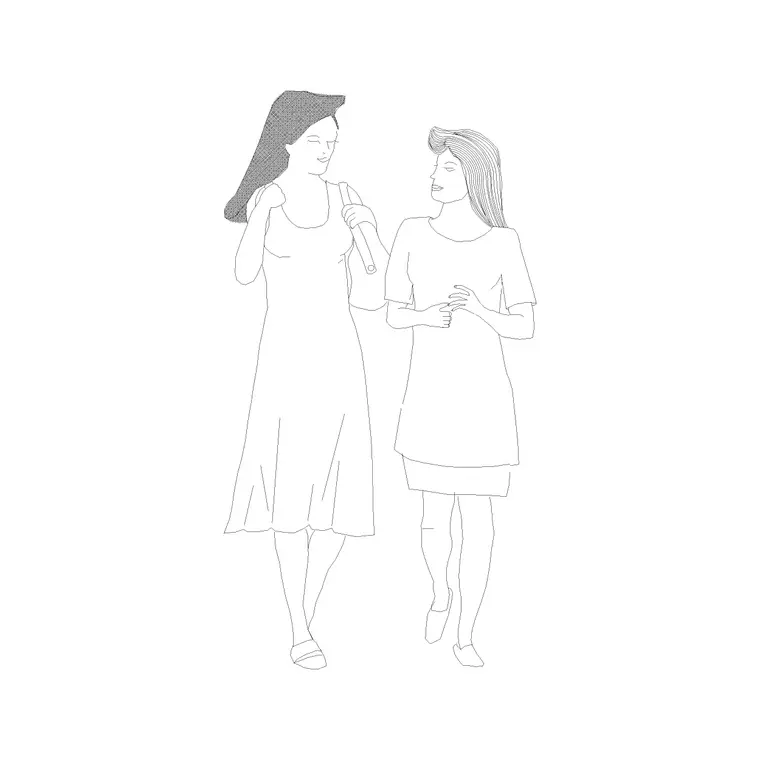
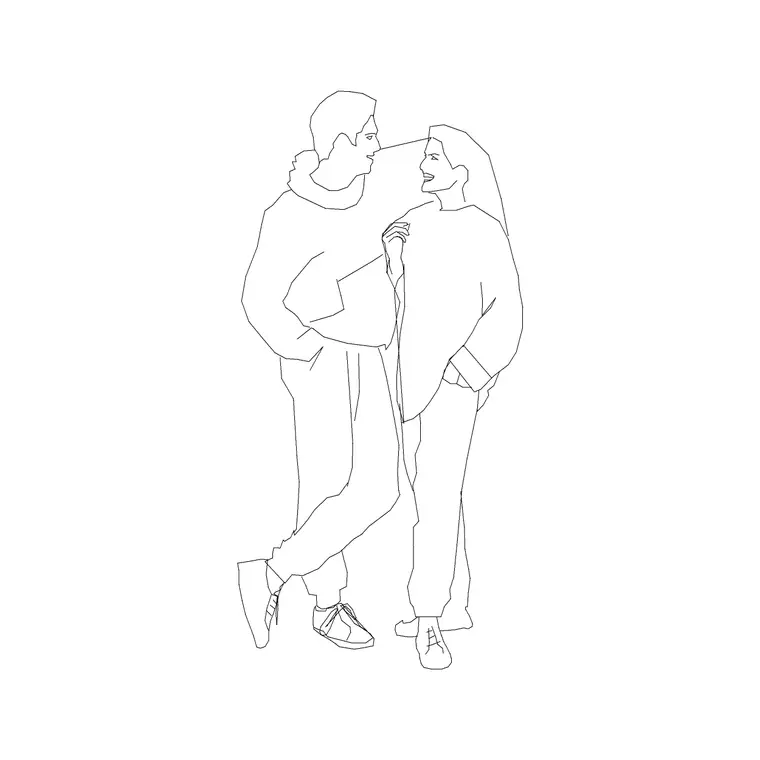
The block is two adult figures in elevation, composed standing close and slightly turned towards each other as if talking. The spacing and stance are what define them as friends rather than a couple or two unrelated passers-by — friendly proximity without the closeness of a pair. They are drawn as clean silhouettes so they animate the scene without competing with the architecture.
Because the two are a single block reference, they insert and move together with their composition locked. That keeps the conversational spacing intact wherever you place them, and editing the master block updates the pair everywhere they appear, which is far tidier than positioning two separate figures by hand each time.
Cafés, streets, campuses and plazas
The two friends figure suits the ordinary social life of public space. At a café or shopfront the pair shows people gathering outside, setting the scale of the facade while animating it. In a street or plaza elevation friends standing and talking communicate that the space is used, not just built. On a campus or in a civic project the figure reads as students or colleagues, exactly the population those briefs are about.
As a scale device the pair gives two reference heights close together, which helps the eye fix the height of a canopy, a shopfront or a level change. Used with single figures and groups at other distances, a few pairs of friends quickly build a believable, lived-in crowd without any one figure dominating.
Figure heights and conversational spacing
Both figures are at adult scale, with an average standing adult commonly taken as around 1700 to 1800 mm at the design stage — a range to read the architecture against, not a fixed dimension. A small height difference between the two keeps them believable, and the gap between them is set for conversational distance: close enough to read as together, open enough to read as friends rather than a couple.
Keep the pair full size and uniform; stretching a figure to change its height breaks the proportion and the believability. Set INSUNITS to millimetres so AutoCAD rescales on insertion if the block was built in other units, and mirror the whole block rather than one figure when you need the pair to face the other way.
Placing the two friends in AutoCAD
INSERT the block and snap the feet to your floor or ground line with endpoint OSNAPs so both figures stand on the surface. The conversational spacing is built in, so you simply place the pair where the composition wants them — outside a café, on a pavement, in a plaza. Use MIRROR on the whole block to flip the pair's facing while keeping their arrangement intact.
Put the friends on a dedicated scale-figure layer, screened or non-plotting if they are presentation-only, so they show in client PDFs but drop out for construction issue. Keep one master block for consistency across the sheet, and avoid exploding it, which would let the two figures drift apart and lose the conversational read that makes them work.
Mixing pairs with other figures
A pair of friends is a good building block for a populated scene. Combine several pairs at different distances with single walking and standing figures to create a believable crowd, or add a couple and a family group for a mix of social relationships across a plaza or street. For a top-down layout, switch to plan-view people kept on their own block so elevation and plan never mix.
The full people category collects pairs, couples, groups, families and single figures so you can populate a scheme from one consistent set. Keep the two friends in the same drawing as your other people so they share insertion scale and layer conventions and the finished scene reads as a single coherent crowd.
Free download
Browse the full library — DWG & DXF, no signup.
Questions
Frequently asked
How is the two friends figure different from a couple?+
The spacing and stance are more neutral — friendly conversational distance rather than the intimate closeness of a couple. It suits public and commercial scenes where you want sociable people without a romantic read.
Why use a pair block instead of two single figures?+
The pair is pre-composed with conversational spacing and a natural height difference, and it moves as one unit so the arrangement stays intact. That saves hand-positioning two figures every time you place them.
How tall are the figures?+
Both are at adult scale, with an average adult commonly taken as roughly 1700 to 1800 mm at the design stage. A small height difference keeps them believable; treat the heights as ranges rather than fixed specs.
Is the block free for commercial projects?+
Yes. The DWG and DXF download is free for personal and commercial use with no signup, watermark or attribution, so it can go straight into client presentation drawings.
Can I build a crowd from this block?+
Yes — place several pairs at different distances, mirror some, and mix in single figures, couples and family groups for variety. Keep them all on one scale-figure layer so the crowd reads as one consistent set.
Related downloads
Blocks for this guide
Popular blocks to download
Related categories
Related guides
Block landing
Human Figure Plan CAD Blocks — Free DWG
Download free human figure plan-view CAD blocks in DWG — people seen from above, drawn to scale for floor plans and circulation. AutoCAD 2004+, no signup.
Block landing
Human Figure Elevation CAD Blocks — Free DWG
Free human figure elevation CAD blocks in DWG — people drawn front-on and in profile to scale your sections and streetscapes. AutoCAD 2004+, no signup.
Block landing
Standing Person Scale Figure CAD Blocks (Free)
Free standing person scale figure CAD blocks in DWG — clean, true-height figures to set the scale of plans, sections and elevations. AutoCAD 2004+, no signup.