Block landing · triple bowl sink cad block
Triple bowl sink CAD block in DWG and DXF
By Saumyajit Maity · Published 26 Jan 2022 · Updated 22 May 2026
A triple bowl sink — three basins in a line — is the heavy-duty wet station you see in commercial kitchens, bars and catering fit-outs, where a wash, rinse and sanitise sequence is run across three separate compartments. It also appears in large domestic utility setups. Because three bowls plus tap decks make a long unit, scaling it correctly is what tells you whether it fits the available wall and leaves room to work. This page gives you a free triple bowl sink CAD block in DWG and DXF, drawn at true millimetre dimensions for AutoCAD 2004 or later, free for personal and commercial work with no signup or watermark.
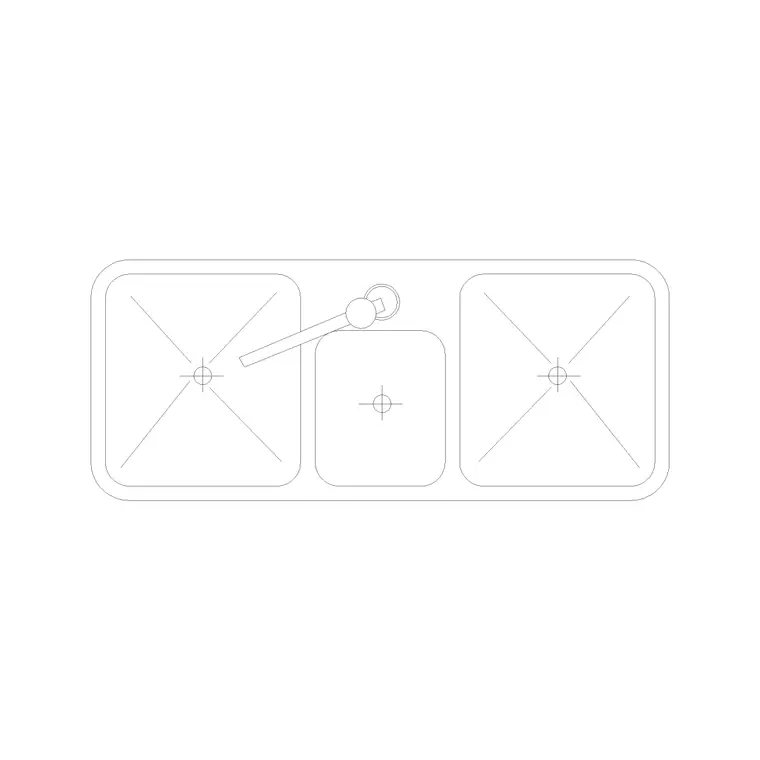
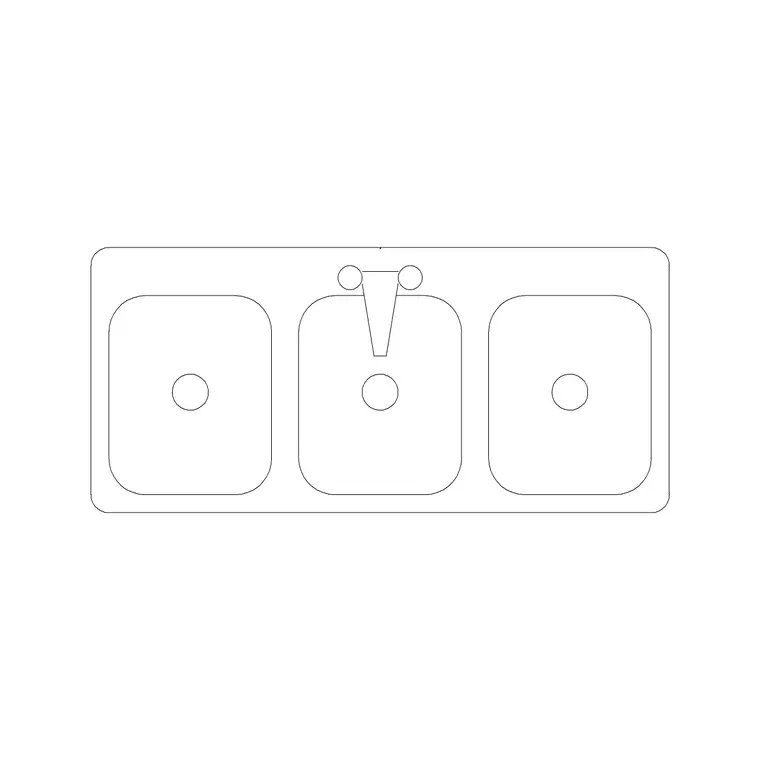
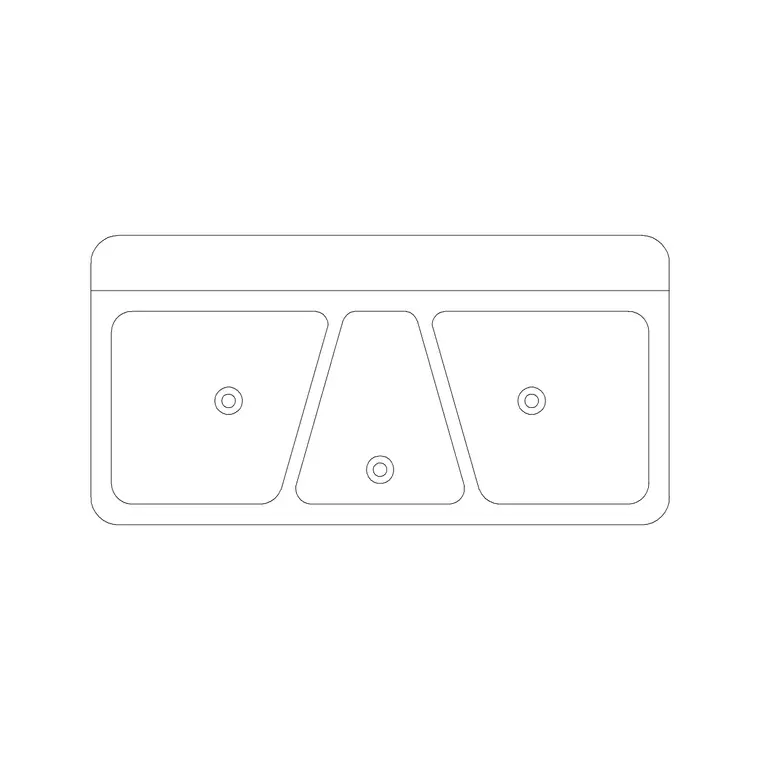
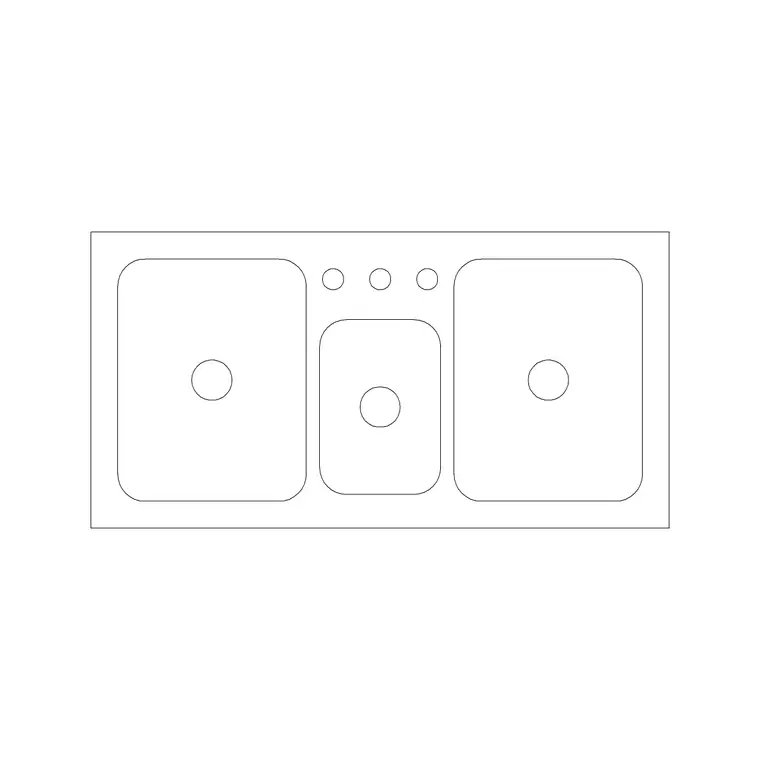
Drop the block onto a plan and the full three-compartment footprint shows at once, so you can read the run length against the kitchen wall, position it relative to the dishwash and prep zones, and confirm there is standing space in front for an operator. In a commercial drawing the triple sink is often a fixed point that the rest of the wash-up area is planned around.
What a triple bowl sink block represents
The block draws three basins set side by side, divided by two partitions, with tap or pre-rinse positions behind. In plan you see all three bowl openings, the dividers and the tap deck; the three-compartment arrangement is the defining feature, matching the wash-rinse-sanitise method used in food-service kitchens. Some versions show the bowls equal in size, others a larger central or end bowl.
It is built as a single block reference, so the whole three-bowl run moves and rotates as one object. The bowls, dividers and taps are drawn so you can recolour or freeze them as needed — handy when you want the bowl cut-outs to stand out on a stainless-steel fabrication drawing but stay quiet on a general arrangement plan.
Views and what's included
The plan view is the working view for kitchen and wash-up layouts, showing the three basins from above along the worktop or fabricated bench. Where an elevation is supplied, it shows the bowl depths below the bench line and the tap or pre-rinse spray profile rising above — useful for a stainless-steel bench elevation or a fabrication sheet.
A triple sink is usually drawn symmetrical end-to-end, so orientation is mostly about which way the operator faces and where the drainage runs. Insert it, align it with the bench, and keep the taps as separate elements so you can substitute a commercial pre-rinse unit or pillar taps from the faucet category without redrawing the basins.
Typical triple bowl sink sizes
Treat these as ranges to design around, not exact specs. A triple bowl unit is long: the three compartments plus dividers commonly push the overall length well beyond a metre, often in the region of 1000–1500 mm or more depending on bowl size, and individual bowls tend to be deeper than domestic basins to handle pans and trays. Bench depth in a commercial setting is frequently drawn at around 600–700 mm.
In a commercial kitchen the sink usually forms part of a fabricated stainless bench at a working height conventionally around 850–900 mm. Because the unit is long and the duty is heavy, plan generous standing and circulation space in front, and allow landing area at each end for dirty items in and clean items out.
How to insert and scale the block
The block is drawn full size in millimetres. Insert at scale 1 in a millimetre drawing, 0.001 in a metre drawing, or set INSUNITS to millimetres so AutoCAD rescales an imperial template on insertion. Use INSERT or drag the DWG from a tool palette.
Pick an insertion point you can snap to the bench line — an end corner or a bowl centre — and rotate to suit the wash-up wall. Put the sink on a sanitary-ware or catering-equipment layer so you can produce a clean shell plan by freezing equipment and a fitted plan by thawing it. If you need to change a bowl size or the tap arrangement, edit the block definition once with BEDIT and every placed instance updates together.
Where triple bowl sinks are used
Triple sinks are standard in commercial and institutional kitchens, bar back-of-house, cafes, canteens, school and hospital catering, and any setting where a three-stage manual wash is required or specified. They also suit serious domestic utility rooms, potting sheds and workshops where a multi-stage rinse is wanted.
Plan the triple sink alongside the dishwash machine, the soiled-dish landing and the clean-dish drying zones so the wash-up flows in one direction. Pair the block with the commercial cooker, prep bench and shelving blocks in the kitchen and equipment sets, and keep the catering equipment on its own layer so the drawing stays readable as the fit-out develops.
Free download
Browse the full library — DWG & DXF, no signup.
Questions
Frequently asked
What is a triple bowl sink used for?+
Three compartments support the commercial wash, rinse and sanitise sequence used in food-service kitchens and bars. The block draws all three basins to scale so you can plan the wash-up zone around them.
How much wall length does a triple sink need?+
Triple sinks are long, often in the region of 1000–1500 mm or more overall depending on bowl size. The block is true-scale, so insert it and measure against your actual bench run rather than assuming a fixed length.
Can I swap the taps for a commercial pre-rinse unit?+
Yes. The taps are kept as separate elements where possible, so you can delete them and insert a pre-rinse spray or pillar-tap block from the faucet category without redrawing the basins.
Is the triple bowl sink block free for commercial drawings?+
Yes. It downloads free in DWG and, where available, DXF, with no signup, watermark or attribution, and it is cleared for use in commercial project work.
Related downloads
Blocks for this guide
Related categories
Related guides
Block landing
Free Sanitary Fixtures CAD Blocks — DWG Download
Download free sanitary fixtures CAD blocks in DWG and DXF — WCs, wash basins, urinals and sinks in plan and section for AutoCAD sanitary plans.
Block landing
Free Kitchen Faucet / Mixer Tap CAD Block — DWG
Download free kitchen faucet and mixer tap CAD blocks in DWG and DXF — monobloc and pull-out mixers in plan and elevation. No signup, commercial OK.
Block landing
Free Kitchen Sink Unit CAD Block — DWG Download
Download free kitchen sink unit CAD blocks in DWG and DXF — single, double and 1.5-bowl sinks with drainers in plan and section. AutoCAD 2004+, no signup.