Explainer · top view vs plan view
Top view vs plan view: are they the same thing? in 2026
By Sumana Kumar · Published 21 Sep 2025 · Updated 5 Feb 2026
If you have browsed a CAD block library, you have probably seen the same kind of block labelled two different ways — sometimes 'top view', sometimes 'plan view'. It raises a fair question: are they the same thing, or is there a real distinction hiding behind the labels? The honest answer is that they overlap heavily, and in everyday use people treat them as synonyms — but the terms come from slightly different traditions and carry slightly different baggage worth knowing.
This guide untangles top view and plan view: what each term really means, where they come from, the small but real differences in how they are used, and — the practical bit — which block to download when you see either label. Whether a tree block is sold as a 'top view' canopy or a 'plan view' canopy, you will know it is the right one for a floor or site plan.
The short answer
For most purposes, top view and plan view mean the same thing: an object or building seen from directly above, projected straight down onto a horizontal plane, with no perspective. A tree's canopy seen from above, a chair seen from the top, a building's layout looked down upon — all are both a top view and a plan view.
So when you see a CAD block labelled 'tree top view' versus 'tree plan view', you are almost always looking at the same kind of block: the object drawn as it appears from above, ready to drop into a layout. The difference is mostly which word the person who named the block reached for, and which field they came from. The distinctions below are real but rarely change which file you actually want.
Where 'top view' comes from
'Top view' is the language of orthographic engineering drawing. In the standard six-view orthographic system used in mechanical and product design, an object is shown from six directions — front, top, bottom, left, right and rear. The top view is simply the one looking straight down. It is one of a family of equally-weighted views, and it describes a discrete object rather than a building.
Because of that origin, you tend to see 'top view' on product-style and component blocks, and on furniture and fixtures described as objects. A 'top view' of a sofa or a sink is the engineering-drawing way of saying 'this is what it looks like from above', sitting alongside its front and side views in the same orthographic family.
Where 'plan view' comes from
'Plan view' is the language of architecture and construction. A plan, as architects use the word, is not just 'seen from above' — it is a horizontal cut taken through the building at about 1.2 m and viewed from above. That cut is what makes doors and windows show in their openings and walls appear as sliced solids.
So in its strict architectural sense, a plan implies a cut, while a pure top view does not. A top view of a building would show the roof; a floor plan shows the storey below the roof because it is cut. For furniture and objects this distinction usually dissolves — the cut passes over a low chair without changing it — which is why the two terms behave as synonyms for most blocks even though their definitions differ at the building scale.
Where the difference actually bites
The distinction matters most at building scale and for tall objects. Ask for a 'top view' of a house and, strictly, you should get the roof seen from above. Ask for a 'plan' of the same house and you get the floor layout, because the plan is cut below the roof. That is a genuinely different drawing.
It can also matter for tall furniture or fittings. A 'top view' of a wardrobe shows its top surface; a 'plan' taken at cut height might show the interior arrangement if the cut passes through it. For low objects — a chair, a table, a tree canopy — the cut sails over the top and the two views are identical. So the rule of thumb is: the taller the thing and the closer it is to the cut height, the more 'top view' and 'plan view' can diverge.
Which block should you download?
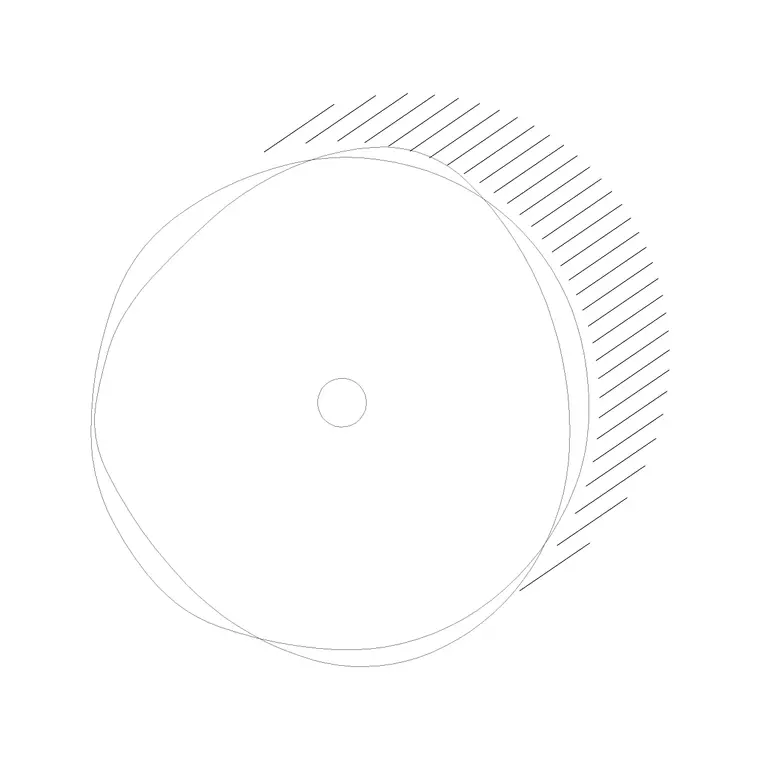
For a floor plan or a site plan, you want the object as seen from above — and whether the block is labelled 'top view' or 'plan view', that is what you are getting for furniture, fixtures, vehicles and trees. A 'tree top view' canopy and a 'tree plan view' canopy both drop into a site plan exactly the same way.
The one time to read carefully is at building scale: if you need a floor layout, look for 'floor plan', not a roof 'top view'. For everything object-sized, treat the labels as interchangeable and choose the block whose drawing style and detail suit your scale. The blocks here are drawn for layout use, so a top-view or plan-view canopy is ready to array across a plan without any reinterpretation.
A quick way to keep them straight
Hold two ideas in mind and you will never be confused. First: both are 'seen from straight above with no perspective', so for any object-sized block they are effectively the same view and the labels are interchangeable. Second: 'plan' carries an extra architectural meaning — a horizontal cut through a building — so at building scale a plan is the cut floor layout, not the roof you would see in a literal top view.
In practice, you will spend most of your time placing object blocks where the distinction does not bite, so reach for whichever is labelled and trust it. Save the careful reading for building-scale drawings, where asking for a 'plan' rather than a 'top view' gets you the floor layout you actually need.
Free download
Browse the full library — DWG & DXF, no signup.
Questions
Frequently asked
Is top view the same as plan view?+
For object-sized blocks like furniture, fixtures and trees, yes — both mean 'seen from straight above with no perspective', so the labels are interchangeable. They diverge at building scale, where a 'plan' is a horizontal cut through the storey while a literal 'top view' would show the roof.
Why do some CAD blocks say 'top view' and others say 'plan view'?+
It usually reflects the naming tradition of whoever made the block — 'top view' comes from engineering orthographic drawing, 'plan view' from architecture. For most blocks they describe the same above-looking view, so either label gives you a block ready for a layout.
If I'm drawing a floor plan, which should I pick?+
Either, for furniture and fixtures — a 'top view' chair and a 'plan view' chair both drop into a floor plan the same way. Only at building scale should you specifically look for 'floor plan' rather than a roof 'top view'.
Does a top view include the roof of a building?+
Strictly, yes — a literal top view of a building shows the roof. A floor plan is different: it is cut below the roof at about 1.2 m, so it shows the layout of the storey rather than the roof above it.
Related downloads
Blocks for this guide
Popular blocks to download
Related categories
Related guides
Explainer
Plan vs Elevation vs Section Explained
Plan vs elevation vs section explained simply — what each architectural view shows, how they differ, when to use each, and how they read together in a drawing set.
Explainer
2D vs 3D CAD Blocks Explained in 2026
2D vs 3D CAD blocks explained — what each is, file size and performance differences, when to use flat blocks vs solid models, and which to download for your drawing.
Explainer
What Is a Floor Plan? A Clear Explanation
What is a floor plan? A clear explanation of what it shows, the cut height, the symbols it uses, how to read one, and how it differs from other drawings.