Block landing · small kitchenette cad block
Free small kitchenette CAD block for AutoCAD
By Saumyajit Maity · Published 5 Apr 2024 · Updated 20 Feb 2026
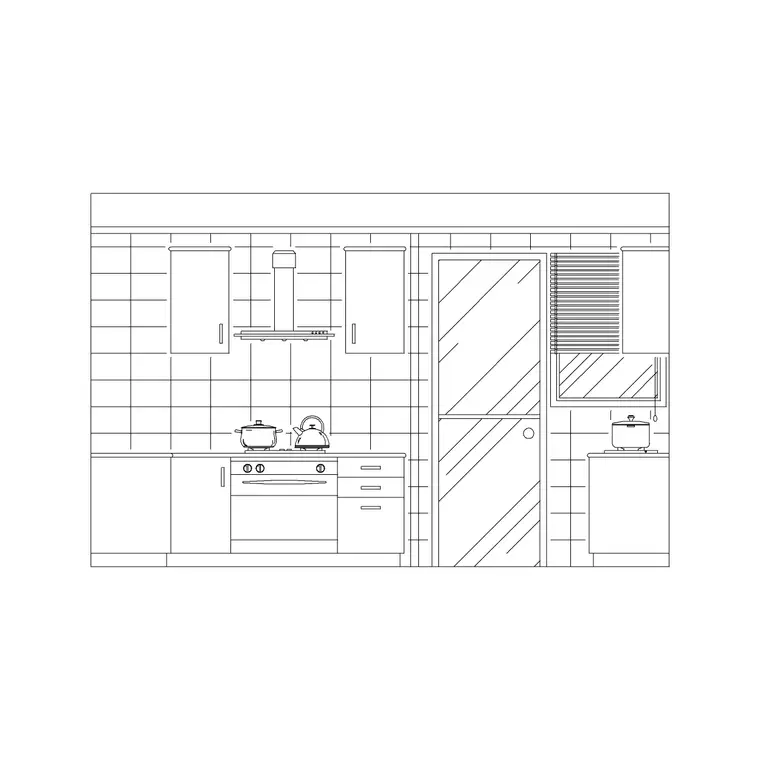
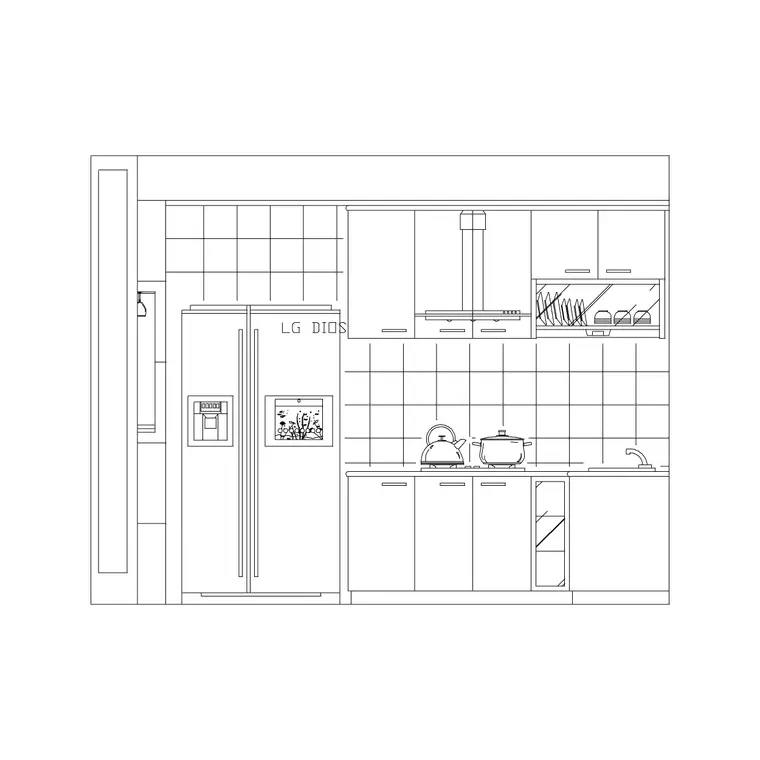
A kitchenette packs the essentials of a kitchen — a sink, a hob or small cooker, an undercounter fridge and a little storage — into the shortest possible run, for studio flats, offices, hotel rooms and annexes where a full kitchen won't fit and isn't needed. This page gives you a free small kitchenette CAD block in DWG: a compact, single-wall kitchen drawn to scale and ready to drop into tight plans. It opens in AutoCAD 2004 and later and is free for personal and commercial use, no signup, no watermark.
The whole challenge of a kitchenette is doing a lot in very little length, so a scaled block is especially valuable here — every hundred millimetres counts when the entire kitchen is two or three modules long. Dropping in a correctly-sized kitchenette lets you see immediately whether it fits the alcove, the wall or the cupboard you have, and whether there is room to stand and use it.
Use it on studio and micro-apartment plans, office tea-points, hotel and serviced-apartment rooms, granny annexes and basement conversions. It pairs with the individual sink, hob and undercounter blocks when you need to tune the mix.
What a kitchenette block includes
A kitchenette block compresses the kitchen down to its essentials along a single short run: a small sink, a two-burner hob or a compact cooker, an undercounter fridge, and a base unit or two for storage, all under a continuous worktop. Wall cabinets or open shelves often sit above to claw back storage in the limited footprint. There is no room triangle to speak of — everything is within arm's reach along one line.
It is drawn as a coordinated little assembly you can insert as one reference and explode to edit. Because it is built on the same 600 mm module as a full kitchen, the parts share the grid, but the run is far shorter — often just 1.2 to 2.4 m end to end depending on what it has to include.
Kitchenette sizing and the run length
The defining dimension of a kitchenette is its overall run length, and it is set by how many modules you fit. A minimal kitchenette — sink plus two-burner hob plus a small undercounter fridge — can sit in roughly 1.2 to 1.5 m of run; add more storage or a slightly larger cooker and it grows toward 2.0 to 2.4 m. Depth stays on the standard 600 mm base line, and worktop height on the usual 900 mm.
The clearance that matters is the space to stand and work in front of the run. In a studio, that floor zone often doubles as circulation, so allow enough clear depth in front — around 1000 mm — for someone to open the undercounter fridge and stand at the hob. Treat these as the typical ranges to design within and confirm against the specific units and appliances you choose; the point of the scaled block is that the fit is real, not guessed.
Fitting a kitchenette into a tight plan
Insert the block full size in millimetres — scale 1 in a millimetre drawing, or set INSUNITS to millimetres so AutoCAD rescales on insertion. Slide it against the wall or into the alcove it has to occupy and check the run length against the available wall: a kitchenette lives or dies on whether it fits the space it is given.
If the run is slightly too long, explode the block and drop a module — swap a base unit for open shelves, or a small cooker for a two-burner hob plus a separate compact oven only if there is room. If it is too short, you have spare wall to add a little storage. Because every part is a scaled block, you tune the mix while keeping the fit honest, and the worktop stays continuous as you stretch it to the new length.
Kitchenette vs full kitchen on the drawing
The difference is ambition, not just size. A full kitchen is designed around a work triangle between cooker, sink and fridge, with generous worktop and storage; a kitchenette gives that up for compactness, lining everything along one short run for occasional or light cooking. On the drawing, a kitchenette is essentially a single-wall kitchen shrunk to its minimum.
Choose a kitchenette block when the space and the brief call for a tea-point or a studio kitchen rather than a household kitchen — an office break area, a hotel room, a bedsit, an annex. If the room and the use justify a proper kitchen, reach for the complete-layout or individual kitchen blocks instead. Drawing the kitchenette to scale makes the case either way, because it shows honestly how little — or how much — the run delivers.
Who uses the kitchenette block
Architects use it to fit credible compact kitchens into studios, micro-apartments and HMO rooms where space is at a premium. Interior designers and office fit-out designers use it for break-out tea-points. Hotel and serviced-apartment designers use it for in-room kitchenettes. Students use it for small-dwelling and conversion projects where every millimetre of the plan is contested.
It pairs with the small-sink, two-burner hob, undercounter fridge and compact-oven blocks in the kitchen category for when you explode and tune it, and with the furniture and bathroom categories to fit out a whole studio or annex from one consistent library.
Layering and reusing the kitchenette
Keep the kitchenette's appliances, base units, wall units and worktop on their own layers so you can produce a clean plan and a fitted plan from the same drawing, just as with a full kitchen. The small footprint makes tidy layering even more useful, because there is no room for ambiguity in a tight plan.
Once you have a kitchenette mix that suits a recurring situation — a studio-flat tea-point, say — WBLOCK it as your own kitchenette block so the right compact kitchen drops into the next unit in one move. For a development of small units, a couple of these saved kitchenette blocks let you populate every studio quickly and consistently, then fine-tune any that sit in an awkward wall.
Free download
Browse the full library — DWG & DXF, no signup.
Questions
Frequently asked
What does a kitchenette block include?+
The kitchen essentials compressed into one short run: a small sink, a two-burner hob or compact cooker, an undercounter fridge and a base unit or two, under a continuous worktop, often with shelves or wall units above. It is a single-wall kitchen at its minimum size.
How long is a small kitchenette run?+
A minimal kitchenette sits in roughly 1.2–1.5 m of run; adding storage or a larger cooker takes it toward 2.0–2.4 m. Depth stays on the 600 mm base line and worktop height on the usual 900 mm. Confirm against the actual units you choose.
When should I use a kitchenette instead of a full kitchen?+
Use a kitchenette where space and brief call for a tea-point or studio kitchen — offices, hotel rooms, bedsits, annexes — and light or occasional cooking. Use a full kitchen where the room and use justify a work triangle, generous worktop and storage.
Is the kitchenette CAD block free for commercial work?+
Yes. It downloads free in DWG with no signup, no watermark and no attribution requirement, and it is cleared for commercial project use.
Related downloads
Blocks for this guide
Related categories
Related guides
Block landing
Free Bathroom Fixtures CAD Blocks — DWG Download
Download free bathroom fixtures CAD blocks in DWG and DXF — toilets, wash basins, bathtubs, showers and vanities drawn in plan and elevation. No signup, commercial OK.
Block landing
Free Gas Stove / Cooktop CAD Blocks — DWG
Free gas stove and cooktop CAD blocks in DWG and DXF — drawn in plan and elevation at true kitchen-module sizes for AutoCAD 2004+. No signup, commercial-use OK.
Block landing
Single Burner Hob CAD Block — Free DWG
Free single burner hob CAD blocks in DWG and DXF for compact kitchens and studios — plan and elevation, true sizing for AutoCAD 2004+. No signup, commercial OK.