Room guide · scullery cad blocks
Scullery CAD blocks for back-kitchen and prep layouts
By Sumana Kumar · Published 12 Apr 2023 · Updated 5 Jan 2026
A scullery is a working back kitchen — the messy, hard-working room behind the show kitchen where the real washing-up, prep and bulk storage happen. In modern homes it is the partner to an open-plan kitchen: the island and the polished run stay clean and sociable because the scullery, hidden behind it, takes the dishes, the appliances and the clutter. Historically it was where pots were scrubbed; today it is a prep-and-wash workhorse. Designing one is about cramming serious working function into a utilitarian space.
The blocks here are the working kit — twin or large sinks, a dishwasher, a washing machine, a generous prep counter, and tall storage — drawn to true dimensions in DWG and DXF and free for personal and commercial use. Because they are scaled, you can prove the scullery holds the wash zone, the second appliances and the bulk store that the main kitchen offloads, in the tight footprint these rooms usually get.
The organising idea of a scullery is offload: it absorbs the functions that would clutter an open kitchen — the dirty dishes, the prep mess, the appliances, the dry store — so the main kitchen can stay clean and on show. Pack the wash zone, the prep run and the storage in efficiently and a small scullery does the heavy lifting for a beautiful kitchen.
What a scullery does and how it pairs with the kitchen
A scullery is the back-of-house kitchen. In a contemporary home it sits directly behind or beside the open-plan kitchen, often through a doorway off the run, and takes everything that would spoil the look of the show kitchen: the sink full of dishes, the dishwasher, the bins, the prep mess, the small appliances and the bulk dry store. The host preps and washes here, then carries the clean, finished result out to the island.
That pairing drives the design. The scullery is utilitarian — durable surfaces, lots of worktop, a big wash zone — and it connects to the main kitchen by a short route so things move easily between the two. It overlaps with the idea of a butler's pantry, but a scullery leans toward washing and prep rather than serving and china storage. The blocks suit either reading because both are a working run of sink, appliances and storage.
The wash zone as the priority
Washing is the scullery's headline job, so the wash zone is the priority. That usually means a large or twin sink — one bowl for washing, one for rinsing or draining — with a generous draining run beside it, plus the dishwasher next to it sharing the waste and water. Because the dirty dishes come here rather than to the show kitchen, the sink is often bigger than the main kitchen's.
Give the sink a long landing run on at least one side for stacking and draining, and put the dishwasher immediately beside it so loading is a turn, not a walk. A second under-counter zone can take a washing machine where the scullery doubles as a utility. Draw the twin sink, the draining run and the dishwasher together as a wash block, and confirm the dishwasher door, when down, still leaves room to stand at the sink.
Blocks for a working scullery
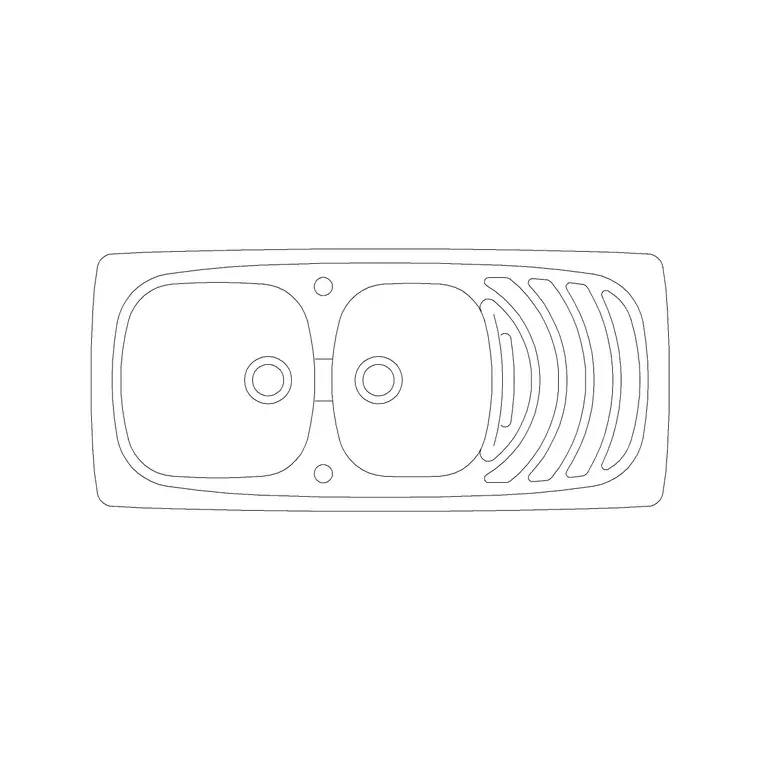
The wash zone leads — a double sink with a drainer and a compact, hard-wearing faucet, with the dishwasher footprint beside it. A washing machine often shares the room where it is part utility. A generous prep counter, longer than the main kitchen sometimes allows, gives the messy preparation surface; small-appliance blocks — a toaster, a juicer, a grill, a stand mixer — live here permanently, out of the show kitchen.
Tall storage and cabinet runs hold the dry goods and the bulk store the open kitchen has no room for, so a run of tall units or shelving lines one wall. A second fridge or under-counter cold store frequently lives here too. The kit is deliberately heavy on wash, prep and storage and light on cooking — a scullery may have no hob at all, since the cooking stays in the show kitchen.
- Wash: double sink, drainer, dishwasher, faucet - Utility: washing machine where the room doubles up - Prep: a long, durable worktop run - Store: tall units and shelving, a second fridge - Parked appliances: toaster, juicer, grill, mixer
Clearances in a tight working room
Sculleries are usually small, so the clearances are the same as a galley kitchen and just as critical. Between opposing runs, keep at least 1000 mm of clear floor so a person can work the sink on one side and reach storage on the other, and so the dishwasher and oven doors can open. Where the scullery is a single run, allow at least 1000 mm of standing space in front so doors clear and someone can work at the counter.
The door to the main kitchen is part of the flow — keep its swing clear of the wash zone and the appliance doors, because traffic between the two rooms passes through it constantly while cooking. Draw the dishwasher and washing-machine door swings into the gap; in a narrow scullery two appliance doors opening opposite each other can block the room entirely, which a scaled plan exposes at once.
Drawing the scullery in AutoCAD
Draw the room and the connecting doorway to the main kitchen first, since the route between the two governs the layout. Place the wash zone — twin sink, drainer, dishwasher — on the wall nearest the existing waste, with a long draining run beside the sink. Set the prep counter on the facing or adjacent wall and line the remaining wall with tall storage blocks.
Keep the wash zone, appliances, prep counter, tall storage and lighting on separate layers, exactly as for a main kitchen, so you can plot a plan and an elevation. Draw the appliance door swings into the circulation gap and confirm 1000 mm clear between runs. Add good task lighting on the lighting layer over the sink and the prep run — a scullery is a working room and wants more light than a show kitchen, not less.
Common scullery mistakes
The first mistake is treating the scullery as an afterthought and starving it of worktop — its whole purpose is to absorb prep and washing, so a stingy counter sends the mess back into the show kitchen. Give it a generous run. The second is a narrow room where the dishwasher door and a facing appliance door open into the same gap and block the floor, which only a drawn door swing reveals.
The third is forgetting the route to the main kitchen — a scullery whose doorway is choked by the wash zone or whose swing fouls an appliance makes the constant back-and-forth during cooking painful. The fourth is under-lighting it because it is hidden; a back kitchen where the real work happens needs bright task light over the sink and prep run, planned on the lighting layer from the start.
Free download
Browse the full library — DWG & DXF, no signup.
Questions
Frequently asked
What is a scullery and how is it different from a pantry?+
A scullery is a working back kitchen for washing, prep and bulk storage that keeps the main kitchen clean, so it has a big sink, a dishwasher and prep counter. A pantry is dedicated storage — shelving and larder units — with no wash zone. A scullery often includes pantry-style storage as well.
Does a scullery need a hob?+
Often not. The cooking usually stays in the show kitchen, and the scullery concentrates on washing, prep and storage. The kit leans heavily on a large sink, a dishwasher, a long prep counter and tall storage rather than a cooking zone.
How much clearance does a scullery need between runs?+
Keep at least 1000 mm of clear floor between opposing runs, the same as a galley kitchen, so a person can work the sink on one side and reach storage on the other and the dishwasher and appliance doors can open without blocking the floor.
Why have a separate sink in the scullery as well as the kitchen?+
The scullery sink takes the dirty dishes and prep washing so the main kitchen's sink and the open island stay clean and on show. It is often larger — a double bowl with a long drainer — because it does the heavy washing-up for the home.
Are the scullery blocks free and in what formats?+
They download in DWG and DXF, open in AutoCAD 2004 and later, and are free for personal and commercial use with no signup or watermark.
Related downloads
Blocks for this guide

Related categories
Related guides
Room guide
Kitchen CAD Blocks — Design the Room in DWG
Design a full kitchen in AutoCAD with free DWG blocks — appliances, sink, cabinets and lighting scaled for the work triangle, clearances and a clean plan.
Room guide
Modular Kitchen CAD Blocks — DWG Module Grid
Free modular kitchen CAD blocks in DWG — base, wall and tall units on the standard module grid, plus appliances sized to drop straight into the carcass run.
Room guide
Kitchenette CAD Blocks — Compact Kitchen DWG
Free kitchenette CAD blocks in DWG — compact sink, two-burner hob, under-counter fridge and short cabinet runs scaled for studio, office and apartment plans.