Room guide · patio cad blocks
Free patio CAD blocks for AutoCAD
By Saumyajit Maity · Published 11 Feb 2026 · Updated 19 May 2026
A patio is a paved outdoor floor — usually flush with the ground and adjoining the house — built to hold furniture and outdoor living. Where a deck is timber over a frame and a terrace sits on a roof, a patio is a hard surface laid on the ground: the simplest outdoor room, and the one most defined by its paving and the furniture on it. These free patio CAD blocks bring together the paver patterns, outdoor dining and lounge furniture, planters and edging you need to lay one out to scale in AutoCAD, all in DWG.
The whole art of a patio plan is sizing. A patio that is too small for its furniture is the single most common mistake in residential landscape drawings — the table fits on paper but there is no room to pull a chair out or walk behind a seated guest. Drawing the furniture into the paving at true scale, with real clearances, is what makes the difference.
Everything is free for personal and commercial use, no signup, no watermark, and opens in AutoCAD 2004 or later. Start by placing the furniture you actually need, then draw the paving around it with proper clearances — not the other way around.
What a patio is and how it differs from a deck or terrace
A patio is a paved area at ground level, typically against the house, used as an outdoor dining and sitting room. It differs from its cousins by construction and position: a deck is raised timber or composite on a frame, a terrace is a paved upper-floor or roof space, and a balcony projects from an upper room. The patio is the ground-level paved floor — and that simplicity is its strength, because there is no structure to design around, only the surface and what sits on it.
That makes the patio the most furniture-led of the outdoor rooms. The paving is the stage; the dining set, lounge seating and planters are the cast. Get the relationship between the paving size and the furniture right and a patio works; get it wrong and no amount of planting saves it.
Sizing the patio to its furniture
Size the patio from the inside out. A four-seat round dining set needs the table plus roughly 750–900 mm on every side to pull chairs out and pass behind them, so a 1000 mm table grows into a paved zone well over 2.5 m across before you have added a walkway. A lounge cluster of a three-seat sofa and a couple of chairs around a coffee table needs its own footprint plus a path in.
Draw the furniture first — the dining set, the lounge group, a swing seat — then expand the paving to give every seat its pull-out and circulation clearance. Add a margin so people can walk from the house door to the garden without crossing the dining zone. A patio sized this way is the right size on site, not just on paper.
Paving patterns and edging
Paving is the patio's defining material, so the pattern carries the design. The paving blocks give you several setts and slab patterns; pick one that suits the scale — large-format slabs for a calm contemporary patio, smaller setts for a traditional or textured look. Lay the pattern with a clear edge against the house and a defined boundary to the lawn or beds so the patio reads as a deliberate shape.
Run a subtle fall away from the house — around 1:60 to 1:80 is common — so water drains off the surface and away from the building; carry the exact figure to your section and let the paving joints hint the direction in plan. A clean edging line, whether a contrasting course or a bed, stops the patio bleeding into the garden and makes the whole composition crisper.
Furniture, planters and the link to the garden
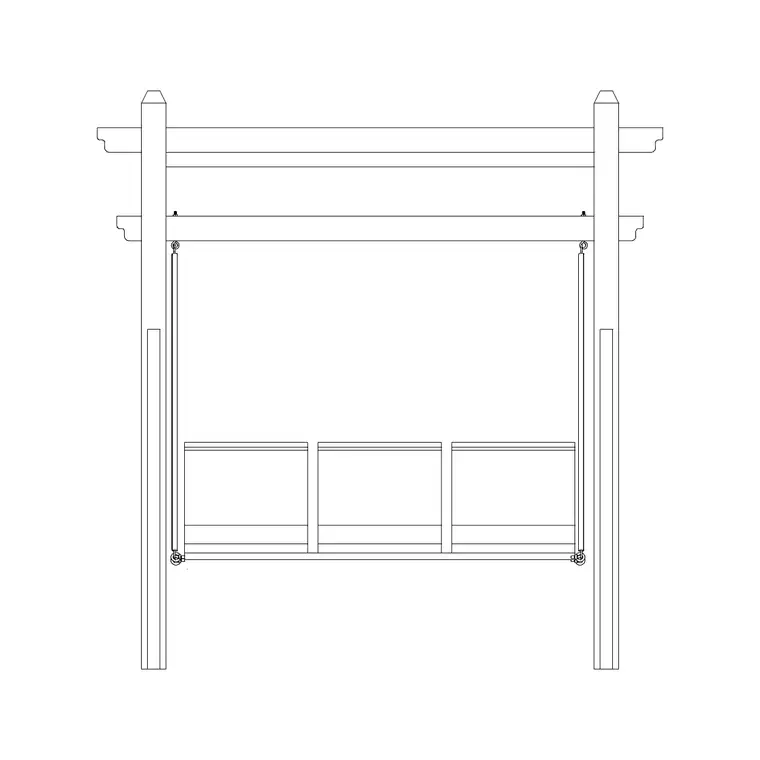
Furnish the patio in two zones where space allows: a dining zone with the table set, and a lounge zone with sofas or a swing seat. The blocks cover a three-seat outdoor sofa in front and side views, a swing chair, and a round two-person table. Orient the dining set to the kitchen door for easy serving and the lounge to the best view or the evening sun.
Soften the hard surface with planters around the edges and a few specimen pots, using the medium and low potted-plant blocks, and let boundary beds frame the patio without crowding the furniture. Where the patio meets the lawn, a step or flush threshold and a clear path keep the link to the rest of the garden legible — the patio is the gateway between house and garden, not a sealed island.
Building the patio plan
Draw it furniture-first. First, place the dining set and lounge cluster at true scale where you want them relative to the house door and the view. Second, expand the paving around them with 750–900 mm pull-out and circulation clearance and a walkway margin. Third, add the edging line and the fall direction. Fourth, ring the patio with planters and frame it with boundary beds. Fifth, draw the threshold and path linking it to the lawn or garden beyond.
Keep paving, furniture, planters and edging on separate layers, and insert furniture and pots as named blocks so a swap updates everywhere. Dimension the clear space around the dining table and the patio's overall size — those numbers are the proof that the patio is genuinely usable, not just drawn.
Patio design mistakes
- Undersizing: the commonest patio error by far. A table that fits on paper with no pull-out room is unusable. Size from the furniture out. - No fall: a flat patio against the house drains toward the building and damps the wall. Always slope away from the house. - No edge: paving that fades into the lawn looks unfinished and spreads. Define a crisp edging line. - One cramped zone: forcing dining and lounging into the same tight footprint pleases neither. Give each a zone where space allows. - Furniture as an afterthought: paving a slab and then trying to fit furniture is backwards. The furniture sizes the patio.
Free download
Browse the full library — DWG & DXF, no signup.
Questions
Frequently asked
How is a patio different from a deck or terrace?+
A patio is a paved floor at ground level, usually against the house. A deck is raised timber or composite on a frame, and a terrace is a paved upper-floor or roof space. The patio has no structure to design around — just the paving and the furniture it carries.
How do I size a patio correctly?+
Size it from the furniture out. Place the dining set and lounge cluster at true scale, then expand the paving to give every seat 750–900 mm to pull out and pass behind, plus a walkway margin. A four-seat round set alone needs a paved zone well over 2.5 m across.
Which way should a patio drain?+
Always away from the house, at a gentle fall of roughly 1:60 to 1:80, so surface water runs off toward the garden rather than the building. Show the direction with the paving joints in plan and carry the exact fall to your section.
What furniture blocks suit a patio?+
A round dining table with chairs for the dining zone, and a three-seat outdoor sofa or swing seat for the lounge zone, softened with potted plants around the edges. Orient the dining set to the kitchen door and the lounge to the best view or evening sun.
Are the patio blocks free to use commercially?+
Yes. Every block downloads as DWG free for personal and commercial work, no signup or watermark, and opens in AutoCAD 2004 or later and most DWG-compatible CAD software.
Related downloads
Blocks for this guide



Related categories
Related guides
Room guide
Free Balcony CAD Blocks — DWG Download
Free balcony CAD blocks in DWG — railings, compact seating, planters and pavers drawn to scale for AutoCAD apartment plans. No signup, commercial use OK.
Room guide
Terrace Garden CAD Blocks — Free DWG
Free terrace garden CAD blocks in DWG — raised planters, potted greenery, seating and paving to design a green roof terrace in AutoCAD. No signup.
Room guide
Rooftop Deck CAD Blocks — Free DWG
Free rooftop deck CAD blocks in DWG — lounge seating, railings, planters and decking pavers for roof terrace plans in AutoCAD. No signup, commercial OK.