Room guide · kitchen garden cad blocks
Free kitchen garden CAD blocks for AutoCAD
By Saumyajit Maity · Published 20 Feb 2024 · Updated 5 May 2026
A kitchen garden — a potager, a veg patch, a grow garden — is an outdoor room designed around production rather than display. It is laid out for growing food: raised beds and rows of planting, access paths between them wide enough to work and barrow along, a boundary that keeps animals out, and a service corner for potting, compost and tools. These free kitchen garden CAD blocks give you the raised beds, planting, paths, fencing and gate you need to plan one with real working geometry in AutoCAD, all in DWG.
The kitchen garden has a logic all its own. Beds are sized so you can reach the middle from the path without stepping on the soil; paths are sized for a person and a wheelbarrow; the whole layout favours a clear, often gridded plan that makes rotation, sowing and harvesting easy to manage. Beauty here follows function — a well-organised potager is handsome precisely because it is workable.
Everything is free for personal and commercial use, no signup, no watermark, and opens in AutoCAD 2004 or later. Start by setting out the bed-and-path grid, because the reach-and-barrow dimensions of that grid are what make a kitchen garden actually productive.
What a kitchen garden is built to do
A kitchen garden is a dedicated growing space — for vegetables, herbs, salads and soft fruit — attached to a home, restaurant, school or community plot. Unlike an ornamental garden, every decision serves production and the work of tending it: how far you can reach into a bed, how easily you can move a barrow, how the boundary keeps pests out, and where the dirty jobs of potting and composting happen. It is an outdoor workroom as much as a garden.
That function fixes the geometry. Beds are sized for reach so the soil is never compacted by footfall; paths are sized for a worker and a wheelbarrow; the layout is usually a clear grid because rows and rotation are easier to manage on a regular plan; and a fenced boundary protects the crop. Get those dimensions right in CAD and the garden works on the ground.
Raised beds and the reach rule
The raised bed is the kitchen garden's basic unit, and its width is governed by reach. Keep beds you work from both sides to roughly 1.2 m wide so the centre is reachable without standing on the soil, and beds against a wall or fence to about 0.6–0.75 m so you can reach the back. Length is flexible — set it to suit the plot and the path grid.
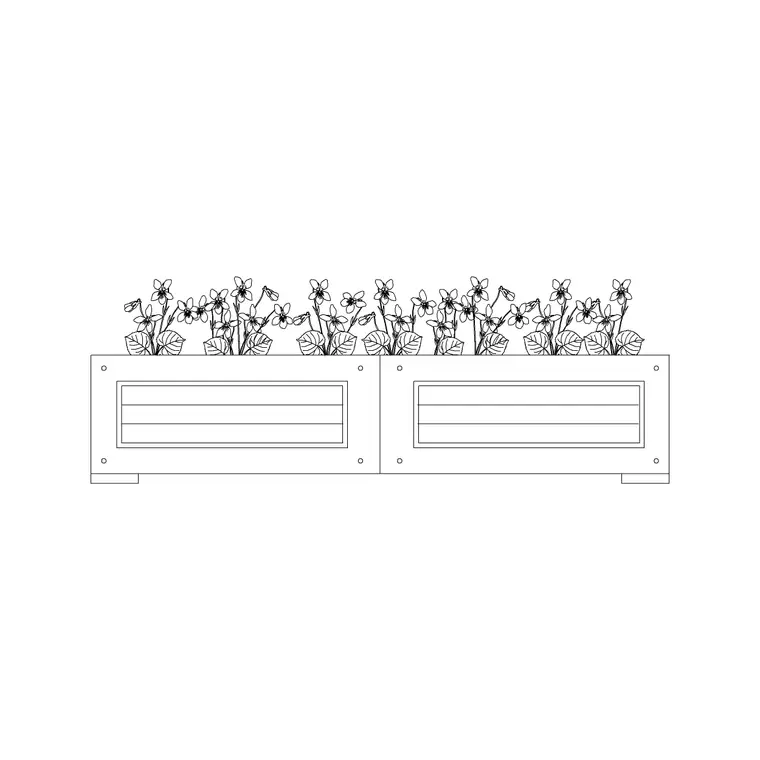
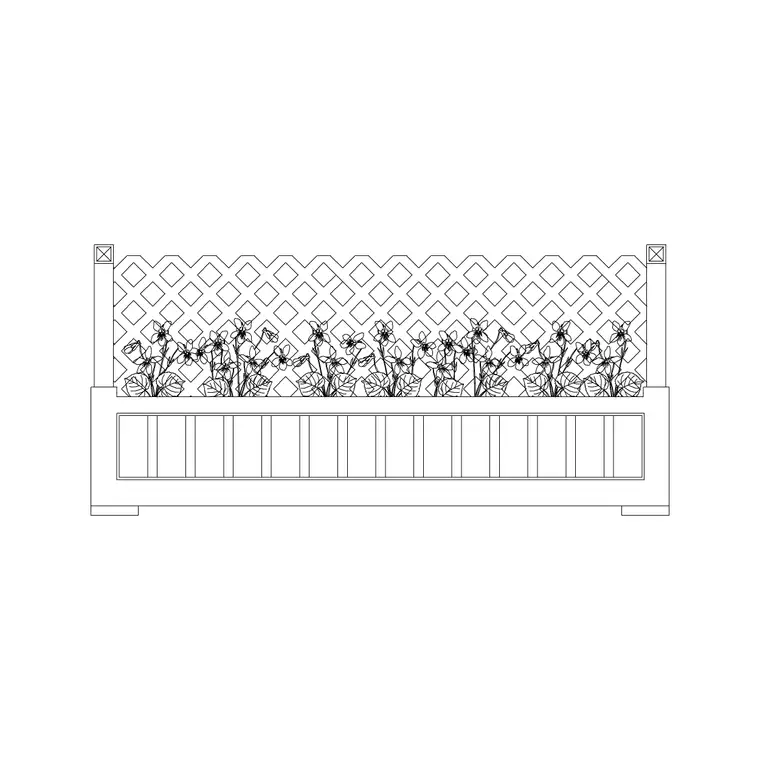
Use the rectangular and standard flower-bed blocks as raised growing beds, arrayed on a regular grid, and the round iron-fenced bed as a herb or feature centrepiece. Draw the beds at their built footprint and leave the planting symbols light, because the bed outline and the path between beds are what matter dimensionally. A grid of correctly sized beds is the backbone of a productive layout.
Paths, access and circulation
Paths in a kitchen garden are working corridors, not just routes. Keep main paths wide enough for a wheelbarrow and a turn — around 0.9–1.2 m — and secondary paths between beds at roughly 0.45–0.6 m, enough to kneel and tend. A central main path with beds either side is a classic, efficient arrangement that gets a barrow to every bed.
Surface the main paths so they stay usable when wet — a paver pattern or compacted gravel — and keep secondary paths simpler. The paving blocks suit the main spine. Set the grid so no bed is more than a short reach from a path and every bed can be barrowed to; a kitchen garden where you have to cross one bed to reach another is one that compacts its own soil. Circulation here is productivity.
Boundary, gate and the service corner
A crop needs protecting, so the boundary matters. Run a fence around the kitchen garden — a wooden fence for a traditional plot, an iron or metal fence for something more robust against animals — and place a gate wide enough to bring a barrow or deliveries through. The fence blocks and the single-swing and iron gate blocks cover this.
Reserve a service corner, ideally near the gate, for the unglamorous but essential functions: a potting bench, compost bins, a water butt and tool storage. Keep it out of the main view but easy to reach with a barrow. Tuck a small table or bench where you can pause among the beds. This combination — protected boundary, working gate and a service corner — is what turns a set of beds into a functioning kitchen garden.
Setting out the kitchen garden plan
Draw the grid first. First, set out the bed-and-path grid: beds at reach width (≈1.2 m worked both sides, ≈0.6–0.75 m against a wall), main paths at 0.9–1.2 m and secondary paths at 0.45–0.6 m. Second, draw the boundary fence and a barrow-width gate. Third, place the raised-bed blocks on the grid, with a feature bed or herb wheel as a centre if wanted. Fourth, surface the main path and lay the secondary paths. Fifth, set the service corner near the gate with potting, compost and water, and a bench among the beds.
Keep beds, paths, boundary, service area and planting on separate layers, and insert beds, fences and gates as named blocks so a resize ripples through the grid. A north arrow is essential here — it tells you which beds get full sun for fruiting crops and which sit in shade for leaves, which is real growing information, not decoration.
Kitchen garden mistakes
- Beds too wide to reach: a bed you must step into to tend compacts the soil and stunts the crop. Keep to the reach rule. - Paths too narrow for a barrow: a main path a wheelbarrow cannot pass makes the garden hard to work. Size the spine generously. - No protected boundary: an unfenced kitchen garden feeds the local wildlife first. Fence it and gate it for a barrow. - No service corner: nowhere to pot, compost or store tools means mess spreads through the beds. Reserve a working corner. - Ignoring the sun: placing fruiting crops in shade because the plan ignored orientation wastes a season. Mark north and plan by light.
Free download
Browse the full library — DWG & DXF, no signup.
Questions
Frequently asked
How wide should a raised bed be?+
About 1.2 m where you can work it from both sides, so the centre is reachable without standing on the soil, and about 0.6–0.75 m against a wall or fence so you can reach the back. Length is flexible and set to suit the plot and the path grid.
How wide do the paths need to be?+
Keep main paths at roughly 0.9–1.2 m so a wheelbarrow can pass and turn, and secondary paths between beds at about 0.45–0.6 m, enough to kneel and tend. A central main path with beds either side gets a barrow to every bed efficiently.
Why does a kitchen garden need a fence and gate?+
To protect the crop from animals and to control access. Run a fence around the plot — wooden for a traditional look, iron or metal for robustness — and fit a gate wide enough to bring a barrow or deliveries through. An unfenced kitchen garden tends to feed the wildlife first.
What is the service corner for?+
For the working functions a productive garden needs out of the main view: a potting bench, compost bins, a water butt and tool storage. Place it near the gate so it is easy to reach with a barrow, and keep it tucked away so the beds stay the focus.
Are the kitchen garden blocks free for commercial use?+
Yes. Every block downloads as DWG free for personal and commercial work, no signup or watermark, and opens in AutoCAD 2004 or later and most DWG-compatible CAD software.
Related downloads
Blocks for this guide
Related categories
Related guides
Room guide
Free Balcony CAD Blocks — DWG Download
Free balcony CAD blocks in DWG — railings, compact seating, planters and pavers drawn to scale for AutoCAD apartment plans. No signup, commercial use OK.
Room guide
Terrace Garden CAD Blocks — Free DWG
Free terrace garden CAD blocks in DWG — raised planters, potted greenery, seating and paving to design a green roof terrace in AutoCAD. No signup.
Room guide
Rooftop Deck CAD Blocks — Free DWG
Free rooftop deck CAD blocks in DWG — lounge seating, railings, planters and decking pavers for roof terrace plans in AutoCAD. No signup, commercial OK.