Block landing · greek temple cornice cad block dwg
Greek temple cornice CAD block in DWG
By Saumyajit Maity · Published 9 Apr 2025 · Updated 8 Jun 2026
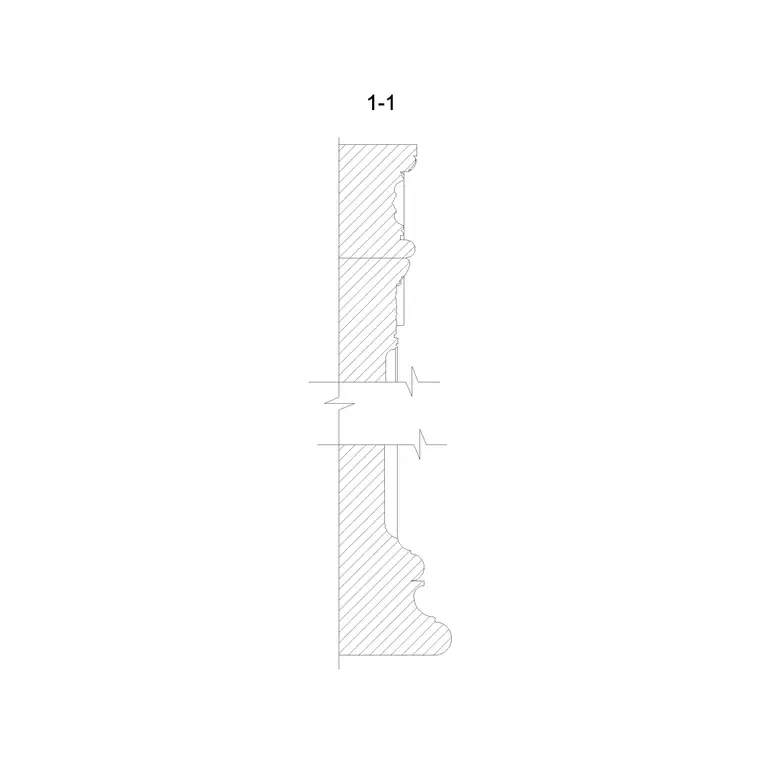
A Greek temple cornice CAD block gives you the geison — the projecting cornice that crowns a classical temple's entablature — drawn in section, with the mutules, the drip and the bold profile that throws the temple's characteristic shadow line. This free DWG is drawn full-size in millimetres and opens in AutoCAD 2004 or later. It is free for personal and commercial use, with no signup, no watermark and no attribution requirement.
The temple cornice is a specific, recognisable thing rather than a generic moulding: it is the top member of the Doric or Ionic entablature, it projects strongly to protect the frieze below, and its underside carries the mutules (Doric) or a dentil course (Ionic). This block carries that character so you can crown a temple-style portico, a classical pediment or a peristyle correctly, rather than approximating with a plain cornice.
What the temple cornice block shows
The block is a section through a Greek temple cornice — the geison — sitting at the top of the entablature. It carries the projecting corona, the bed mould below it, and the underside detail that signals the order: flat mutules with their guttae (small pegs) on a Doric cornice, or a dentil course on an Ionic one. Above the corona you may see the cyma (the crowning ogee) that runs up to the roof or pediment, and below it the frieze line.
It is editable linework, so you can adjust the projection, swap the Doric mutules for Ionic dentils, or simplify the profile for a small-scale drawing. Because it is real geometry, you can hatch the stone, dimension the projection and height, and keep the corona, bed mould and underside detail on separate sub-layers.
Views and the entablature it tops
This is the section view — the cornice profile cut through, which is how a temple cornice is detailed. It is the topmost of the three members of a classical entablature (architrave, frieze, cornice), so it pairs directly with the entablature block: use the entablature block for the full three-part assembly, and this cornice block when you want to focus on the crowning member or detail it at large scale.
On a pediment, the same cornice profile runs up the raking sides as the raking cornice, so the block also serves the sloping cornice of a gable. Pair it with the column elevation block below the entablature and the pediment above, and keep the cornice on its own layer so you can detail it independently of the frieze and architrave.
Proportions and sizing
A temple cornice is sized by the order and the column module, not by an absolute figure. The whole entablature is usually about a quarter of the column height, and the cornice is roughly the top third of that entablature, so on a tall portico the cornice can be a substantial band. Its projection is generous — enough to protect the frieze and triglyphs below and to read boldly from the ground — and the corona's underside is undercut with a drip so water does not track back onto the frieze.
Scale the block to your entablature depth, which in turn follows from your column diameter and height. Treat the classical proportions as a guide and design ranges rather than fixed dimensions, and confirm the support, fixing and weathering of any real built cornice against your construction standards, since the geison is a large projecting stone in masonry construction.
Inserting and detailing in AutoCAD
The block is full-size in millimetres. Insert at scale 1 in a millimetre drawing, 0.001 in metres, or set INSUNITS to millimetres in an imperial template so AutoCAD rescales on insertion. Snap the insertion point to the top of the frieze line and align the cornice with your entablature section.
For a pediment, place the horizontal cornice across the top of the entablature and run a copy of the same profile up each raking side, mirrored about the apex — the raking and horizontal cornices share the profile but meet at the pediment corners. Keep the cornice on its own layer, dimension the projection and height, and add the mutules or dentils to the underside. If you refine the profile, save it back with BEDIT so it runs consistently around the whole temple.
Where the temple cornice is used
It belongs on anything quoting Greek (or Greek-revival) temple architecture: porticos and porches with pediments, civic buildings, museums, banks, memorials and monuments, and the peristyles of temple-form buildings. Architects use it on neo-classical and Greek-revival facades; set and exhibition designers on temple-front backdrops; restoration teams on record and repair drawings of classical buildings.
Interiors borrow it for grand ceiling cornices and over-door treatments in classical rooms. Because the block is licence-clear, it suits student studies of the orders and competition boards without sourcing worry. Combine it with the column elevation, entablature and pediment-related blocks from the same family to assemble a complete Greek temple front, and with the cornice and skirting blocks for the interior.
Doric versus Ionic underside detail
The quickest way to set the order is the cornice underside. A Doric geison carries flat, sloping mutules with rows of guttae, lined up over the triglyphs of the frieze below; an Ionic geison usually carries a dentil course — a row of small rectangular blocks — instead. This block lets you switch between them by editing the underside, keeping the rest of the profile, so you can match the cornice to whichever order your columns use.
Keep the mutules or dentils on their own sub-layer so you can align them precisely with the frieze elements below and control their lineweight. When the order is set, reuse the cornice as a single profile block so every cornice on the building matches, and mirror it correctly at the pediment apex so the raking cornices meet cleanly.
Free download
Browse the full library — DWG & DXF, no signup.
Questions
Frequently asked
What is a Greek temple cornice called?+
The cornice of a Greek temple entablature is the geison — the projecting top member above the frieze. This block draws it in section, with the corona, bed mould and the mutules or dentils that mark the order on its underside.
How does a Doric temple cornice differ from an Ionic one?+
Mainly on the underside: a Doric geison carries flat mutules with guttae aligned over the triglyphs, while an Ionic geison usually carries a dentil course. The block lets you switch the underside detail while keeping the rest of the profile.
Can I use this cornice on a pediment?+
Yes. The horizontal cornice runs across the top of the entablature, and the same profile runs up the raking sides of the pediment, mirrored about the apex, so the temple cornice serves both the level and the sloping cornice.
Is the Greek temple cornice block free for commercial use?+
Yes. It downloads free in DWG with no signup, no watermark and no attribution requirement, cleared for commercial, personal and student projects.
Related downloads
Blocks for this guide

Related categories
Related guides
Block landing
Free Classical Column CAD Blocks — DWG Download
Download free classical column CAD blocks in DWG — shaft, capital and base drawn in elevation and plan for AutoCAD. No signup, free for commercial use.
Block landing
Free Greek & Ionic Column CAD Blocks — DWG
Free Greek and Ionic column CAD blocks in DWG — fluted shafts and volute capitals drawn in elevation for AutoCAD. No signup, free for commercial use.
Block landing
Free Decorative Arch CAD Blocks — DWG Download
Download free decorative arch CAD blocks in DWG — round, segmental and classical archways drawn in elevation for AutoCAD. No signup, free for commercial use.