Room guide · front yard landscape cad blocks
Free front yard landscape CAD blocks for AutoCAD
By Saumyajit Maity · Published 29 Apr 2024 · Updated 26 Apr 2026
The front yard is the public face of a property and a working access zone at the same time. It has to look welcoming from the street, guide a visitor to the door, and accommodate a car, the bins and the boundary all at once. That dual job — kerb appeal plus circulation — makes it a different design problem from the private backyard. These free front yard landscape CAD blocks give you the driveway paving, boundary fencing and gates, entry trees and planting you need to lay one out at scale in AutoCAD, all in DWG.
A front yard is read in two ways: as a composition from the street, and as a route from the gate to the front door (and from the car to the door). The strongest front gardens resolve both — a clear, generous path to the entrance, parking that does not dominate, a boundary that frames the plot, and planting that softens the hard surfaces without hiding the house.
Everything is free for personal and commercial use, no signup, no watermark, and opens in AutoCAD 2004 or later. Begin with the boundary, the gate and the front door, because the path between gate and door is the spine the whole front yard hangs on.
What a front yard has to balance
A front yard, or front garden, is the space between the public street and the house entrance. It serves arrival and display: it carries the path to the door, often a driveway and parking, the boundary wall or fence with its gate, the bins and meters, and the planting that gives kerb appeal. Unlike a backyard it is overlooked by the public and used mostly in transit, so legibility — can a visitor instantly see where to go — matters as much as beauty.
The non-negotiables are the route and the access. The path from gate to door must be obvious and direct; the car must get in and out without three-point manoeuvres; the bins need a home that is not the first thing you see. Resolve those, and the planting and surfaces can do the work of making it handsome.
The path and the driveway
Two hard surfaces dominate most front yards: the path to the door and the driveway. Draw the path first as a direct, generous route from the gate to the entrance — at least 900 mm wide, more where it is the main approach — paved in a pattern that reads as the welcome mat. The paving blocks give you several patterns to distinguish the path from the drive.
The driveway needs room for a car to park clear of the path and to turn or reverse safely; draw a real vehicle footprint plus door-opening clearance rather than a token rectangle. Keep the driveway material and pattern distinct from the pedestrian path so the two routes read separately. Where parking dominates a small frontage, break the hard surface with planting strips so it does not become a slab of paving.
Boundary, gate and fencing
The boundary frames the front yard and signals the threshold from public to private. Choose the boundary block that suits the house — a low wall, an iron fence for a formal frontage, a wooden fence for a softer one, or a metal fence with wall for security. Run it along the plot line and set the gate where the path meets the street.
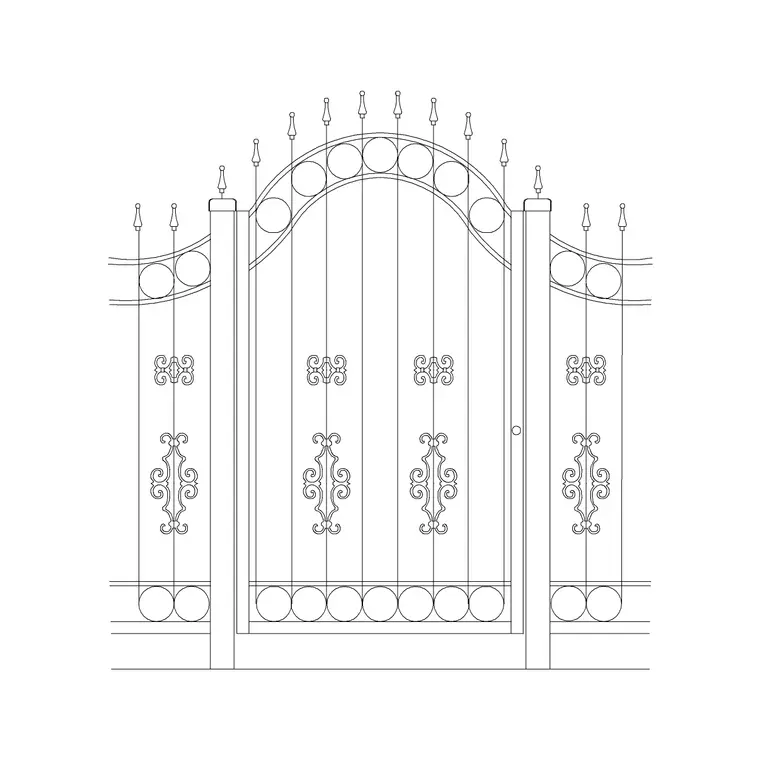
The blocks include an iron gate in plan and a single-swing metal gate; draw the gate's swing so it does not foul the path or a parked car. A pedestrian gate aligns with the path to the door; a vehicle gate spans the driveway. Keep the boundary low enough at the entrance to keep the house visible and the approach welcoming — a front yard walled in like a fortress loses its kerb appeal.
Entry planting and trees
Front-yard planting works hardest at the entrance and along the boundary. Place a specimen tree or a matched pair to frame the door or the gate, using the pine plan and elevation blocks, and draw them by canopy so they neither swamp the path nor clash with the house. Run beds and clipped planting along the boundary and beside the path to soften the hard surfaces.
Keep the planting low and open near the entrance and the driveway exit so sightlines to the street stay clear for safety — tall planting at a vehicle exit is a hazard, not a feature. Potted plants and a flower basket at the door add a welcoming detail. The aim is to frame and soften, never to obscure the route or the house number.
Drawing the front yard plan
Lay it out from the boundary inward. First, draw the plot boundary with the fence or wall, the pedestrian gate and any vehicle gate, and the house wall with the front door. Second, draw the path from gate to door as the spine. Third, set the driveway with a real car footprint and turning room, kept distinct from the path. Fourth, place framing trees by canopy at the entrance and beds along the boundary. Fifth, add bins, meters and entry pots in their least-prominent honest positions.
Keep boundary, paths, driveway, planting, trees and gates on separate layers, and insert trees, fences and gates as named blocks. Dimension the path width and the parking space, and draw every gate swing — those are the practical checks that decide whether the front yard actually works on arrival.
Front yard mistakes
- A hidden or indirect path: a visitor who cannot see the route to the door is a sign of a failed front yard. Make the path obvious. - Token parking: a car space too small to use forces parking across the path. Draw the real vehicle footprint plus door clearance. - An all-paving frontage: wall-to-wall hard surface looks bleak and floods. Break it with planting strips and beds. - Planting that blocks sightlines: tall growth at a driveway exit hides oncoming traffic. Keep entry and exit planting low. - A fortress boundary: a high wall hiding the house kills kerb appeal. Keep the entrance open and the house visible.
Free download
Browse the full library — DWG & DXF, no signup.
Questions
Frequently asked
How is a front yard different to design than a backyard?+
A front yard is public-facing and access-driven: it must read clearly from the street and carry the path to the door, a driveway and the boundary, used mostly in transit. A backyard is private and lived-in, so it prioritises zones for relaxing and dining over arrival and display.
How wide should the path to the front door be?+
At least 900 mm, and more where it is the main approach, drawn as a direct route from the gate to the door. Keep its paving pattern distinct from the driveway so the pedestrian and vehicle routes read separately.
How do I draw the driveway and gate?+
Draw a real car footprint plus door-opening and turning clearance, kept clear of the path. Place a single-swing or iron gate at the boundary and draw its swing so it fouls neither the path nor a parked car, with a pedestrian gate aligned to the door path.
Where should front-yard trees go?+
Frame the door or gate with a specimen tree or a matched pair, drawn by canopy so they suit the path and the house. Keep planting low at the driveway exit and entrance so sightlines to the street stay clear for safety.
Are the front yard blocks free for commercial projects?+
Yes. Every block downloads as DWG free for personal and commercial work, no signup or watermark, and opens in AutoCAD 2004 or later and most DWG-compatible CAD applications.
Related downloads
Blocks for this guide



Related categories
Related guides
Room guide
Free Balcony CAD Blocks — DWG Download
Free balcony CAD blocks in DWG — railings, compact seating, planters and pavers drawn to scale for AutoCAD apartment plans. No signup, commercial use OK.
Room guide
Terrace Garden CAD Blocks — Free DWG
Free terrace garden CAD blocks in DWG — raised planters, potted greenery, seating and paving to design a green roof terrace in AutoCAD. No signup.
Room guide
Rooftop Deck CAD Blocks — Free DWG
Free rooftop deck CAD blocks in DWG — lounge seating, railings, planters and decking pavers for roof terrace plans in AutoCAD. No signup, commercial OK.