Block landing · wardrobe cad block
Free wardrobe CAD blocks in DWG and DXF
By Saumyajit Maity · Published 15 Sep 2024 · Updated 26 Apr 2026
A wardrobe is the biggest single piece of storage in most bedrooms, so where it lands — and which way its doors open — shapes the whole room. This page collects free wardrobe CAD blocks in DWG and DXF, including multi-door hinged wardrobes from compact units up to six and seven-door runs, drawn at true millimetre dimensions and ready for AutoCAD 2004 or later. Every file is free for personal and commercial use, with no signup, no watermark and no attribution required.
Use these blocks to lay out bedrooms, dressing rooms, guest rooms and hotel rooms. The detail that earns its keep is the door swing: a hinged wardrobe needs clear floor in front of it for the doors to open, and the block lets you draw that swing arc and prove the doors clear the bed, the circulation route and each other.
What a wardrobe block should show
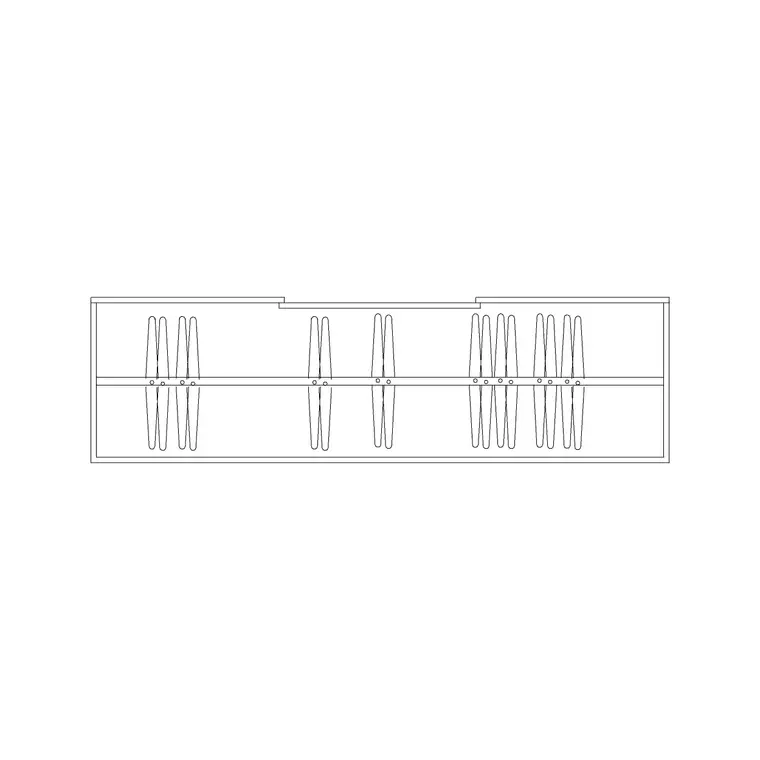
A useful wardrobe block is more than a deep rectangle. The plan view should show the carcass footprint and — crucially — the door swings, drawn as arcs that sweep into the room. Those arcs are what tell you whether a hinged wardrobe can open without hitting the bed, a side table or the opposite wall, which is the number-one wardrobe planning question.
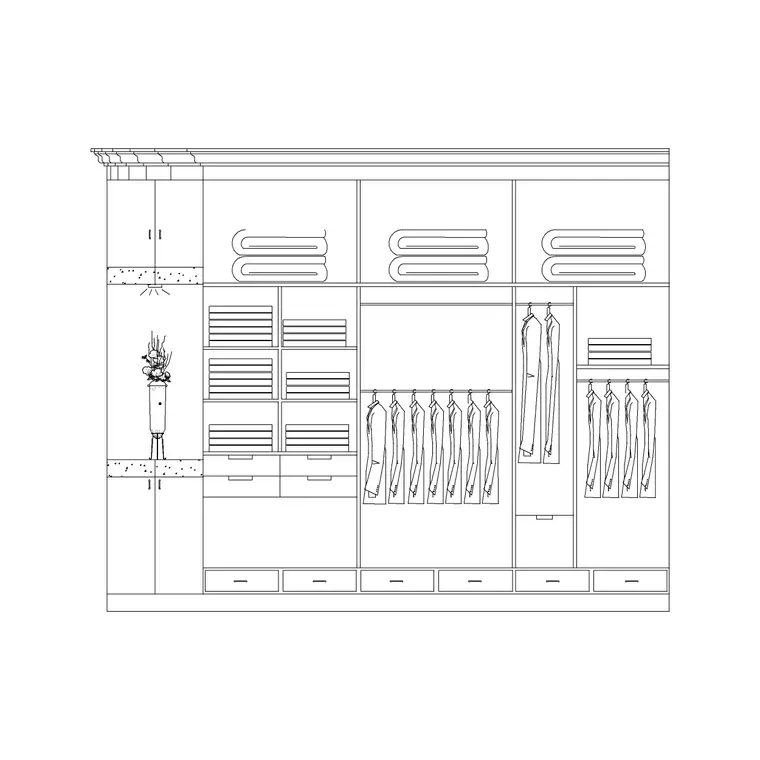
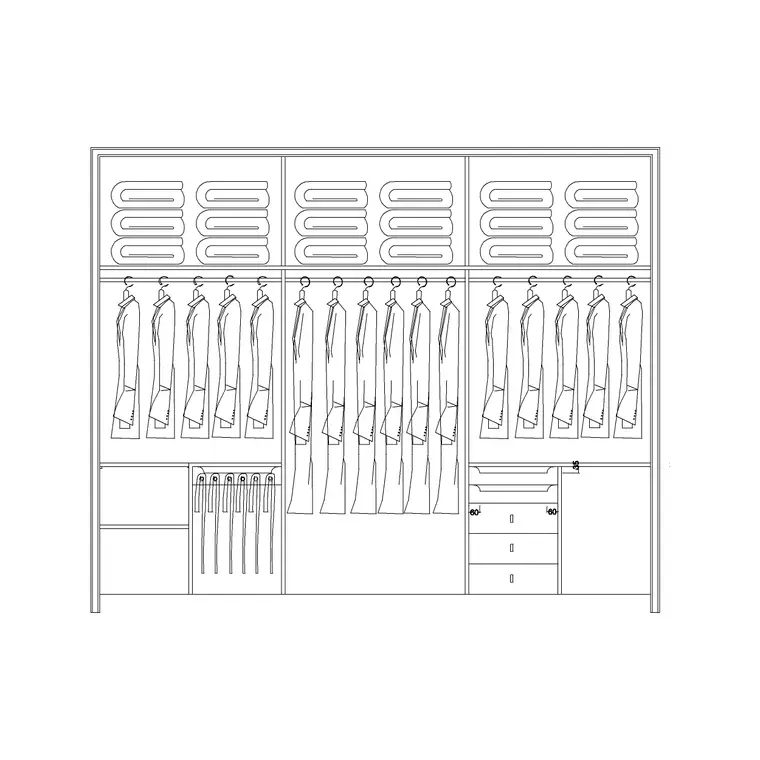
The elevation matters too, because a wardrobe is a tall, dominant face on the bedroom wall. It carries the door divisions, the handle line and the overall height. The blocks here keep the carcass, the doors and the swing arcs on sensible layers so you can show a clean storage plan, or thaw the swings to coordinate clearances, from the same drawing.
Wardrobe sizes to design around
Use these as your reference. Depth is the constant: a wardrobe is typically 550–650 mm deep to take a hanger across the rail. Height runs 1800–2400 mm, often to the ceiling in fitted designs. Width depends on the door count — each hinged door is roughly 450–600 mm, so a two-door unit is around 900–1200 mm, a four-door 1800–2400 mm, and a six or seven-door run spans 2700–4200 mm or more along a wall.
The swing clearance is the figure people miss. A hinged door needs clear floor in front equal to its width — so 450–600 mm of swept space per door — kept free of the bed and the walking route. Drop the scaled block in, draw the swing arcs, and these clashes become obvious before they reach site.
Door swings and clearance
The whole art of placing a hinged wardrobe is the door swing. Each door sweeps an arc into the room as it opens, and that arc must stay clear of the bed, the bedside tables, the circulation route and any door into the room. A wardrobe that opens onto the foot of the bed, or into the path to the en-suite, is a planning failure that the swing arcs catch instantly.
Draw each swing as a quarter-circle from the hinge, using the door width as the radius, and confirm none of them collide. Where floor space is tight in front of the wardrobe, that's the signal to consider sliding doors instead — and the swing arcs are exactly how you make that call on the drawing rather than discovering it on site.
Inserting and placing the block
These blocks are drawn full size in millimetres. Insert at scale 1 in a millimetre drawing, 0.001 in a metre template, or set INSUNITS to millimetres so AutoCAD rescales on insertion. Run INSERT or drag the DWG in, snap the back of the carcass flush to the wall, and rotate to suit the wall it sits against.
Because door count drives width, pick the block — or array the modules — to fill the wall run you have. As a single block reference, the wardrobe copies cleanly into repeated rooms, which is ideal for hotel and apartment schemes. Keep the wardrobe on a joinery or furniture layer so you can freeze the swings for a clean plan and thaw them when you coordinate clearances.
Where wardrobe blocks are used
Wardrobe blocks appear in bedrooms, dressing rooms, guest rooms, hotel rooms, student accommodation and apartment fit-outs. In residential work they prove the bedroom has both enough storage and enough clear floor for the doors and the circulation. In hospitality and multi-unit schemes they let you standardise a storage module and repeat it room to room.
They're specified alongside beds, side tables and dressing tables, so reach for the side table and dressing table blocks in the furniture category when you fit out a bedroom. The same scaled wardrobe carries from a concept plan to a furnished and a joinery drawing, so the room stays consistent across the set.
Hinged versus sliding wardrobes on a plan
The biggest decision a wardrobe block helps you make is hinged versus sliding, and it comes down to the floor in front. A hinged (h400d) wardrobe is cheaper and gives full access to the interior, but it demands clear swept floor equal to each door's width — fine in a generous room, a problem in a tight one. A sliding-door wardrobe needs almost no clearance in front because the doors run sideways, which is why it wins in compact bedrooms and where the wardrobe faces the bed across a narrow gap.
The swing arcs on a hinged wardrobe block are the tool that makes this call objective. Draw them; if they collide with the bed or the route, the room is telling you to switch to sliding doors. Drawing both options as scaled blocks lets you compare them on the same plan and choose with evidence rather than instinct — and for the sliding case, see the dedicated sliding-door wardrobe blocks, which omit the swing and reclaim that floor.
Free download
Browse the full library — DWG & DXF, no signup.
Questions
Frequently asked
How deep is a standard wardrobe?+
A wardrobe is typically 550–650 mm deep, which is what's needed to hang a garment on a rail across the carcass. Width depends on the door count, and height usually runs 1800–2400 mm. The blocks are drawn to these ranges.
Do the wardrobe blocks show door swings?+
Yes. The hinged wardrobe blocks include the door swing arcs in plan, because clearing those swings of the bed, side tables and circulation is the key planning check. You can freeze the swings for a clean storage plan.
How much clearance does a hinged wardrobe need in front?+
Each hinged door needs clear floor equal to its width — roughly 450–600 mm of swept space per door — kept free of the bed and the walking route. If that space isn't available, a sliding-door wardrobe is the better choice.
Are the wardrobe blocks free for commercial use?+
Yes. Every block downloads free in DWG (and DXF where available) with no signup, no watermark and no attribution requirement, cleared for commercial project use.
Related downloads
Blocks for this guide
Related categories
Related guides
Block landing
Free Office Chair CAD Blocks — DWG Download
Download free office chair CAD blocks in DWG and DXF — task chairs, swivel chairs and executive seats drawn in plan and elevation, AutoCAD 2004+, no signup.
Block landing
Free Bar Table CAD Blocks — DWG Download
Download free bar table CAD blocks in DWG and DXF — round, square and rectangular high bar tables in plan and elevation for AutoCAD. No signup, commercial-use OK.
Block landing
Free Restaurant Table CAD Blocks — DWG Download
Download free restaurant table CAD blocks in DWG and DXF — 2, 4 and 6 cover tables with chairs drawn in plan and elevation for AutoCAD. No signup, commercial-use OK.