Block landing · wall hung toilet cad block
Free wall-hung toilet CAD blocks for AutoCAD
By Sumana Kumar · Published 21 Jul 2023 · Updated 16 Feb 2026
A wall-hung toilet bolts to a concealed frame so the pan floats clear of the floor, with the cistern hidden inside a stud wall or duct behind it. It is the WC of choice when a designer wants a clean wall line, an uninterrupted floor for easy cleaning, and a shorter projection into a tight room. This page gathers free wall-hung toilet CAD blocks in DWG and DXF, drawn to true size and ready for AutoCAD 2004 or later, free for personal and commercial work with no signup and no watermark.
The block looks deceptively simple in plan — just the pan, with no visible cistern — but the detail that matters is hidden behind it: the supporting frame and the concealed cistern occupy a duct or thickened wall typically 150–200 mm deep. Drawing that duct alongside the floating pan is what makes a wall-hung layout buildable rather than just neat on paper.
How a wall-hung WC differs from a floor pan
A wall-hung toilet hangs from a steel support frame fixed to the structure, with the cistern concealed within the wall behind it. Nothing touches the floor, which is why the type reads as 'floating'. The visible ceramic is just the pan; the flush plate sits on the wall face above it.
Compared with a close-coupled two-piece pan, the wall-hung block has a shorter visible projection but needs a deeper wall zone to hide the frame and cistern. So when you draw it, you trade a slimmer fixture footprint for a thicker wall — a trade that is usually worth it where floor space is precious and the wall can absorb the duct.
Drawing the concealed frame and duct
The single most important thing to draw with a wall-hung WC is the duct or thickened wall that hides the frame and cistern. Allow roughly 150–200 mm of wall depth behind the pan for the carrier frame and concealed cistern. On the plan, draw that zone as a clear band so the room dimension reflects the real, finished wall line, not just the back of the pan.
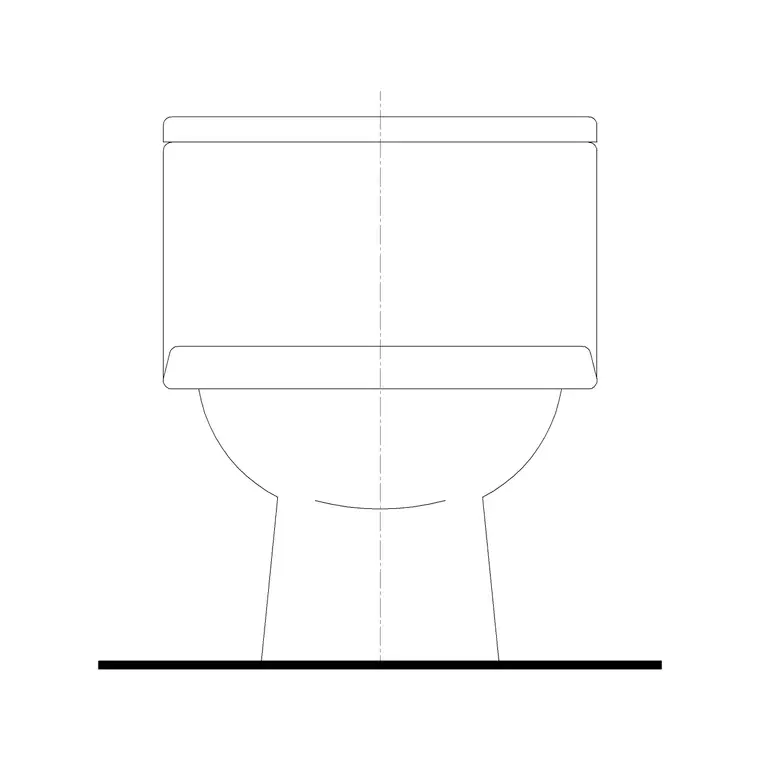
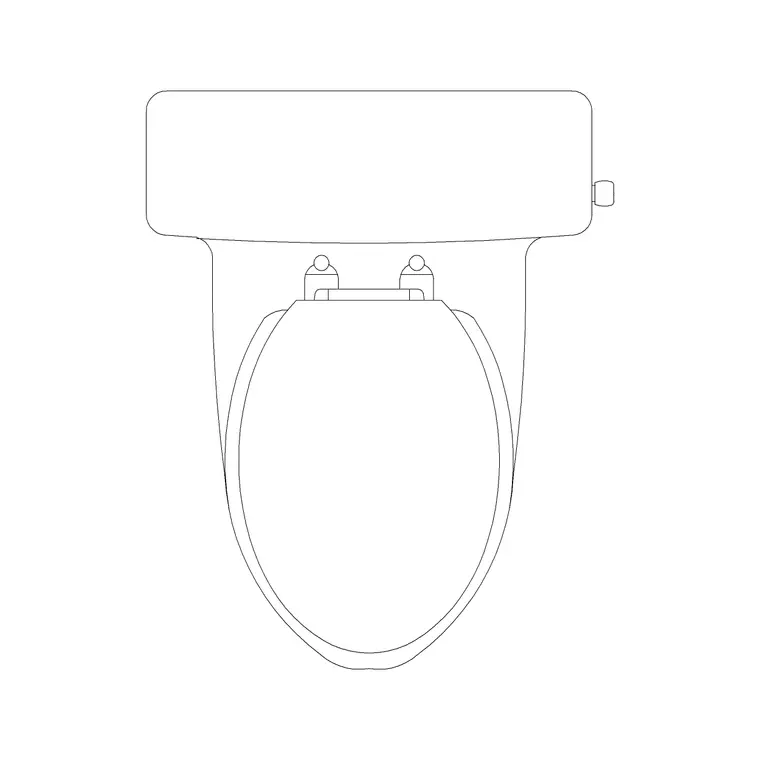
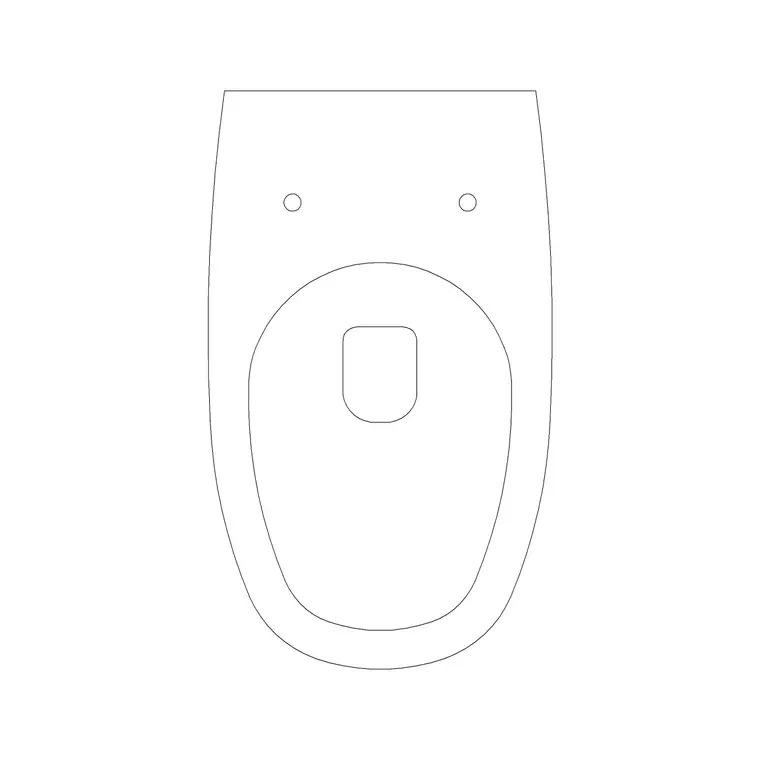
The block here shows the floating pan in plan and elevation; add the duct band on your wall layer so the setting-out reads correctly. Skipping the duct is the classic wall-hung mistake — the layout looks generous until the frame eats 200 mm off the room.
Typical wall-hung toilet dimensions
Design around these figures. Pan width: 350–400 mm. Pan projection from the finished wall: 480–560 mm (shorter than a close-coupled pan). Mounting height to the top of the pan rim: commonly set so the seat lands at a standard 400–430 mm, though wall-hung pans allow the height to be tuned at install. Concealed frame and cistern wall depth: 150–200 mm. Flush plate height on the wall: around 1000–1100 mm.
In front of the pan, keep the usual 600 mm of clear activity space. Because the pan height is adjustable on a wall-hung frame, this WC type is also useful where a comfort-height or accessible seat level is required.
Inserting the wall-hung block
The blocks are drawn full size in millimetres — insert at scale 1 in a millimetre drawing, or set INSUNITS to millimetres for automatic rescaling. Use INSERT, snap the insertion point to the finished face of the wall on the pan centreline, and rotate to the wall the WC serves.
Because the cistern is concealed, your setting-out shifts to the finished wall face and the centreline, plus the height of the flush plate on the elevation. Add the duct band behind on your wall layer, and keep the pan on a sanitaryware layer. That way the structural plan, the sanitary plan and the tiling elevation all read from the same correctly-positioned block.
Where wall-hung toilets are specified
Wall-hung WCs dominate contemporary residential bathrooms, hotels, restaurants and commercial washrooms where a clean, easy-to-clean look matters. They suit minimalist en-suites, where the floating pan and concealed cistern give an uncluttered floor, and they are common in accessible and comfort-height installations because the mounting height can be set to suit the user.
Use the wall-hung block when the design language is modern and the wall can take a duct; reach for a close-coupled two-piece block instead on budget or retrofit jobs where building a concealed frame into the wall is not practical.
Coordinating with the wall build-up
A wall-hung WC ties the sanitary layout to the construction more tightly than a floor pan does, because the frame must be fixed to something solid. On a stud wall that means a proprietary carrier frame; on masonry it may mean a thickened wall or a built-out duct. Draw that build-up early so the room dimensions, the door positions and the tiling all account for the thicker wall.
Keeping the pan as a scaled block lets you dimension from the finished wall face to the pan centreline and to the flush-plate position, which is exactly what the installer sets the frame to. Coordinating the duct depth with adjacent fixtures — a vanity, a shower, a bath panel — early on avoids the awkward situation where the concealed cistern wall collides with another fixture's setting-out.
Free download
Browse the full library — DWG & DXF, no signup.
Questions
Frequently asked
What is a wall-hung toilet?+
A wall-hung toilet is a pan that bolts to a concealed steel frame in the wall, so it floats clear of the floor with the cistern hidden behind it. It gives a clean wall line, an easy-to-clean floor and a shorter projection than a floor-standing pan.
How much wall depth does a concealed cistern need?+
Allow roughly 150–200 mm of wall depth behind the pan for the carrier frame and concealed cistern. Draw that duct band on the plan so the finished room dimension reflects the real wall line.
Can I set the height of a wall-hung toilet?+
Yes. Because the pan hangs from an adjustable frame, the seat height can be tuned at installation — useful for comfort-height or accessible WCs. The block is drawn to a standard 400–430 mm seat level you can adjust on your elevation.
Are the wall-hung toilet blocks free for commercial work?+
Yes. They download free in DWG and, where available, DXF, with no signup, no watermark and no attribution requirement, and they are cleared for commercial project use.
Related downloads
Blocks for this guide
Related categories
Related guides
Block landing
Free Bathroom Fixtures CAD Blocks — DWG Download
Download free bathroom fixtures CAD blocks in DWG and DXF — toilets, wash basins, bathtubs, showers and vanities drawn in plan and elevation. No signup, commercial OK.
Block landing
Free Sanitary Fixtures CAD Blocks — DWG Download
Download free sanitary fixtures CAD blocks in DWG and DXF — WCs, wash basins, urinals and sinks in plan and section for AutoCAD sanitary plans.
Block landing
Free Toilet / WC CAD Blocks — DWG Download
Download free toilet / WC CAD blocks in DWG and DXF — close-coupled, back-to-wall and commode pans in plan and elevation for AutoCAD. No signup, commercial OK.