Room guide · laboratory cad blocks
Free university lab CAD blocks for AutoCAD
By Sumana Kumar · Published 15 Feb 2025 · Updated 23 Mar 2026
A university teaching lab is a grid of benches with a safety system wrapped around it. Unlike an office or a classroom, the furniture is mostly fixed services — benches carrying power, gas, water and extract — and the layout is governed as much by safe egress and equipment access as by how many students fit. The benches set the module; the aisles, the safety stations and the clear escape routes set the rules. Scaled blocks let you lay the bench grid and prove the circulation before any services are run.
This page collects free university lab CAD blocks in DWG and DXF — lab benches, stools, write-up desks, instructor furniture, human figures and safety symbols — drawn to scale for AutoCAD 2004 or later. All free for personal and commercial work, no signup, no watermark.
Use the blocks to lay out a chemistry or physics teaching lab, a biology bench room, a computer/engineering lab or a mixed write-up-and-wet space. Because the benches, stools and aisles are scaled, you can test bench capacity, the circulation that lets students move safely, the access to fume hoods and safety stations, and the egress a hazardous room demands.
A teaching lab is a services grid
A teaching lab combines hands-on practical work with instruction, and the practical work needs services at the bench: electrical outlets, gas, water, drainage and often local extract or fume hoods. Those services fix the benches in place, so the bench grid is the skeleton of the room and everything else hangs off it. Once the benches are set, you can't casually shuffle furniture the way you can in an office.
The room usually pairs a bench zone (where the practical work happens) with a write-up zone (desks for notes and theory) and an instructor/demonstration zone at the front. Safety infrastructure — emergency shower, eyewash, fire extinguisher, first-aid point and clearly signed exits — is distributed so it's reachable from anywhere a student works. Lay the bench grid, the instructor front and the safety stations first; the aisles and write-up area fill in around them.
Bench grid, aisles and safe egress
The benches run in rows, usually as islands or peninsulas, with aisles between them. The aisles do double duty: they're working circulation and they're escape routes, so they have to stay clear and wide enough that students can pass each other and leave quickly in an emergency. A lab aisle that's fine when empty but impassable with stools pulled out and bags on the floor is a real failure.
Every student position should have two ways out — no dead-end bench runs that trap people behind a hazard. Keep a clear path from every bench to an exit, and don't let an aisle dead-end at a fume hood or a corner. Set out one bench, array it into the grid, then walk a standing figure down every aisle with stools in their working position to confirm the room still flows when it's in use.
The blocks that furnish a lab
Lab furniture is modular and repeated, with a few fixed anchors.
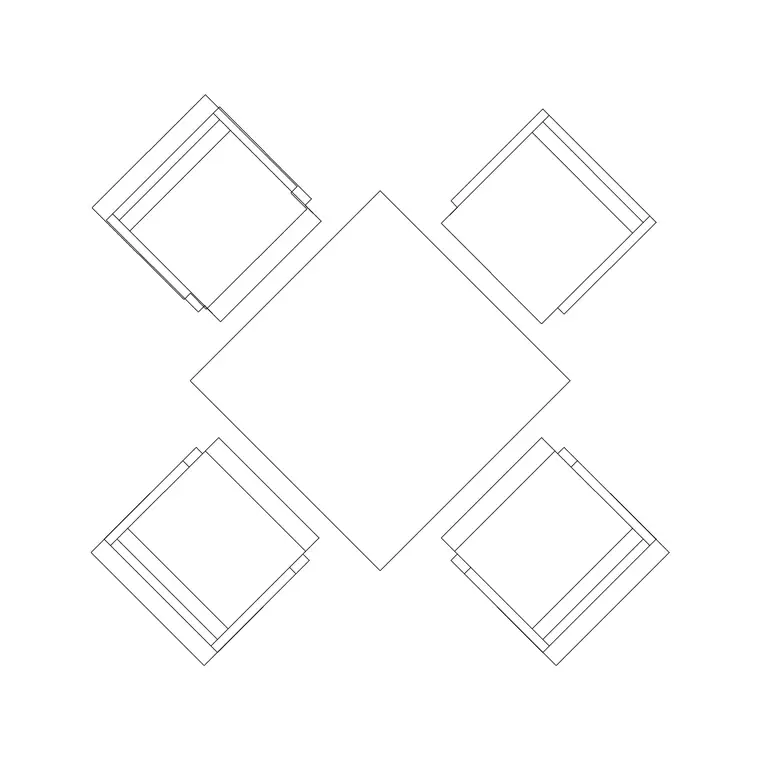
- Lab benches — rectangular bench blocks; the 1000mm and 800mm 4-person table blocks stand in for island and peninsula benches set out on the services grid. - Stools — backless lab stools at each bench position; a simple stool block arrayed along the bench. - Write-up desks — office tables and chairs in the theory/notes zone. - Instructor furniture — an office or demonstration table at the front. - Human figures — seated figures at benches and write-up desks to check density, standing figures to test aisles and egress. - Safety symbols — fire, first-aid, emergency-exit and accessibility symbols placed at their stations.
Keep benches, stools, write-up furniture, figures and safety symbols on separate layers so the furniture plan, the egress plan and the safety-station plan come off one drawing.
Dimensions, clearances and safety stations
Use these as design ranges and defer to lab safety codes. Lab bench depth: often 600–900 mm for a single-sided bench, more for a back-to-back island. Working width per student at a bench: allow enough for apparatus and elbow room, typically 1000–1200 mm. Stool space: room to sit and stand clear of the bench and the aisle.
Aisles between benches need to be wide enough for two people to pass with stools out and for safe evacuation — often 1200 mm or more for a primary aisle. The emergency shower and eyewash must be reachable within a few seconds' unobstructed travel from any wet-work position. A fume hood needs clear approach and a working zone in front that the aisle traffic doesn't cross. Place safety symbols at every station and walk figures from the furthest bench to each one to confirm the reach. Scaled blocks make all of this visible before commissioning.
Assembling the lab plan from blocks
Draw the shell and place the fixed points: the instructor front, the fume-hood wall, the sink/wet positions and the safety stations. Set out one bench, then array it into the island/peninsula grid that matches the services. Add stools along each bench. Lay the aisles between bench runs at your chosen widths, ensuring two-way escape from every position.
Place the write-up desks and chairs in their zone, and seat figures at benches and desks to check density. Walk standing figures down every aisle with stools out, and from the furthest bench to the shower, eyewash, first-aid and exits, confirming each is reachable. Mark fire, first-aid, exit and accessibility symbols at their stations. With benches, stools, write-up furniture, figures and symbols layered, the safety-station and egress plans are simply the relevant layers thawed over the furniture.
Common university lab mistakes
The first is a dead-end bench run — a student at the far end trapped behind a hazard with only one way out. Always give every position two escape directions. The second is aisles sized for an empty room: fine on the plan, blocked once stools are pulled out and bags are down. Test aisles with stools in their working position. The third is a safety station that's hard to reach — an eyewash behind a bench or a fire extinguisher down a side aisle nobody can get to fast.
Other traps: a fume hood with the main circulation crossing its working zone, write-up desks mixed into the wet bench area so notes and chemicals share a surface, and forgetting accessible bench provision and routes. Walking figures from the worst bench to every exit and safety station, with the room in working condition, exposes these before the lab is built and serviced.
Free download
Browse the full library — DWG & DXF, no signup.
Questions
Frequently asked
How wide should aisles be in a teaching laboratory?+
Wide enough for two people to pass with stools pulled out and for safe evacuation — often 1200 mm or more for a primary aisle, treated as a design range subject to lab safety codes. Test the width by walking a figure down each aisle with the stools in their working position, not tucked away.
Why do lab benches fix the room layout?+
Benches carry fixed services — power, gas, water, drainage and local extract — so they can't be moved casually like office furniture. The bench grid becomes the skeleton of the lab, and aisles, write-up desks and safety stations are arranged around it. That's why you set the bench grid first.
Where do safety symbols go on a lab plan?+
Place fire-extinguisher, first-aid, emergency-shower/eyewash and exit symbols so each is reachable within a few seconds' unobstructed travel from any working position. Use the building-symbols set, then walk a figure from the furthest bench to each station to confirm the reach before finalising the plan.
Can I use the table blocks as lab benches?+
Yes. The rectangular 4-person table blocks stand in well for island and peninsula benches set out on the services grid, and you can array them to build the bench rows. Add stool blocks at each position and keep them on a separate layer so you can show the room with and without seating.
Related downloads
Blocks for this guide

Related categories
Related guides
Room guide
Free Bank Branch CAD Blocks — DWG Download
Free bank branch CAD blocks in DWG and DXF — teller counters, advisory desks, seating and figures to plan a branch interior in AutoCAD. No signup.
Room guide
Free Community Hall CAD Blocks — DWG Download
Free community hall CAD blocks in DWG and DXF — round and rectangular tables, chairs, figures and exit symbols for a multipurpose event hall.
Room guide
Free Cafeteria CAD Blocks — DWG Download
Free cafeteria CAD blocks in DWG and DXF — dining tables, chairs, servery, figures and canteen symbols to plan a cafeteria in AutoCAD. No signup, commercial OK.