Block landing · triple bowl sink cad block
Free triple-bowl sink CAD blocks for AutoCAD
By Sumana Kumar · Published 25 Dec 2023 · Updated 8 Apr 2026
Three bowls in a row signal a serious kitchen, and a scaled triple-bowl sink CAD block lets you lay one out where it actually belongs — along a long run with real cabinet width to spare. This page collects free triple-bowl sink CAD blocks in DWG and DXF — three-compartment units of roughly 1100 mm and up, including the 42-inch triple and the 1170 mm triple — drawn in plan view at true size for AutoCAD 2004 or later. Free for personal and commercial work, no signup, no watermark.
The triple bowl is less common in a domestic kitchen and far more common where a process demands separation: wash, rinse and sanitise in commercial food prep, or simply a generous three-station sink in a large family or estate kitchen. Because the unit is long, the planning question is almost always about run length and cabinet support, and that is exactly what a scaled plan answers. Drop the block onto the worktop and you can see whether the run can carry a sink over a metre wide and still leave usable preparation space.
What a triple-bowl sink block shows
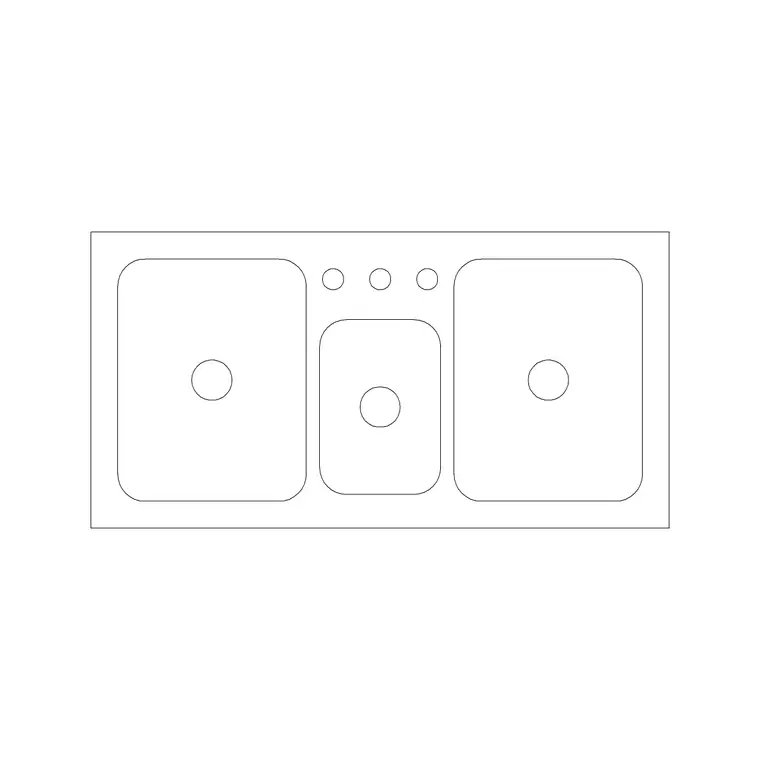
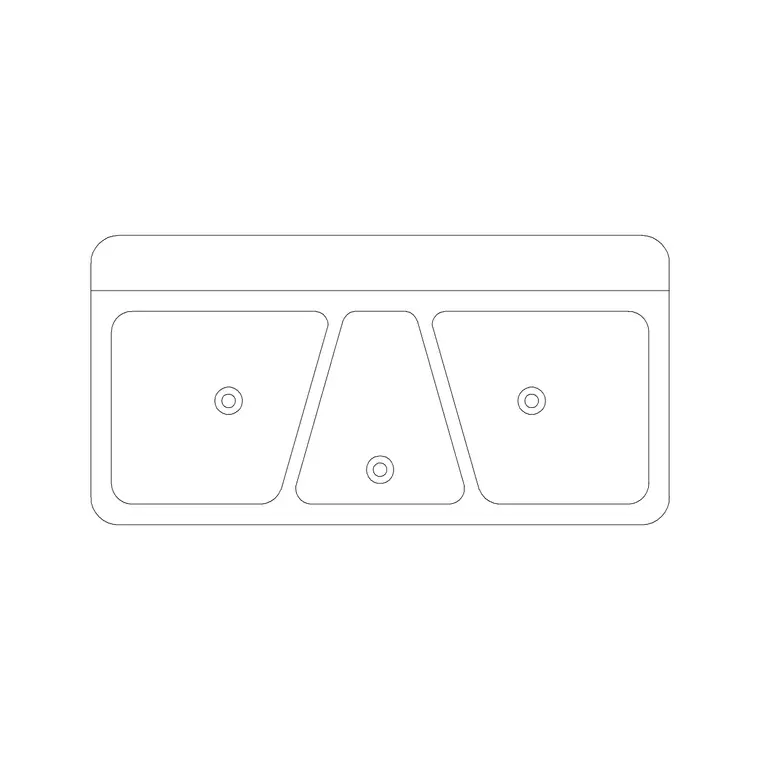
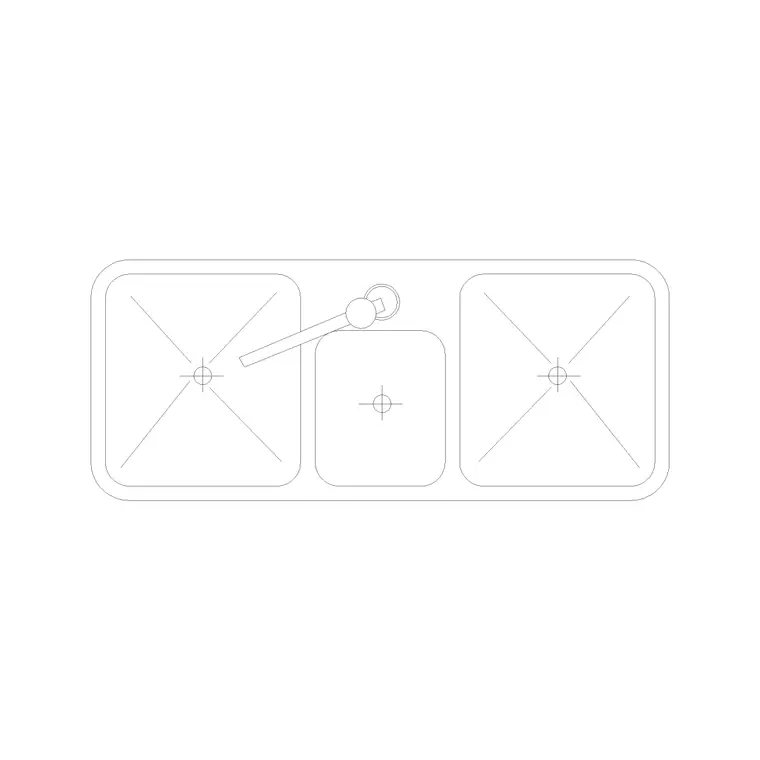
A triple-bowl block draws the sink top with three bowls in a line, each with its own waste position, plus the tap arrangement at the back. In plan you see all three compartments inside the unit outline, which is what you need both to lay the unit onto a long cabinet run and to set out three wastes feeding a shared trap or a manifold.
The footprint is the worktop cut-out, so when you snap a triple to the cabinet line you immediately see how much of the run it consumes. Blocks like the 1170 mm triple and the 42-inch triple cover the common sizes, drawn so the bowl spacing matches how three-compartment sinks are actually fabricated.
Typical triple-bowl sink dimensions
Design to these ranges. Triple-bowl sink top width: commonly 1100–1200 mm and up, with the 42-inch unit around 1067 mm and the 1170 mm triple a touch wider. Front-to-back depth: around 480–600 mm domestic, often deeper for commercial sinks. Each bowl: roughly 300–360 mm wide so three fit across the unit. Bowl depth: 160–200 mm domestic, deeper in catering sinks.
The planning fact that matters is run length: a 1100–1200 mm triple needs a base run that can carry it — typically a 1200 mm cabinet or a pair of units beneath a continuous worktop. In a commercial fit-out the sink may be a freestanding stainless bench rather than a cabinet sink. Either way, dropping the scaled block on shows whether the run has the length to spare.
When a triple bowl makes sense
Reach for a triple when a process or a large kitchen justifies the width. In commercial and catering kitchens, a three-compartment sink supports the classic wash-rinse-sanitise sequence and is often a code expectation for manual ware-washing. In a large domestic or estate kitchen, a triple gives a wash bowl, a rinse bowl and a vegetable or prep bowl without crowding.
For most homes, though, a triple is overkill — a double or 1.5-bowl does the job in far less width. The drawing makes the case either way: lay the triple beside a double on the same run and you can see how much extra worktop the third bowl costs, which is the honest test of whether the kitchen can carry it.
How to insert and place the triple sink
The blocks are drawn full size in millimetres: insert at scale 1 in a millimetre drawing, 0.001 in a metre drawing, or set INSUNITS to millimetres so AutoCAD rescales automatically. Use INSERT or drag from a tool palette.
Because a triple is long, place it on the longest available run and snap the back edge to the worktop line so all three bowls sit clear of the cabinet fronts. With three wastes, keep the block on a services layer and dimension each bowl centreline, because the plumber needs to set out three drains and the supply. In a commercial layout, coordinate the sink with the drainage falls and any required air gaps early — the scaled block makes those clearances easy to draw around.
Where triple-bowl sinks are used
Triple-bowl sink blocks appear in commercial kitchen plans, restaurant and café back-of-house layouts, catering and institutional kitchens, bar and prep stations, and large domestic or estate kitchens where a generous sink is part of the brief. In a food-service drawing the triple sink is frequently a compliance item, so getting its size and clearances right on the plan matters.
Use the triple alongside the single and double blocks in the sinks-and-faucets category so you can compare bowl counts on one drawing, and combine it with the appliance and worktop blocks to build the full kitchen layer. For commercial schemes, pair it with the bar/prep sink blocks to cover both the main ware-washing sink and the smaller service sinks.
Free download
Browse the full library — DWG & DXF, no signup.
Questions
Frequently asked
How wide is a triple-bowl sink?+
Triple-bowl sink tops are commonly 1100–1200 mm and up, with the 42-inch unit around 1067 mm and the 1170 mm triple a little wider. They generally need a 1200 mm cabinet run or a freestanding bench to carry them.
Where are three-compartment sinks normally used?+
In commercial and catering kitchens, where the three bowls support a wash-rinse-sanitise sequence for manual ware-washing, and in large domestic or estate kitchens that want separate wash, rinse and prep bowls.
What view are the triple-bowl sink blocks drawn in?+
They are plan-view (top-view) blocks showing all three compartments inside the sink top, ready to lay onto a long worktop run and to set out three wastes against the drainage drawing.
Are the triple-bowl sink blocks free for commercial projects?+
Yes. Every block downloads free in DWG and DXF with no signup, no watermark and no attribution requirement, and they are cleared for commercial use, including catering and food-service fit-outs.
Related downloads
Blocks for this guide
Related categories
Related guides
Block landing
Free Sanitary Fixtures CAD Blocks — DWG Download
Download free sanitary fixtures CAD blocks in DWG and DXF — WCs, wash basins, urinals and sinks in plan and section for AutoCAD sanitary plans.
Block landing
Free Kitchen Faucet / Mixer Tap CAD Block — DWG
Download free kitchen faucet and mixer tap CAD blocks in DWG and DXF — monobloc and pull-out mixers in plan and elevation. No signup, commercial OK.
Block landing
Free Kitchen Sink Unit CAD Block — DWG Download
Download free kitchen sink unit CAD blocks in DWG and DXF — single, double and 1.5-bowl sinks with drainers in plan and section. AutoCAD 2004+, no signup.