Block landing · straight staircase cad block
Free straight flight staircase CAD blocks for AutoCAD
By Sumana Kumar · Published 23 Mar 2023 · Updated 3 Mar 2026
A straight flight staircase is the simplest stair of all: a single run of treads from one floor to the next, with no turn and no intermediate landing. This page collects free straight staircase CAD blocks in DWG and DXF, drawn in plan as a clean run of parallel treads and in elevation as the familiar sawtooth rise, ready to insert into AutoCAD 2004 or later. Everything is free for personal and commercial work, with no signup and no watermark.
Its simplicity is exactly why the straight flight is the stair everyone draws first and the easiest to set out. The blocks here are drawn to a real going and rise so the run you place reads at true length — which matters more than people expect, because a straight flight is the longest of the stair types on plan and will not fit every room. Drop the scaled block in and you immediately see whether the full run, plus the clear landing space top and bottom, fits the space you have.
What a straight flight block shows
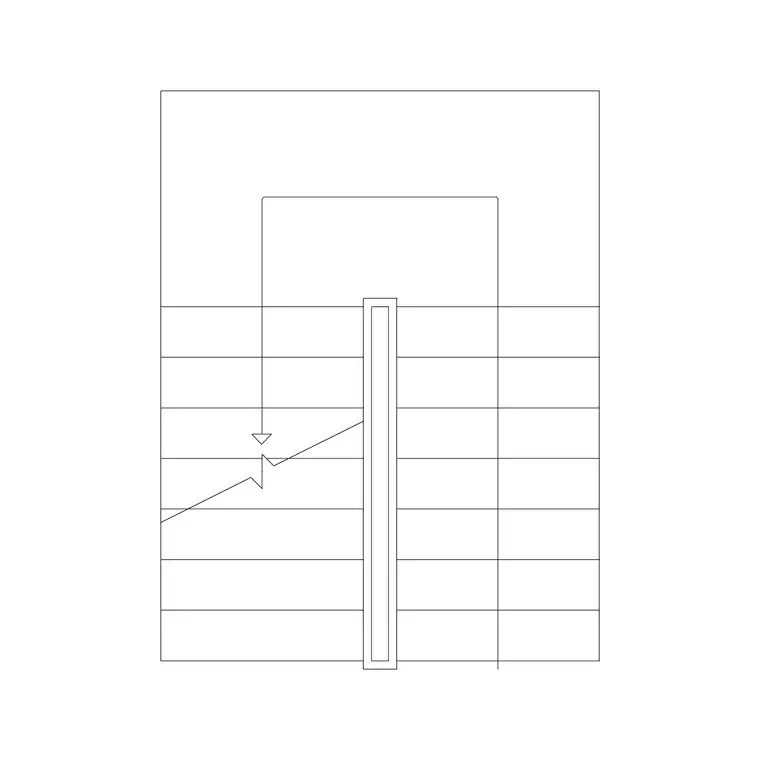
In plan, a straight flight reads as a rectangle filled with parallel tread lines running across it, an up/down arrow along the direction of travel, and a break line cutting the run where it passes the floor level above. The bottom and top nosings are shown, and the handrail or balustrade runs down one or both sides. It is the most legible of all stair plans because there is nothing to interpret — the run goes straight from A to B.
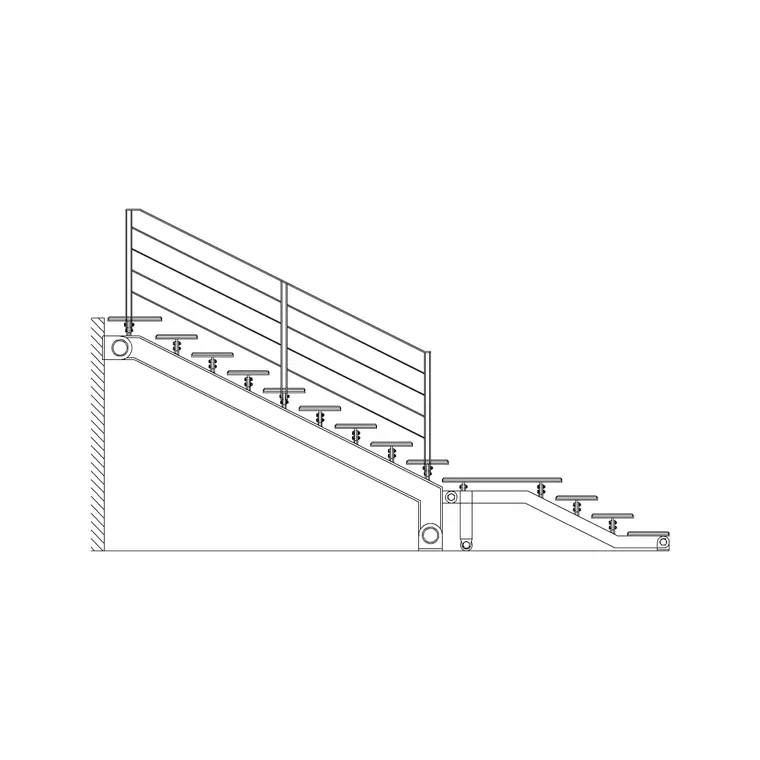
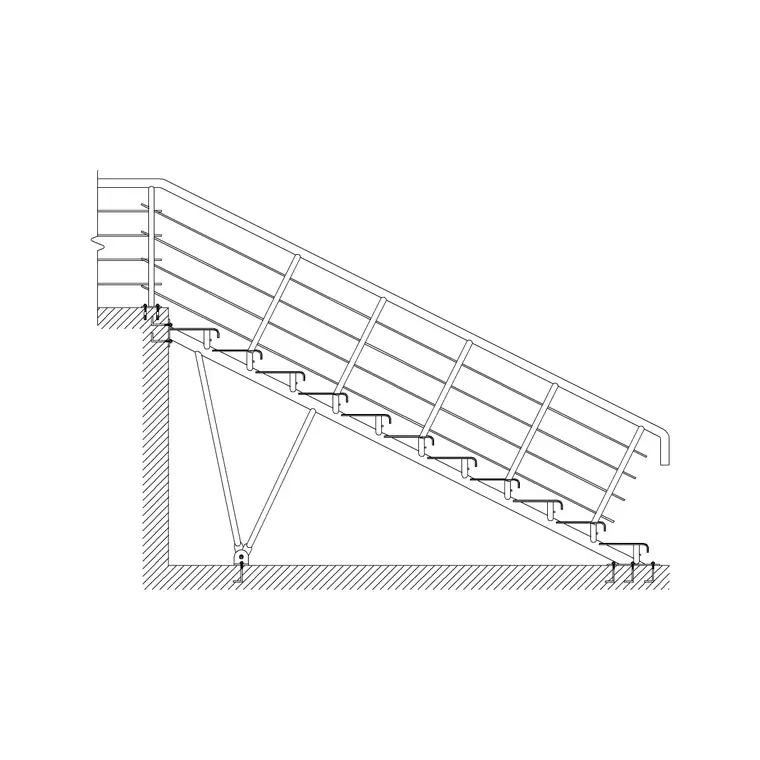
In elevation the same stair shows the sawtooth profile of treads and risers climbing at a constant pitch from floor to floor, with the balustrade following the line of the nosings. Because there is no landing, the elevation is a single clean diagonal — the clearest possible view for checking the pitch and the headroom along the whole run.
Why the run length matters
A straight flight trades simplicity for length. Because every riser is stacked in a single line, the run on plan is the sum of all the goings — which makes a straight flight the longest-footprint stair for a given storey height. That is the first thing to check when you place the block: does the full horizontal run fit, with a clear floor area to arrive and depart at each end?
This is where the scaled block pays off. Rather than guessing, you see the true length the moment it lands, and you can decide whether a straight flight suits the room or whether a turning stair (dog-leg or L-shape) is needed to fold the run into a smaller footprint. For long storey heights some straight stairs include an intermediate landing to break the run and meet the limit on the number of risers in a single flight — check whether the block you need is a pure single flight or a straight run with a landing.
Views and what's included
Straight flight downloads here typically pair a plan with an elevation, and some include a section. The plan goes into the floor layout and sets the run length and the landing space at each end. Because a straight flight serves two levels, the plan often shows the run with a break line so the same block reads on both the lower and upper floor drawings.
The elevation and section describe the pitch and the headroom and belong on the stair detail sheet. Keep the treads, the balustrade and any structure on sensible layers so a single block produces a clean architectural plan and a detailed stair drawing without redrawing. Where the block carries the balustrade separately, you can show or hide the rail for a structural-only versus a presentation view.
Typical straight flight dimensions
A straight flight is set out from three numbers: the rise per tread, the going per tread, and the flight width. Rise and going sit in the normal comfortable stair band, and there is a well-known relationship between them — a steeper rise needs a deeper going to stay comfortable. The number of risers is the floor-to-floor height divided by the chosen rise; the run length is the number of goings multiplied by the going.
Domestic flight widths commonly fall in the region of 800–1000 mm, wider for shared or commercial stairs. Many building codes cap the number of risers in a single uninterrupted flight, which is why very tall straight runs gain a landing. Headroom — the clear height measured vertically above the pitch line — must be maintained along the whole run, especially where the flight passes the floor opening above. Treat all of these as ranges to design within and confirm rise, going, width, flight length limits and headroom against your local building regulations.
Inserting and aligning the block
The blocks are drawn full size in millimetres. Insert at scale 1 in a millimetre drawing, 0.001 in a metre drawing, or set INSUNITS to millimetres so AutoCAD rescales on insertion. A natural insertion point is the bottom nosing of the first tread, so the stair starts from a known datum at floor level and you can dimension the run from there.
Use ROTATE to align the run with the wall it sits against, and MIRROR if you need the up direction to read the other way. Because a straight flight is a single block reference, those moves keep the whole run coordinated. The straight flight is also the easiest stair to ARRAY conceptually — if a building repeats the same flight floor to floor, you can stack copies — and the simplest to WBLOCK as a reusable unit. Keep it on a dedicated stair layer to freeze for the shell plan and thaw for the furnished drawing.
Where straight flight blocks are used
Straight stairs appear wherever there is length to spare and simplicity is wanted: open-plan homes and lofts with a long wall to run the stair against, basements and split-levels, external entrance steps, industrial and access situations, and minimalist interiors where the clean single line of a straight flight is the design. They are also the standard teaching stair, so they fill student projects and quick concept drawings.
Because the blocks are free and licence-clear, they suit a fast layout sketch as readily as a developed drawing set. Pair them with the other stair blocks in the stairs category when a scheme mixes a straight main flight with a turning stair elsewhere, and use the plan and elevation together so the run length and the pitch are both checked before the design is fixed.
Free download
Browse the full library — DWG & DXF, no signup.
Questions
Frequently asked
What is a straight flight staircase?+
A straight flight (or straight run) staircase is a single run of treads from one floor to the next with no turn and no intermediate landing. It is the simplest stair type and the easiest to set out, but it has the longest footprint on plan for a given storey height.
Why is my straight stair so long on the plan?+
Because every riser is stacked in one line, the run length equals the number of goings times the going, which makes a straight flight the longest-footprint stair. If it doesn't fit, a turning stair such as a dog-leg or L-shape folds the same climb into a smaller area.
Do the straight flight blocks include plan and elevation?+
Most pair a plan with an elevation, and some add a section. The plan sets the run length on both floors with a break line; the elevation shows the pitch and headroom. Each download page lists the views included.
Are the straight staircase blocks free for commercial use?+
Yes. Every block downloads free in DWG and DXF with no signup, no watermark and no attribution requirement, and they are cleared for commercial project work.
Related downloads
Blocks for this guide
Related categories
Related guides
Block landing
Free Spiral Staircase CAD Blocks — DWG Download
Download free spiral staircase CAD blocks in DWG and DXF — plan and elevation, drawn to real tread radii for AutoCAD. No signup, free for commercial use.
Block landing
Free Circular Staircase CAD Blocks — DWG Download
Download free circular staircase CAD blocks in DWG and DXF — curved stairs in plan and elevation, drawn to scale for AutoCAD. No signup, commercial-use OK.
Block landing
Free Metal Staircase CAD Blocks — DWG Download
Download free metal staircase CAD blocks in DWG and DXF — steel stairs in plan and elevation with stringers and balustrade. No signup, commercial OK.