Block landing · roman window cad block
Free Roman window CAD blocks for AutoCAD
By Sumana Kumar · Published 10 May 2026 · Updated 4 Jun 2026
A Roman window is a window with a classical character — typically an arched head (a semicircular or segmental 'Roman arch') or a defined square-headed surround drawn in the classical idiom. The Roman windows in this collection cover both the rounded-arch form and the square form, in sliding two-shutter and fixed configurations, giving you a small but distinctive family of blocks for façades that want a more traditional or decorative window than a plain rectangle. This page gathers them free in DWG, drawn full size in millimetres for AutoCAD 2004 or later, free for personal and commercial use with no signup or watermark.
Use these blocks on villa and bungalow elevations, heritage-style frontages, entrance bays and feature windows where the arched or formal head does real design work. Because the arc and the surround are drawn to scale, the elevation reads correctly and the proportions stay true when you array a row of them across a façade.
The Roman window is the type where the elevation does most of the talking, because its identity is in the shape of the head and the proportion of the surround. The blocks here ship the plan, elevation and, in some cases, the side view so you can both place the window in the wall and show its character face-on.
What a Roman window block looks like
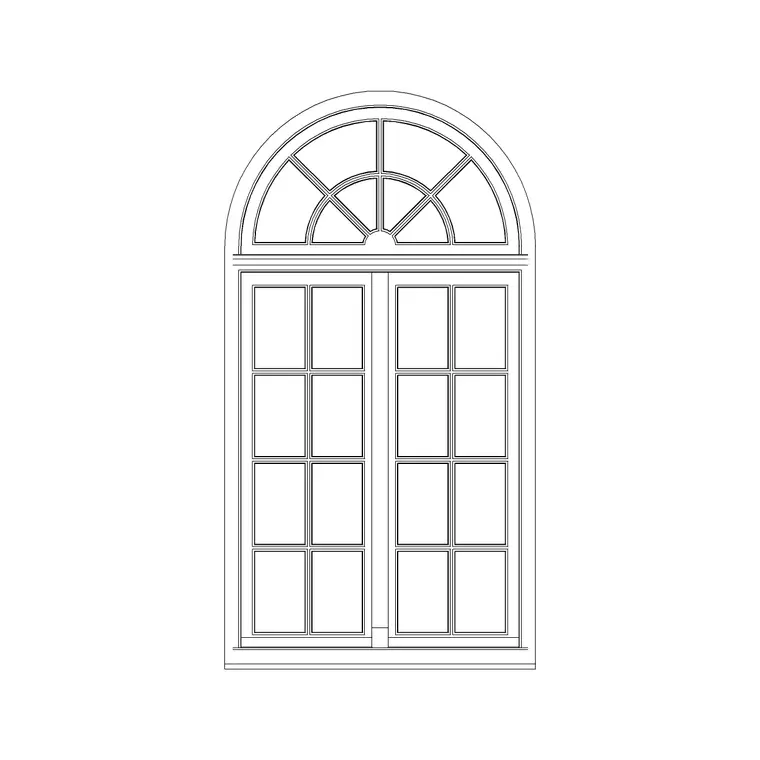
A Roman window block carries the frame and glazing of a normal window plus the defining feature: an arched head (semicircular for a full Roman arch, or segmental for a shallower curve) or a square classical surround. The arched versions draw the curve of the head as a true arc, so the geometry is correct rather than approximated, and the glazing follows the arch. The square Roman versions present the formal rectangular surround.
Some blocks in this set are two-shutter sliding Roman windows, combining the classical head with a practical sliding opening below — the round arch sits as a fixed fanlight over a sliding pair, a very common arrangement on traditional villas. Round-side versions also ship a side view so you can read the projection and reveal.
Arched versus square Roman windows
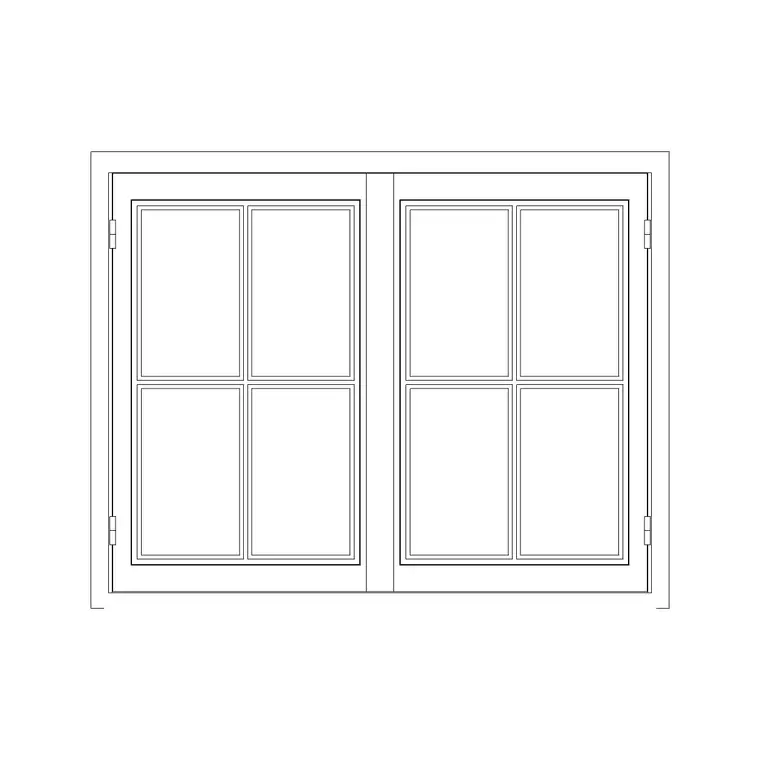
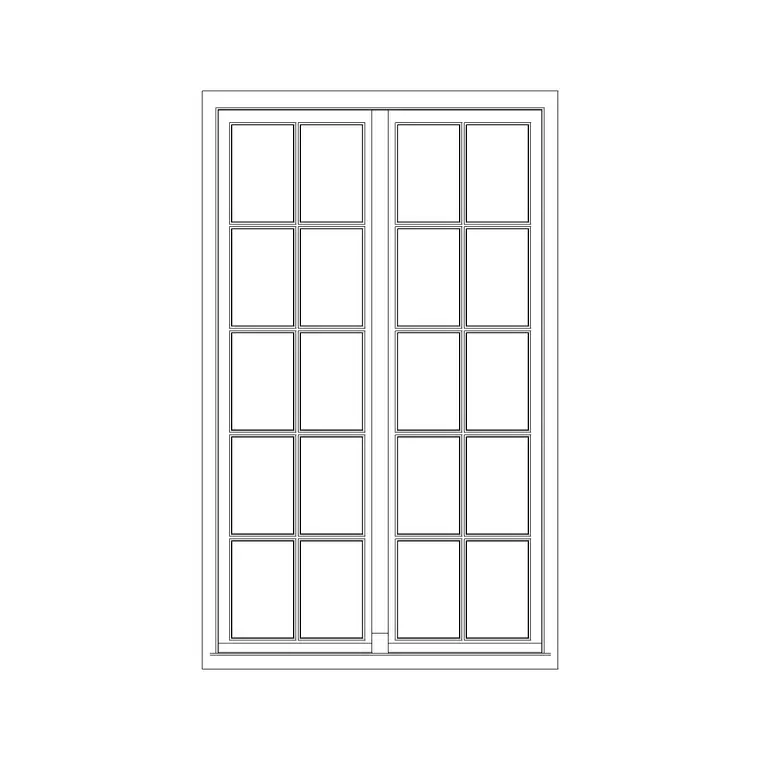
The collection splits into two characters. The round (arched) Roman window has a curved head — a half-circle for a true semicircular arch, or a flatter segmental arc — and reads as soft and classical; it suits villa frontages, entrance bays and feature gable windows. The square Roman window keeps a rectangular opening but draws it with a formal classical surround, reading as ordered and restrained; it suits more disciplined elevations.
Mixing the two deliberately is a classic façade move — a single arched feature window over an entrance, with square Roman windows ranged either side. Because both share a drawing convention and units, you can combine them on one elevation and keep the proportions consistent.
Views: plan, elevation and side
Elevation is where a Roman window lives, because the arched or square head is its whole point — you read the curve, the springing of the arch, the surround and the glazing face-on. This is the view you place on the façade and key into the schedule.
Plan view cuts horizontally through the window to show the frame, reveal and glass, and for the sliding versions, the tracks and sash overlap. The round-side Roman window also ships a side view, useful for showing how the arched head and surround project from the wall in a sectional or three-quarter drawing. Insert whichever view your drawing needs from the multi-view DWG and freeze the rest.
Setting out an arched head
An arch is governed by its springing line (where the curve begins) and its radius. For a true semicircular Roman arch, the radius equals half the opening width and the curve springs from the top of the jambs; for a segmental arch the radius is larger and the curve shallower. The blocks are drawn with correct arc geometry, so when you insert and scale them the head stays a true arc rather than a flattened approximation.
If you need to match an arched window to an existing opening, scale the block to the opening width and the semicircular head follows automatically. Keep the arched head and the surround on sensible layers so you can adjust lineweight for the feature without disturbing the glazing — on a presentation elevation the arch often wants a heavier line to read as the focal point it is.
Where Roman windows are used
Roman windows belong on elevations that want classical or traditional character: villas, bungalows, farmhouses, boutique hospitality, places of worship, and heritage or revival-style frontages. The arched feature window over an entrance or in a stair bay is a recurring motif, as is a ranked row of arched windows along a colonnade or veranda.
Architects and interior designers use the blocks to give a façade its period flavour quickly and correctly; the arc geometry means the windows read as authentic rather than cartoonish. Pair the Roman windows with classical door, column and balustrade blocks to build a coherent traditional elevation from a single, consistent, licence-clear library.
Keeping Roman windows proportionate across a façade
The risk with arched and classical windows is inconsistency — one window with a slightly different springing height or a fatter surround than its neighbours throws the whole elevation off, because the eye reads classical proportion strictly. The fix is to treat the Roman window as a block and repeat it rather than redrawing, so every instance shares the same arch radius, surround width and glazing pattern.
When a façade needs windows of different widths but matching character, scale the block uniformly so the arch stays a true semicircle, or use the segmental versions where a wider opening would otherwise force an awkwardly tall semicircular head. Set the windows on a glazing layer keyed to the schedule, give the feature window its own type reference, and array the ranked windows at equal centres. Done this way, a row of Roman windows reads as a deliberate, ordered composition rather than a set of near-misses, which is exactly the impression a classical elevation is trying to create.
Free download
Browse the full library — DWG & DXF, no signup.
Questions
Frequently asked
What is a Roman window?+
A Roman window is a window drawn in the classical idiom, typically with a semicircular or segmental arched head (the 'Roman arch') or a formal square surround. This collection includes both arched (round) and square Roman windows, in sliding and fixed forms.
Are the arched heads drawn as true arcs?+
Yes. The arched Roman window blocks use correct arc geometry, so a semicircular head is a true half-circle and a segmental head a true segmental arc. When you scale the block to an opening width, the head stays a true arc rather than a flattened curve.
What is a 2-shutter sliding Roman window?+
It combines a classical arched head with a practical sliding opening below — an arched fixed fanlight over a pair of sliding sashes. It is a common arrangement on traditional villas, giving period character with an easy-to-use sliding window.
Which views do the Roman window blocks include?+
Most ship plan and elevation, and the round-side Roman window also includes a side view. Elevation shows the arched or square head face-on; plan shows the frame, reveal and any sliding tracks; the side view shows the projection from the wall.
Related downloads
Blocks for this guide
Related categories
Related guides
Block landing
Free Casement Window CAD Blocks — DWG Download
Free casement (openable) window CAD blocks in DWG — side-hung sashes in plan, elevation and section for AutoCAD. No signup, free for commercial use.
Block landing
Free Single-Shutter Window CAD Blocks — DWG
Free single-shutter window CAD blocks in DWG — one-panel openable sashes in elevation and plan for AutoCAD. Left/right-hung, no signup, commercial OK.
Block landing
Free Double-Shutter Window CAD Blocks — DWG
Free double-shutter window CAD blocks in DWG — two-leaf openable windows with glass, in elevation and plan for AutoCAD. No signup, commercial-use OK.