Block landing · refrigerator cad block
Free refrigerator CAD blocks in plan and elevation
By Saumyajit Maity · Published 23 Mar 2023 · Updated 21 Jan 2026
The refrigerator is the third point of the kitchen work triangle and one of the largest single appliances in the room, so its position and footprint shape the whole layout. This page collects free refrigerator CAD blocks in DWG and DXF — single-door fridges, double-door and side-by-side fridge-freezers, and the deep American-style units — drawn to true millimetre sizes for AutoCAD 2004 or later. Everything is free for personal and commercial use, with no signup and no watermark.
A fridge is unusual because its door swing and ventilation needs reach beyond its body footprint, so placing it from a scaled block tells you not just where the cabinet sits but where the door arc lands and whether a person can stand in front of it with the door open. Drawn to scale, the block lets you settle the work triangle and keep the fridge clear of the walkways.
What a refrigerator block should include
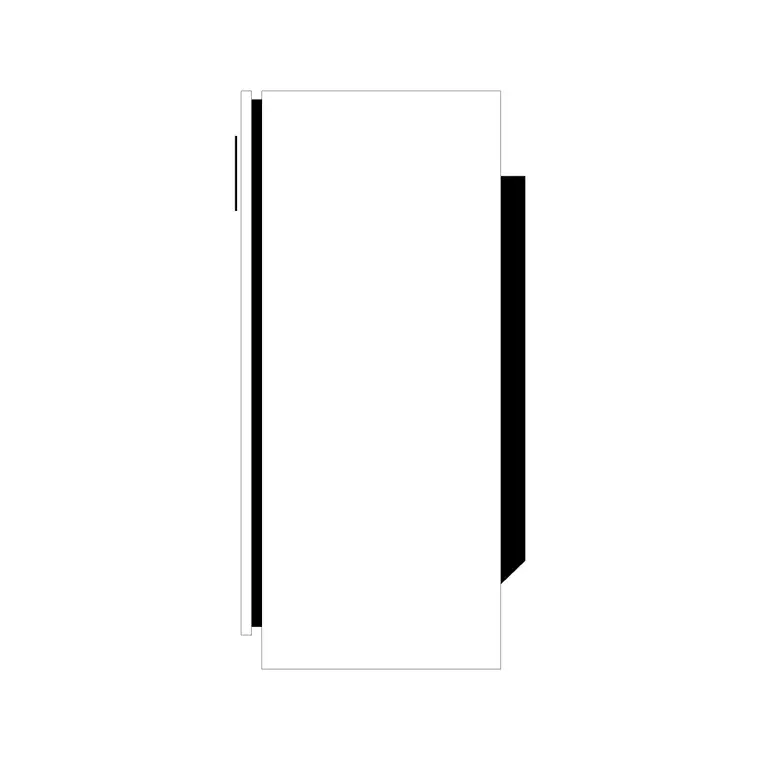
A useful fridge block shows more than a box. The plan view draws the body footprint and, crucially, the door swing arc, because a fridge door that opens into a walkway or against a wall is a layout failure you want to catch on the drawing. For a side-by-side or French-door unit, the plan shows both leaves and the narrower swing each one needs.
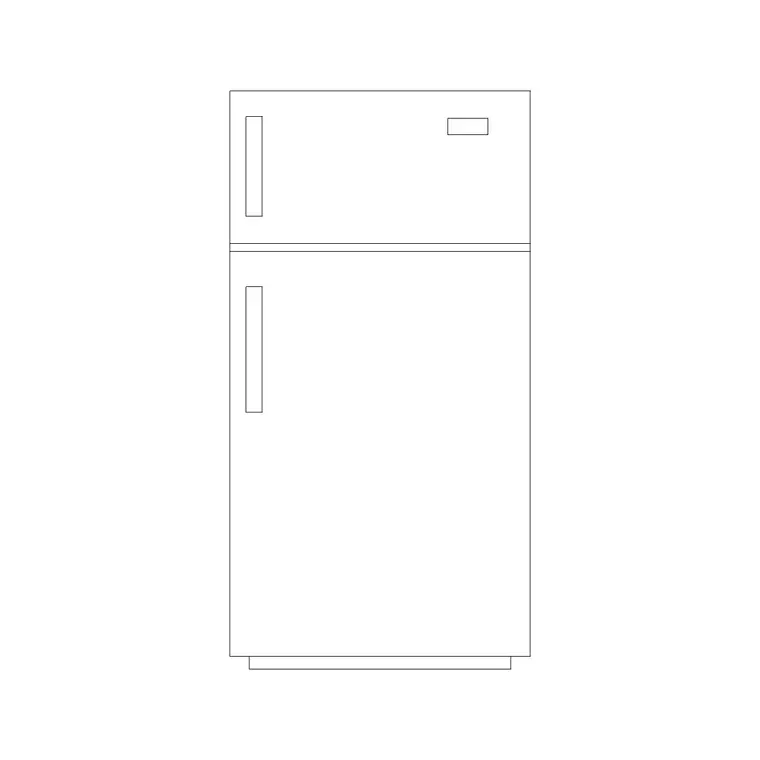
The elevation draws the unit face-on with the door split, the handle line and the height, which is what you check against an overhead cabinet or a tall-unit run. Many fridges are housed in or beside a tall larder unit, so the elevation block carries the body height that the surrounding cabinetry is set out against. The body, doors and swing arc sit on separate layers so you can show or hide the arc.
Plan for the work triangle, elevation for the run
For the kitchen layout you work in plan: the fridge set into the run, positioned with the hob and sink to close the work triangle, with the door swing checked against the walkway and any adjacent cabinet. The plan block is what fixes the cold-storage point and proves the door can open fully.
For joinery drawings and elevations you switch to the elevation, where the fridge is drawn face-on within the tall-unit or cabinet run. Because a full-height fridge-freezer aligns with tall larder units, the elevation block helps set the surrounding cabinetry to the same height line. Many downloads ship both views in one DWG.
Typical refrigerator dimensions
Design around these ranges and confirm against the model. A standard freestanding fridge-freezer sits on a 600 mm footprint, around 600 mm deep, with full-height units reaching 1800 to 2000 mm tall. Double-door and side-by-side American-style fridges are wider — commonly 750 mm to 900 mm and up to 1000 mm — and deeper, often 700 mm or more, so they project beyond a standard 600 mm worktop line.
Leave a ventilation gap behind and above the appliance — typically a few tens of millimetres at the back and a clear gap above for the condenser to breathe. In front, allow enough clear floor for the door to open fully and a person to stand and load it, usually at least the door depth plus 600 mm of standing space.
Inserting and checking the swing
The blocks are full size in millimetres. Insert at scale 1 in a millimetre drawing, 0.001 in a metre template, or set INSUNITS to millimetres so AutoCAD rescales on insertion. Run INSERT, snap the insertion point to a corner or the centre of the body, and rotate so the door hinges on the correct side for the run.
The critical check is the door swing: keep the swing arc layer on while you place the fridge, confirm the door clears the adjacent cabinet and the walkway, and flip the block if the hinge needs to be on the other side. Keep the fridge on its own appliance layer, freeze it for a cabinet-only plan, and a later change of unit size edits the block once.
Where refrigerator blocks are used
Fridge blocks appear in every residential kitchen plan, apartment and studio fit-outs, hotel and serviced-apartment kitchens, and the staff and back-of-house kitchens of commercial schemes. Interior designers use them to set the cold-storage point and check the door swing; architects use them to coordinate the tall-unit run and the ventilation; developers use the footprint to confirm a standard appliance fits the kitchen gap.
Pair the fridge with the hob, sink and tall-larder blocks in the kitchen category to complete the work triangle and the tall-unit run, with cabinets aligning to the fridge height across the elevation.
Door swing and ventilation: the two checks people miss
Two things about a refrigerator catch people out on the plan, and both are why the scaled block matters. The first is the door swing. A fridge door is wide, and it sweeps a large arc — push the fridge into a corner or hard against a return wall and the door cannot open past ninety degrees, which means the salad drawers will not pull out. Keeping the swing arc on the plan while you place the block makes that clash obvious, and flipping the hinge side often solves it.
The second is ventilation. A fridge rejects heat from its condenser, so it needs an air gap behind and above to breathe — box it in tightly and it runs hot and fails early. When a fridge is housed in a tall larder unit, that gap has to be designed into the cabinet, so draw the appliance and the housing to scale and confirm the clearances are there. American-style side-by-side units add a third consideration: they are deeper than a standard worktop, so the plan should show the body projecting proud of the run, not magically flush. Drawn from a scaled block, all three are decisions you make on the drawing rather than problems you meet on site.
Free download
Browse the full library — DWG & DXF, no signup.
Questions
Frequently asked
What size is a standard refrigerator block?+
A standard freestanding fridge-freezer sits on a 600 mm footprint, around 600 mm deep, reaching 1800 to 2000 mm tall. American-style side-by-side and French-door units are wider, commonly 750 to 1000 mm, and deeper at 700 mm or more. Confirm against the model.
Why does the fridge block show a door swing arc?+
Because the door swing is a common layout failure. A fridge door sweeps a wide arc, and if the unit sits in a corner or against a return wall the door cannot open fully, blocking the drawers. Keeping the arc on the plan lets you catch and fix that, often by flipping the hinge side.
How much ventilation gap does a fridge need?+
Leave an air gap behind and above the appliance so the condenser can reject heat — typically a few tens of millimetres at the back and a clear gap above. When the fridge is built into a tall larder unit, design that gap into the housing and draw it to scale to confirm it is there.
Are these refrigerator CAD blocks free for commercial work?+
Yes. They download free in DWG and, where available, DXF, with no signup, no watermark and no attribution requirement, and they are cleared for commercial project use.
Related downloads
Blocks for this guide
Popular blocks to download
Related categories
Related guides
Block landing
Free Bathroom Fixtures CAD Blocks — DWG Download
Download free bathroom fixtures CAD blocks in DWG and DXF — toilets, wash basins, bathtubs, showers and vanities drawn in plan and elevation. No signup, commercial OK.
Block landing
Free Gas Stove / Cooktop CAD Blocks — DWG
Free gas stove and cooktop CAD blocks in DWG and DXF — drawn in plan and elevation at true kitchen-module sizes for AutoCAD 2004+. No signup, commercial-use OK.
Block landing
Single Burner Hob CAD Block — Free DWG
Free single burner hob CAD blocks in DWG and DXF for compact kitchens and studios — plan and elevation, true sizing for AutoCAD 2004+. No signup, commercial OK.