Block landing · reception desk cad block
Free reception desk CAD blocks for AutoCAD
By Sumana Kumar · Published 3 Sep 2023 · Updated 18 Mar 2026
A reception desk is the first thing a visitor meets and one of the more specific pieces of office furniture to draw, because it is really two surfaces in one: a lower working desk for the receptionist and a higher transaction counter facing the visitor. Get those two levels right and the desk reads correctly in both plan and elevation. This page collects free reception desk CAD blocks in DWG and DXF — straight and curved front-desk counters — drawn at true millimetre dimensions for AutoCAD 2004 or later. Free for personal and commercial use, no signup, no watermark.
Use these to lay out office lobbies, clinic and hotel front desks, showroom counters and any reception point. Because the working desk and the raised counter are drawn to scale, you can check the receptionist's working space behind, the visitor's approach in front, and the accessible lowered section that many reception desks need.
The two-level desk and why it matters
A reception desk is not a single worktop. The receptionist works at a desk-height surface, around 720–750 mm, where the keyboard, phone and paperwork sit; the visitor meets a raised transaction counter, typically 1050–1150 mm high, that screens the working clutter and gives a comfortable standing surface to sign or hand over documents. A good reception desk block shows both levels.
In plan that reads as two nested outlines; in elevation it reads as a stepped profile. Drawing both levels matters because it governs the desk depth, the receptionist's knee space behind, and — importantly — the accessible lowered section many reception desks need so a seated or wheelchair-using visitor can be served at desk height.
Straight and curved counter forms
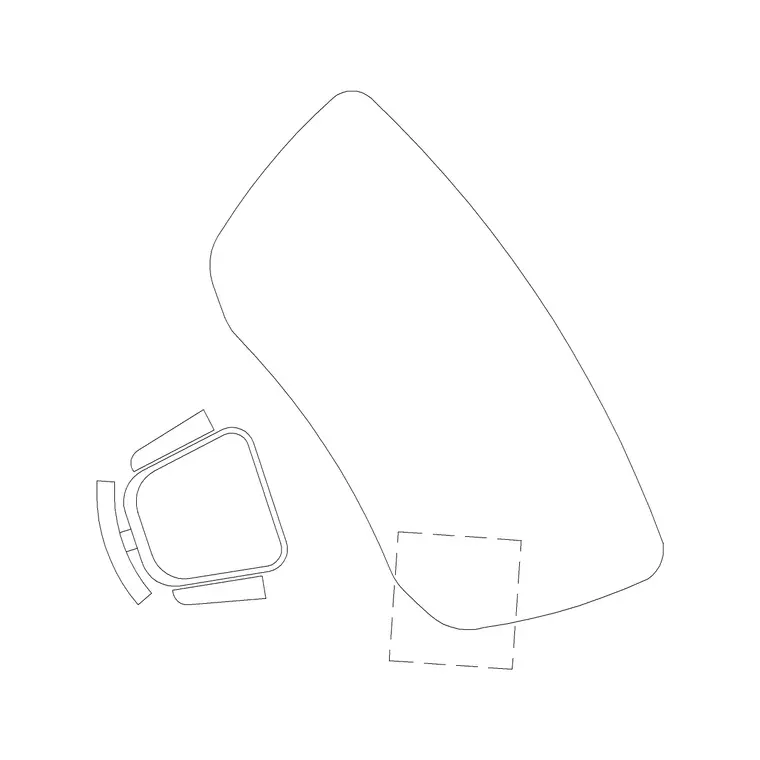
Reception desks come in two broad forms, and the set covers both. A straight counter is the simplest and most space-efficient, suiting compact lobbies and tight front-of-house areas. A curved or L-shaped counter wraps around the receptionist, giving more working surface and a more welcoming, sculptural presence in a larger lobby — and it lets the desk address visitors approaching from more than one direction.
Choose the straight counter where space is tight or the look is utilitarian; choose the curved form where the lobby is a feature space and the desk is part of the first impression. Both are drawn as scaled blocks so you can test either against the lobby footprint and the approach routes.
Reception desk dimensions to design around
Design around these ranges. The receptionist's working surface sits at 720–750 mm high, like any desk; the visitor-facing transaction counter at 1050–1150 mm. Desk depth is typically 800–1000 mm including both levels. An accessible lowered section drops back to desk height over a width of around 900–1000 mm so a seated visitor can be served.
Behind the desk, allow at least 900–1200 mm of clear working space for the receptionist's chair and movement, more if two people share the desk. In front, keep a clear visitor approach and a queuing zone if the reception is busy. The scaled block lets you draw the lobby around these zones rather than discovering the clash later.
How to insert and orient the desk
These reception desk blocks are drawn full size in millimetres. Insert at scale 1 in a millimetre drawing, 0.001 in a metre drawing, or set INSUNITS to millimetres so AutoCAD rescales on insertion. Orient the desk so the transaction counter faces the entrance and the visitor's natural line of approach — the receptionist should see the door.
Pick the insertion point at a desk corner so it snaps to your setting-out grid, then position it to leave the working space behind and the approach in front. For the elevation drawing, insert the elevation view (where the block provides one) so the stepped two-level profile reads against the lobby wall and any signage or feature panel behind.
Where reception desk blocks are used
Reception desk blocks belong wherever a building greets visitors: office lobbies and front-of-house, hotel and serviced-apartment receptions, clinic and dental front desks, showroom and retail counters, gym and leisure-centre desks, and school or institutional reception points. The same two-level desk logic applies across all of them.
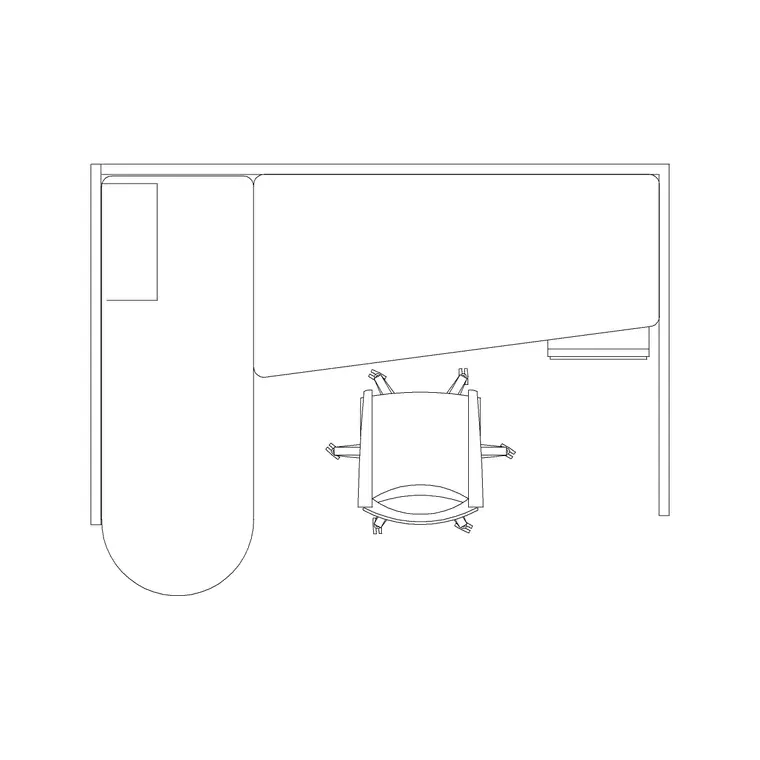
Pair the reception desk with the office chair block behind it, the waiting and lounge seating in front, and the cabin-partition blocks that often define the reception enclosure. Together they let you draw a complete front-of-house — desk, receptionist seating, visitor waiting and the partition or feature wall behind — from one consistent, free block library, with the desk anchoring the whole arrangement.
Designing an accessible, welcoming reception
A reception desk has to work for everyone who approaches it, which makes the accessible lowered section more than a nice-to-have — in many jurisdictions it is a requirement. Drawing the desk as a two-level block with that lowered section already in place lets you check, on the plan, that a wheelchair user has clear approach to a desk-height surface and that the receptionist can serve them face to face rather than across a high counter.
The approach side matters just as much. Keep the route from the entrance to the desk clear and obvious, leave room for a visitor to set a bag down and sign in, and allow a small queuing zone where the reception is busy. Behind the desk, the receptionist needs proper working space and a clear escape route, not a corner they are boxed into. Because the desk, the working zone and the approach are all drawn to scale in the block, these human factors become checks you can see on the drawing — which is the difference between a reception that simply fits and one that actually works the day it opens.
Free download
Browse the full library — DWG & DXF, no signup.
Questions
Frequently asked
Why is a reception desk drawn with two heights?+
A reception desk has a lower working surface for the receptionist (around 720–750 mm) and a raised transaction counter facing the visitor (around 1050–1150 mm) that screens the working area. Good blocks show both levels in plan and elevation.
Do the reception desk blocks include an accessible section?+
The desks are drawn at true size so you can place and dimension a lowered, desk-height accessible section — typically around 900–1000 mm wide — where a seated or wheelchair-using visitor can be served face to face.
Are the reception desk CAD blocks free for commercial use?+
Yes. Every block downloads free in DWG and DXF with no signup, no watermark and no attribution requirement, and they are cleared for commercial project use.
What scale are the reception desk blocks drawn at?+
Full size in millimetres. Insert at scale 1 in a millimetre drawing, or set INSUNITS to millimetres so AutoCAD rescales automatically if your template uses different insertion units.
Related downloads
Blocks for this guide
Related categories
Related guides
Block landing
Free Office Chair CAD Blocks — DWG Download
Download free office chair CAD blocks in DWG and DXF — task chairs, swivel chairs and executive seats drawn in plan and elevation, AutoCAD 2004+, no signup.
Block landing
Free Lighting Fixtures CAD Blocks — DWG Download
Download free lighting fixtures CAD blocks in DWG and DXF — chandeliers, wall lights, downlights and pendants in plan and elevation for AutoCAD.
Block landing
Free Office Desk CAD Blocks — DWG Download
Free office desk CAD blocks in DWG and DXF — straight desks and desk-with-chair units in plan and elevation for AutoCAD. No signup, commercial OK.