Block landing · oval wash basin cad block
Free oval wash basin CAD blocks for AutoCAD
By Sumana Kumar · Published 31 Jul 2022 · Updated 20 Jan 2026
An oval wash basin is the shape designers reach for when they want a softer, more elegant bowl than a hard-edged rectangle — most often as a countertop or inset basin dropped into a vanity top. The elliptical plan changes how the basin reads in a layout and how it is set into the joinery, so it is worth a dedicated block rather than a generic outline. This page collects free oval wash basin CAD blocks in DWG and DXF, drawn to true size and ready for AutoCAD 2004 or later, free for personal and commercial work with no signup and no watermark.
The oval bowl's appeal is partly visual and partly practical: the curved rim has no corners to trap grime, and the shape sits comfortably on a vanity without the squared-off look of a rectangular bowl. Drawing it from a correctly-proportioned block means the ellipse, the tap position and the cut-out in the vanity top are all coordinated from the start.
What makes an oval basin block distinct
An oval basin is defined by its elliptical rim — longer in one axis than the other — which the plan view shows clearly. Compared with a round basin it gives more usable length along the front-to-back or side-to-side axis, and compared with a rectangular basin it removes the corners, softening the look and easing cleaning.
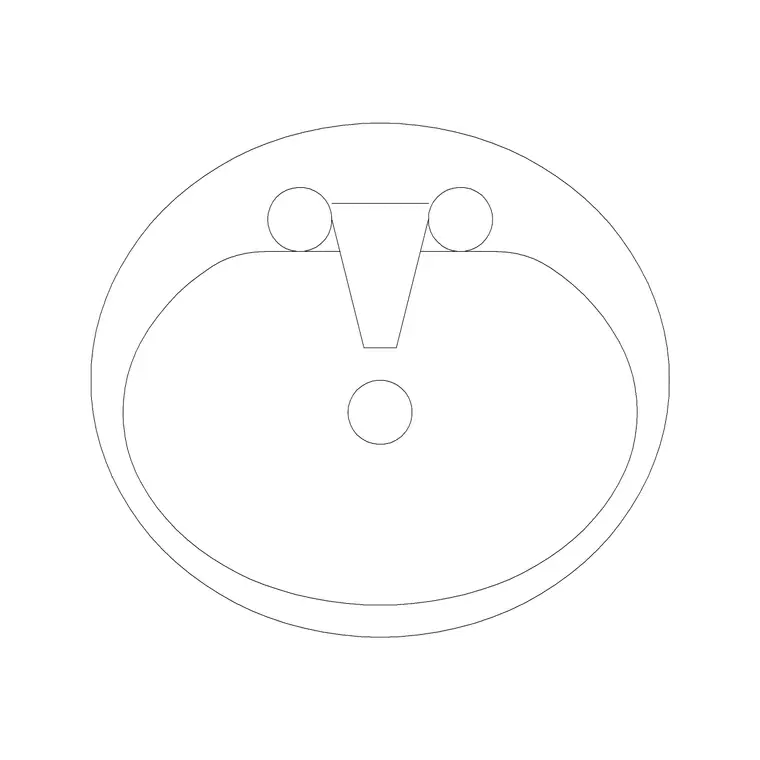
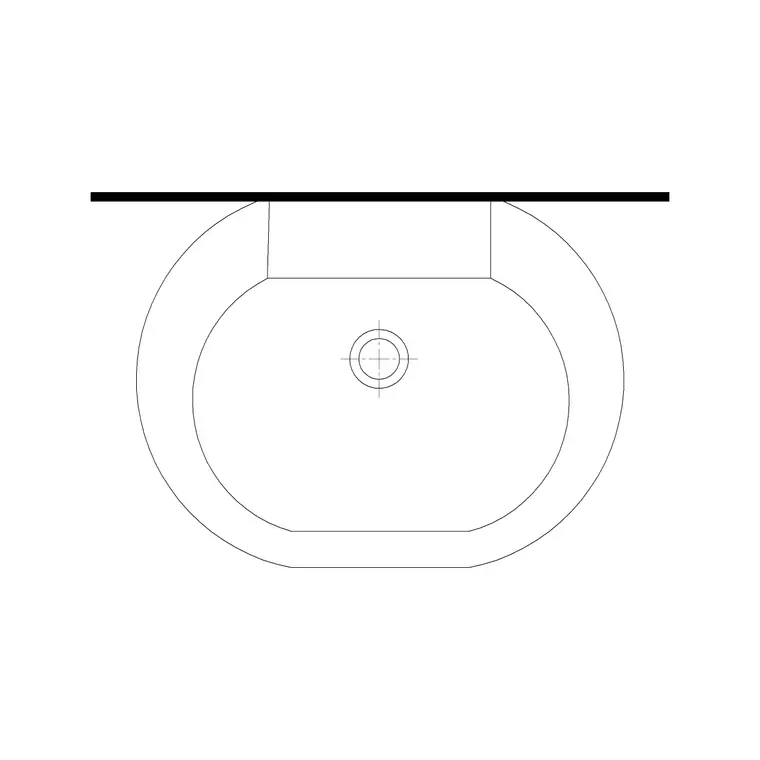
The block shows the oval rim, the inner bowl line, the tap hole position and a centreline on both axes, because an oval is set out from its centre and its two axis lengths. That centreline pair is what you snap to when you place the basin on a vanity top and when you dimension the cut-out the joiner will make.
Countertop vs inset oval basins
Oval basins commonly come in two mountings. A countertop (vessel) basin sits on top of the vanity surface like a bowl, so the whole oval is visible and the rim stands proud — drawn in elevation as a raised bowl on the worktop. An inset (drop-in or under-mounted) basin sets into a cut-out in the top, so only the rim or the bowl below the surface shows.
The distinction matters for the elevation and the joinery. A vessel basin needs a taller tap and adds height above the vanity; an inset basin keeps the surface flat and the tap mounts on the worktop or wall. The blocks here cover both, so you can match the mounting to the vanity detail you are drawing.
Typical oval basin dimensions
Design around these figures. Oval basin: commonly 450–600 mm on the long axis and 330–450 mm on the short axis. Vessel (countertop) bowls tend to be smaller and deeper; inset bowls a little wider and shallower. Rim height for a vessel basin: the bowl adds roughly 100–150 mm above the vanity top, so the worktop sits lower (around 800–820 mm) to keep the usable rim near 850–900 mm.
Allow at least 600 mm of vanity width per oval basin, and more for a generous single bowl. For a double oval-basin vanity, plan on roughly 1300–1600 mm of top so each bowl has space and the taps don't crowd.
Placing the oval basin on a vanity top
The blocks are drawn full size in millimetres — insert at scale 1 in a millimetre drawing, or set INSUNITS to millimetres for automatic rescaling. Draw the vanity-top outline first, then INSERT the oval basin and snap its centre to the position you want on the top. Rotate it so the long axis runs the way the design intends — usually side-to-side on a shallow top, front-to-back on a deep one.
Use the basin's rim line to set out the cut-out the joiner machines into the worktop, and dimension the basin centre from the ends of the vanity. On the elevation, show the bowl height above the top and the tap. Keep the basin on a sanitaryware layer and the vanity on a joinery layer.
Where oval basins suit the design
Oval basins are a staple of contemporary and hotel bathrooms, en-suites and powder rooms where a softer, more refined bowl suits the design language. As vessel basins they make a feature on a vanity; as inset basins they give a clean, easy-to-wipe top. They pair naturally with a vanity unit and a tall mixer where the bowl stands proud.
Reach for an oval basin block when the scheme calls for a rounded, elegant fixture rather than a utilitarian rectangle, and where the vanity top has room for the bowl's length. Pair it with the vanity-unit and bathroom-faucet blocks to coordinate the bowl, the joinery and the tapware on the same drawing.
Coordinating the cut-out and the tap
An oval basin lives on a vanity, so the block earns its keep when you coordinate it with the joinery and the plumbing. The rim line tells the joiner where to machine the cut-out and how much overhang the basin needs to land cleanly; getting that cut-out from the same block that drives the layout avoids a mismatch on site. For an inset basin, draw both the rim and the slightly smaller bowl opening so the cut-out is unambiguous.
The tap position is the other coordination point. A vessel oval basin usually takes a tall mixer mounted on the worktop behind the bowl, or a wall-mounted spout reaching over the rim; an inset basin can take a standard deck mixer. Show the tap hole on the plan and the spout reach on the elevation so the basin, the tap and the splash zone all agree before the worktop is cut.
Free download
Browse the full library — DWG & DXF, no signup.
Questions
Frequently asked
What is an oval wash basin?+
An oval wash basin has an elliptical rim, longer in one axis than the other. It is most often a countertop (vessel) or inset basin dropped into a vanity top, chosen for its soft, corner-free shape that is elegant and easy to clean.
What is the difference between a vessel and an inset oval basin?+
A vessel basin sits on top of the vanity like a bowl, standing proud of the surface, while an inset basin drops into a cut-out so the top stays flat. The blocks cover both, which changes the elevation and the tap mounting.
How wide is an oval basin block?+
Typically 450–600 mm on the long axis and 330–450 mm on the short axis. Allow at least 600 mm of vanity width per basin so the bowl and the tap have room.
Are the oval basin blocks free for commercial work?+
Yes. They download free in DWG and, where available, DXF, with no signup, no watermark and no attribution requirement, and they are cleared for commercial project use.
Related downloads
Blocks for this guide
Related categories
Related guides
Block landing
Free Bathroom Fixtures CAD Blocks — DWG Download
Download free bathroom fixtures CAD blocks in DWG and DXF — toilets, wash basins, bathtubs, showers and vanities drawn in plan and elevation. No signup, commercial OK.
Block landing
Free Sanitary Fixtures CAD Blocks — DWG Download
Download free sanitary fixtures CAD blocks in DWG and DXF — WCs, wash basins, urinals and sinks in plan and section for AutoCAD sanitary plans.
Block landing
Free Toilet / WC CAD Blocks — DWG Download
Download free toilet / WC CAD blocks in DWG and DXF — close-coupled, back-to-wall and commode pans in plan and elevation for AutoCAD. No signup, commercial OK.