Block landing · outdoor table cad block
Free outdoor table CAD blocks for AutoCAD
By Saumyajit Maity · Published 3 Feb 2024 · Updated 20 Jan 2026
An outdoor table anchors a terrace or patio: it sets where people gather, how the seating arranges around it, and how much of the paved space is given to dining. This page collects free outdoor table CAD blocks in DWG and DXF — round and rectangular patio dining tables, picnic tables, coffee and side tables, and complete table-and-chair sets — drawn at true millimetre dimensions and ready to insert into AutoCAD 2004 or later. Everything is free for personal and commercial work, with no signup and no watermark.
Use these blocks to lay out terraces, patios, decks, courtyards and café outdoor areas. Because the table fixes the dining footprint, the plan view is the one you use most — placing the table and reading the clear space the surrounding chairs and the access around them need. Several downloads ship a complete dining set so the table and its chairs land together at the right spacing.
What's in the outdoor table set
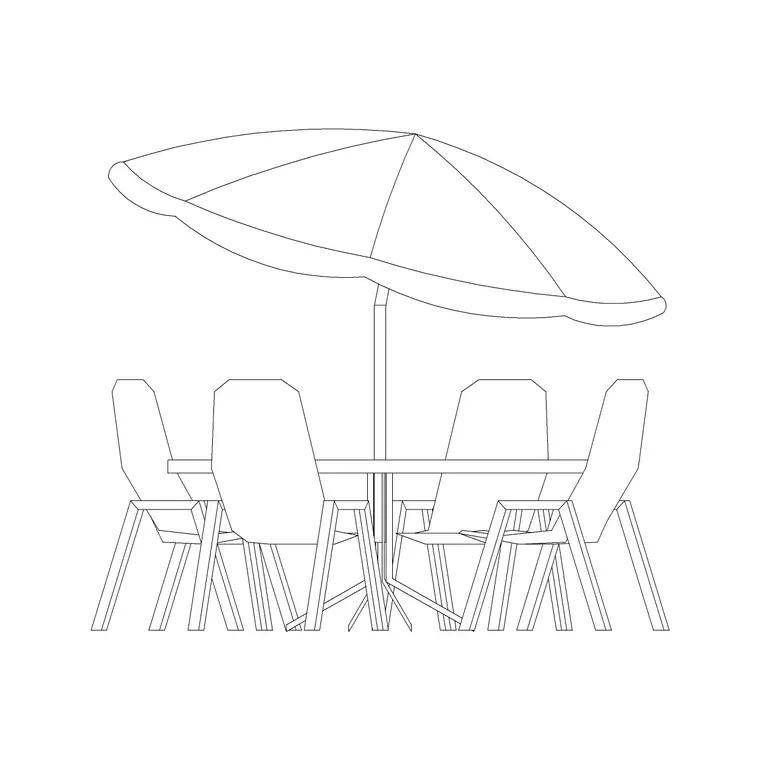
The set covers the tables an external scheme calls for. Patio dining tables come round and rectangular, sized for four, six or more covers. Picnic tables draw the bench-and-table-in-one unit common in parks and gardens. Coffee and side tables furnish lounge groups. Complete table-and-chair sets draw the table with its chairs already arranged, so a dining setting drops in as one block.
Each table draws the top and the leg or base footprint in plan, and the top, apron and legs in elevation, all as editable geometry on sensible layers. The dining-set blocks keep the chairs as part of the arrangement, with the access space between chairs already correct. Because each table or set is a single block reference, you can rotate it to suit the terrace, copy it where a layout repeats covers, and explode a set if you want to re-space the chairs yourself.
Plan for the dining footprint, elevation for presentation
For laying out a terrace you work in plan: the table seen from above with its chairs around it, positioned so the whole dining footprint — table plus pulled-out chairs plus access — sits clear of circulation and other furniture. The plan block is what you place to claim the dining space and to check people can move around the seated group. A round table reads differently from a rectangular one in plan, so picking the right shape matters for fitting the space.
Elevation tables come into play for terrace elevations, sections and presentation drawings, where the table is drawn face-on at its real height with the chairs tucked under. A picnic table in elevation shows the bench-and-top relationship clearly. Many blocks here ship both views in the same DWG, so you can build the plan and the matching elevation from one download.
Typical outdoor table dimensions to design around
Reach for these ranges when you lay out a dining area. A four-seat round patio table is commonly around 900 mm–1.1 m in diameter; a six-seat round runs 1.2–1.4 m. A four-seat rectangular table is roughly 1.2 × 0.8 m; a six-seat is 1.6–1.8 × 0.9 m. Table height sits at the standard 720–750 mm. A picnic table with attached benches occupies roughly 1.5–1.8 m long by 1.5 m wide once the benches are counted.
For the dining footprint, allow roughly 600 mm from the table edge to clear a pulled-out chair, plus another 600 mm or so behind for someone to pass — so a dining set needs around 1.2 m of clear space beyond the table edge all round. These are typical figures, not fixed specifications. The blocks are drawn full size so you can drop the scaled table in and read the footprint at a glance.
How to insert and lay out the table
These table blocks are drawn in millimetres. Insert at scale 1 in a millimetre drawing, 0.001 in a metre template, or set INSUNITS to millimetres so AutoCAD rescales on insertion. Run INSERT or drag the DWG onto the drawing, pick the insertion point at the centre of the table top, and rotate it to align with the terrace or the view.
If you insert a complete table-and-chair set, the chairs land already arranged; if you insert a table on its own, place it first and then array the chairs around it at even spacing with the access clearance checked. Keep the dining set on a furniture or external-living layer so you can freeze it for a clean hard-landscape plan and thaw it for the furnished scheme. Where a café repeats the same setting, copy the set down the terrace.
Where outdoor table blocks are used
Outdoor table blocks appear across landscape and external-living drawings: terraces and patios, decks and balconies, roof gardens, courtyards, café and restaurant outdoor seating, parks and picnic areas, and hotel and resort dining terraces. Landscape designers use them to lay out dining and gathering zones; architects add them to terrace layouts to show amenity and capacity; hospitality designers use them to plan covers and circulation for an outdoor service area.
Pair the table with the outdoor seating, BBQ and planting categories to build a complete external-dining scene — a dining set, a grill, planted beds and the paved surface beneath. Because the table sets the social centre of an outdoor space, getting its footprint and the access around it right is what makes the terrace layout work in practice.
Sizing the dining set to the paved area
The most common outdoor-furniture mistake is a dining set that looks fine until you count the access around it, and the scaled table block is the cure. The table footprint is only part of the story — the real space a dining set claims is the table plus the pulled-out chairs plus the room to walk behind them. Place the table block, drop the chairs, and draw the clear access zone around the group so you can confirm it fits the paved area with room to circulate.
Shape and orientation are the design levers. A round table suits a square terrace and a relaxed, sociable setting; a long rectangular table suits a narrow terrace and a larger party. Rotate the set so the chairs face the view and the access aligns with the route onto the terrace. For a café or restaurant, the same scaled set lets you pack covers to a sensible density without crowding the aisles. Keeping the table as scaled geometry — and reusing it as a set block — means the dining layout is correct by construction and easy to repeat across a terrace or a whole venue.
Free download
Browse the full library — DWG & DXF, no signup.
Questions
Frequently asked
Do the outdoor table blocks come with chairs?+
Several do. The set includes complete table-and-chair blocks where the table and its chairs are arranged together at the right spacing, plus standalone tables you can array your own chairs around. The contents are listed on each block's page.
Are the outdoor table CAD blocks free for commercial use?+
Yes. Every table block downloads free in DWG and, where available, DXF, with no signup, no watermark and no attribution requirement, and they are cleared for commercial project use.
How much space does an outdoor dining set need?+
Allow roughly 1.2 m of clear space beyond the table edge all round — about 600 mm to clear a pulled-out chair plus 600 mm to pass behind it. The scaled block lets you draw that dining footprint directly on the terrace.
What scale are the outdoor table blocks drawn at?+
Full size in millimetres. Insert at scale 1 in a millimetre drawing, or set INSUNITS to millimetres so AutoCAD rescales automatically. You can scale a table to a specific size or explode a set to re-space the chairs.
Related downloads
Blocks for this guide
Related categories
Related guides
Block landing
Free Garden Fence CAD Blocks — DWG & DXF
Download free garden fence CAD blocks in DWG and DXF — timber, panel and contemporary boundary fences drawn in plan and elevation, AutoCAD 2004+, no signup.
Block landing
Free Wrought-Iron Gate CAD Blocks — DWG
Download free wrought-iron and metal gate CAD blocks in DWG and DXF — ornamental garden gates in elevation and plan with swing arcs. No signup.
Block landing
Free Main Entrance Gate CAD Blocks — DWG
Download free main entrance gate CAD blocks in DWG and DXF — driveway, sliding and double-swing gates drawn in elevation and plan with swing arcs. No signup.