Block landing · medical trolley cad block
Free medical trolley CAD block in DWG and DXF
By Sumana Kumar · Published 1 Jan 2025 · Updated 4 Feb 2026
The medical trolley is the small, mobile workhorse of a clinical room — the dressing trolley, the treatment cart, the crash cart, the medication trolley. Individually each is modest, but they accumulate, and a treatment room or theatre that does not allow for them ends up cluttered and unworkable. A scaled medical trolley CAD block lets you place these carts where they belong and keep their access clear. This page offers a free medical trolley block in DWG and DXF, drawn to true millimetre dimensions in plan and elevation, ready for AutoCAD 2004 or later — free for personal and commercial work, no signup, no watermark.
What catches layouts out with trolleys is parking and reach. A crash cart must be reachable in seconds and cannot be boxed in; a dressing trolley needs to come alongside a couch or bed. Drawing the trolleys to scale, on a movable-equipment layer, is how you keep their parking positions and access lanes honest while the room fills with fixed furniture.
Types of medical trolley in the set
Medical trolleys come in a handful of recognisable types, and the set covers the common ones. A dressing or treatment trolley is a small two-tier cart used at the bedside or couch. A medication trolley is taller, often with drawers, and is wheeled along a ward at drug rounds. A crash (resuscitation) cart is a larger multi-drawer trolley that holds emergency equipment and must be instantly accessible. An instrument trolley supports a clinician during a procedure.
Each type is drawn to its own footprint, because they differ enough that substituting one for another would mis-size a room. Drawn to scale, you can show a crash cart parked in its dedicated, unobstructed position and a dressing trolley alongside a couch in the same drawing.
Typical medical trolley dimensions
Design around these ranges. A small dressing or instrument trolley is roughly 600–800 mm long by 450–550 mm wide. A medication or crash cart is larger, often 700–900 mm by 500–650 mm, and taller to carry drawers. Worktop or top-tier height is commonly around 800–950 mm so a standing clinician works comfortably.
The clearance that matters is access, not just footprint: a crash cart needs a clear lane to it and clear space to open its drawers; a dressing trolley needs room to be wheeled alongside the patient. Use the footprint to place the cart and then keep an access band clear around it. These are typical ranges across suppliers — confirm against the actual equipment when known.
Plan for placement, elevation for the worktop
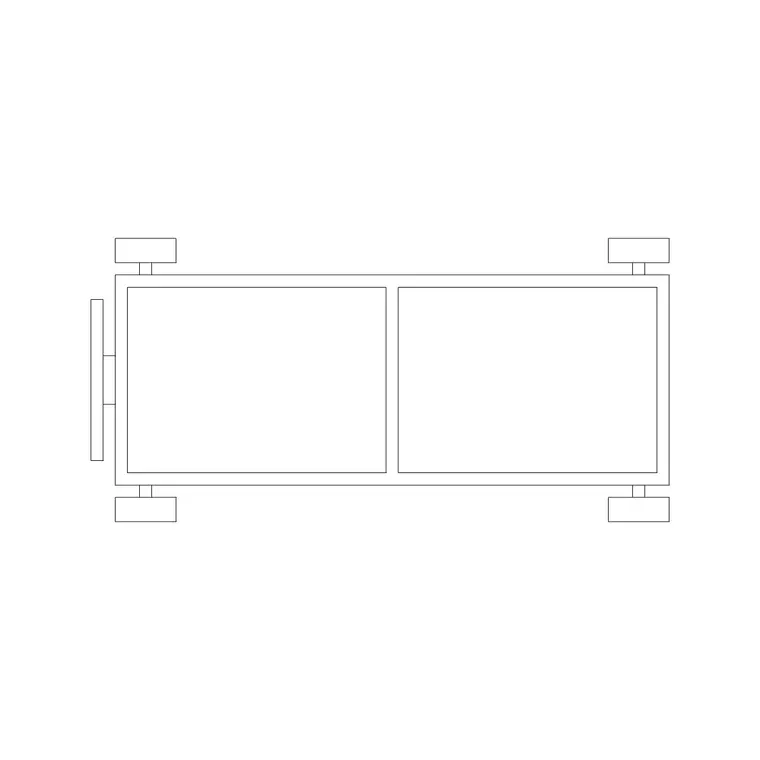
Trolleys are placed in plan: parked against a wall or in a bay when not in use, and shown in their working position alongside a couch, bed or operating table. The plan block is what you copy into a clinical room to confirm there is somewhere sensible for each cart to live and to work.
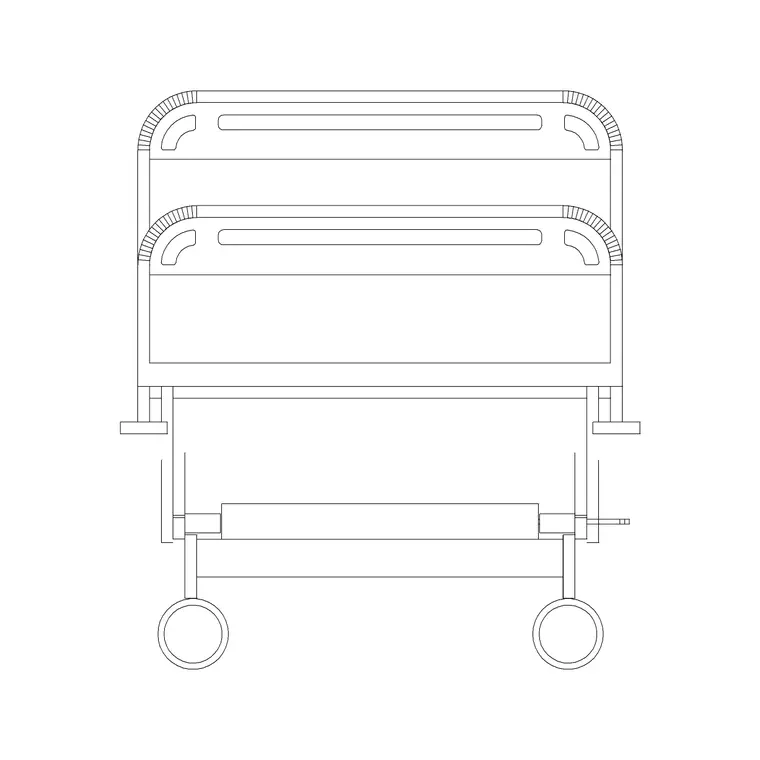
The elevation is useful where the trolley relates to a worktop or a wall-mounted service — confirming the top tier of a dressing trolley sits at a comfortable working height, or that a medication trolley fits under a counter when stored. On a theatre layout, the elevation helps coordinate instrument trolleys with the operating table height.
How to insert and place trolleys
The trolley is drawn full size in millimetres. Insert at scale 1 in a millimetre drawing, 0.001 in a metre drawing, or set INSUNITS to millimetres so AutoCAD converts on insertion. Run INSERT, snap the base point to the centre of the cart, and rotate to suit its parked or working position.
Place the fixed furniture and the couch or bed first, then drop the trolleys into the leftover space, keeping an access lane clear to any crash cart. Keep trolleys on a movable-equipment layer, separate from fixed furniture, so you can produce a clean fixed-furniture plan and a loose-equipment plan from the same drawing — and tag each trolley to count them into an equipment schedule.
Where medical trolley blocks are used
Medical trolley blocks belong in treatment and consulting rooms, operating theatres and recovery, ward drug-round routes, emergency departments and clinics. Healthcare planners use them to confirm a room has room for its loose equipment without crowding the clinical work; architects use them to size treatment rooms; equipment planners use them to schedule and locate the movable kit a department needs.
Because trolleys are loose equipment rather than fixed furniture, they are easy to forget at design stage and then a constant nuisance in use, so a layer of scaled trolley blocks is a cheap way to prevent a cramped room. Pair them with the hospital bed, stretcher and wider medical blocks to complete a clinical-room layout.
Parking, charging and keeping access clear
Trolleys need somewhere to live when they are not in use, and that parking is part of the layout, not an afterthought. A medication trolley parks in a clean utility or against a corridor recess between drug rounds; an instrument trolley returns to the prep area; and many modern carts need a power socket nearby to charge, so the parked position has to sit where a charging point reaches. Drawing each cart in its parked position, against the right wall and near power, keeps the corridors clear and the equipment ready.
The crash cart is the special case that drives its own rule. It must be reachable in seconds from anywhere it serves, never boxed in, and its drawers must open fully without obstruction, so it gets a dedicated, protected position with a clear lane to it. Drawing that lane and the open-drawer swept space, on the movable-equipment layer, is the simplest way to prove on paper that the most safety-critical trolley in the building is always accessible — a check a clinical reviewer will make every time.
Free download
Browse the full library — DWG & DXF, no signup.
Questions
Frequently asked
What types of medical trolley does the set cover?+
The common types — dressing and treatment trolleys, medication trolleys, crash (resuscitation) carts and instrument trolleys — each drawn to its own footprint, because they differ enough that substituting one would mis-size a room.
Why keep trolleys on a separate layer?+
Trolleys are loose, movable equipment rather than fixed furniture. Putting them on a movable-equipment layer lets you produce a clean fixed-furniture plan and a loose-equipment plan from the same drawing, and prove access lanes to a crash cart stay clear.
What scale are the medical trolley blocks drawn at?+
Full size in millimetres. Insert at scale 1 in a millimetre drawing, 0.001 in a metre drawing, or set INSUNITS to millimetres so AutoCAD rescales automatically on insertion.
Are the medical trolley blocks free for commercial use?+
Yes. They download free in DWG and DXF with no signup, no watermark and no attribution, and they are cleared for commercial project use.
Related downloads
Blocks for this guide
Related categories
Related guides
Block landing
Free Hospital Bed CAD Block — DWG & DXF Download
Download a free hospital bed CAD block in DWG and DXF — electric patient bed in plan and elevation with bedside clearances for ward layouts. No signup.
Block landing
Free Patient Stretcher CAD Block — DWG Download
Download a free patient stretcher CAD block in DWG and DXF — wheeled trolley/gurney in plan and elevation for A&E and recovery layouts. No signup.
Block landing
Free Medical Equipment CAD Blocks — DWG Download
Download free medical equipment CAD blocks in DWG and DXF — diagnostic machines and clinical devices in plan and elevation for healthcare layouts. No signup.